
✕
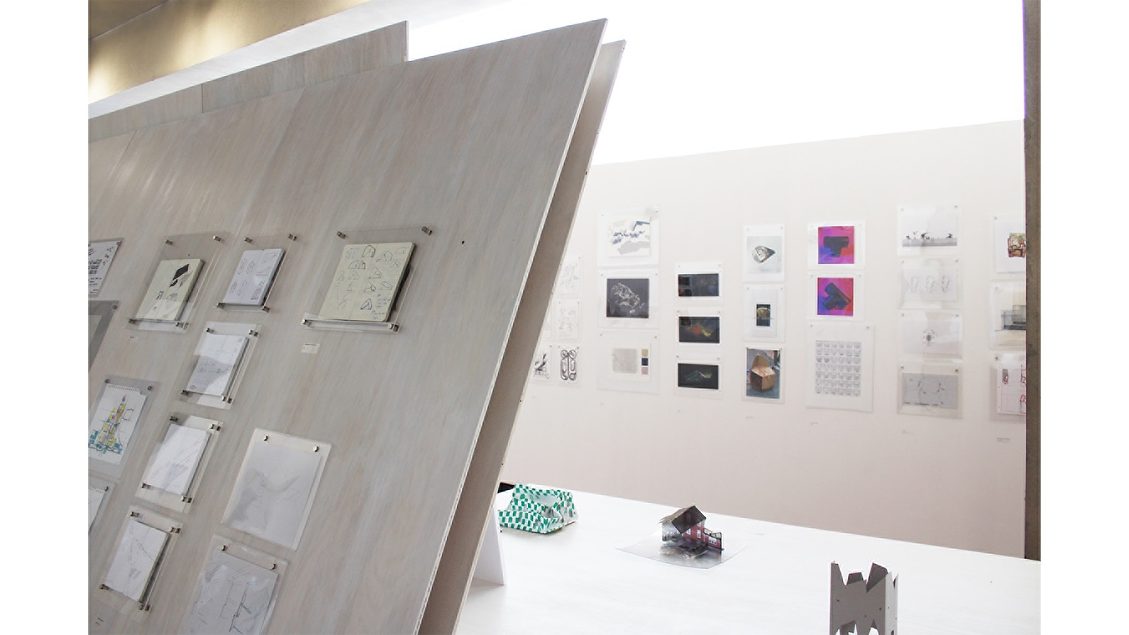
The walls of Pratt Institute’s Higgins Hall gallery are saturated with more than 200 sketches from 62 contributors, ranging from emerging practitioners like Almost Studio and Current Interests (both 2025 Design Vanguards), to disciplinary giants like Steven Holl and Weiss Manfredi. The curatorial approach is reminiscent of the exhibition-bomb format that has become popular in art over the past few years, in which the sheer number of exhibitors attempts to draw a crowd large enough to be called an event. Such was the packed February 4 opening of Levers Long Enough to Move the World, curated by Pratt’s newly appointed chair of graduate architecture, Andrew Holder, and on view until February 27.
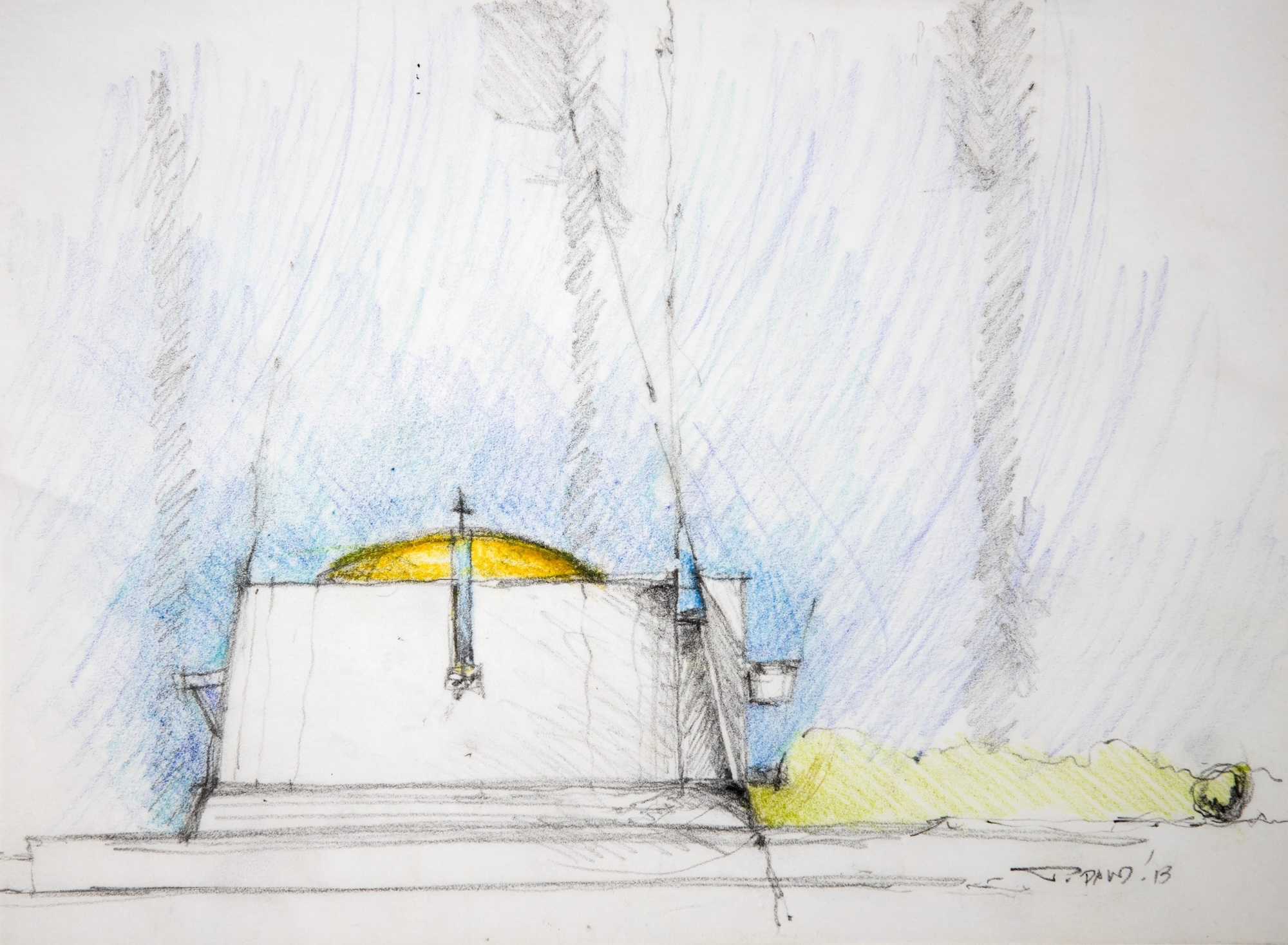
St. Nicholas Shrine by Theoharis David (pencil on paper). Image courtesy Pratt Institute
The exhibition pamphlet, a hefty 30 pages, opens with a quote from the Greek mathematician Archimedes: “Give me a lever long enough and a fulcrum on which to place it, and I shall move the world.” The parallel drawn here is that the sketch, like the lever, multiplies the force applied to it. This is ultimately where its power over the digital lies. At 1,300 words, it is the longest exhibition text I have ever read, but its intellectual rigor mostly justifies its length.
The installation, as the pamphlet explains, is divided into five sections based on the purpose of the sketch: to initiate, to measure, to direct, to instruct, and to accompany. The placards are small and semi-hidden, allowing the visitor to play a guessing game while circling the installation: identify the architect based on the style or project depicted before reading the name.
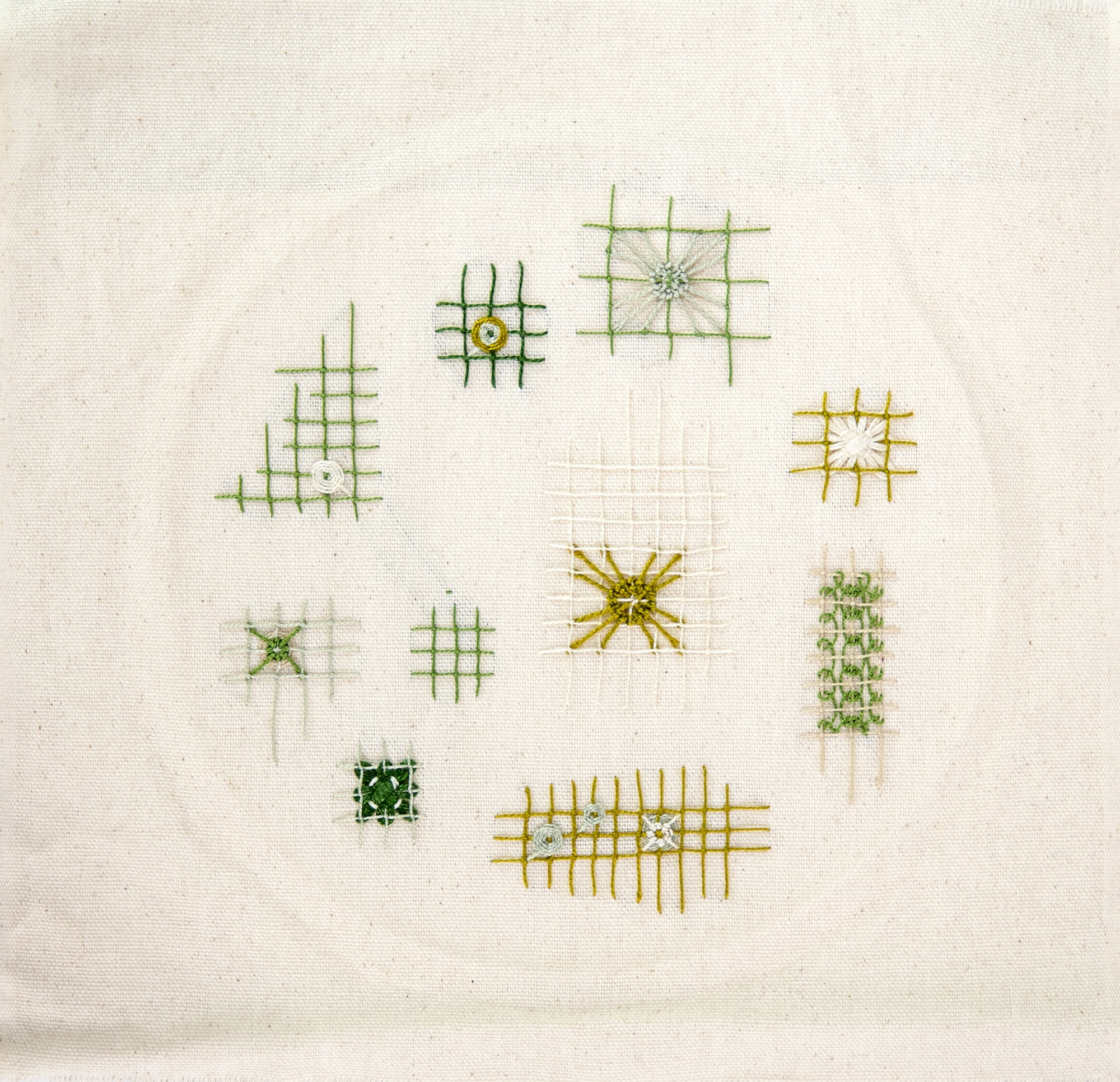
Plantings, Maybe by Mariel Collard Arias (hand embroidery (posta) with cotton). Image courtesy Pratt Institute
The diversity of sketches is overwhelming because each practice approaches sketching in a completely different way. “The sketch is emblematic of architecture’s democratic turn,” Holder emphasizes. “It’s the simplest, quickest, most unassuming kind of representation, seemingly available to anyone.” The artifacts exhibited include drawings in pen, pencil, marker, and crayon, watercolors, Zoom screenshots, iPhone drawings, paper models, written words, math equations, photographs, collages, and a number of uncategorizable digital-analog hybrids.
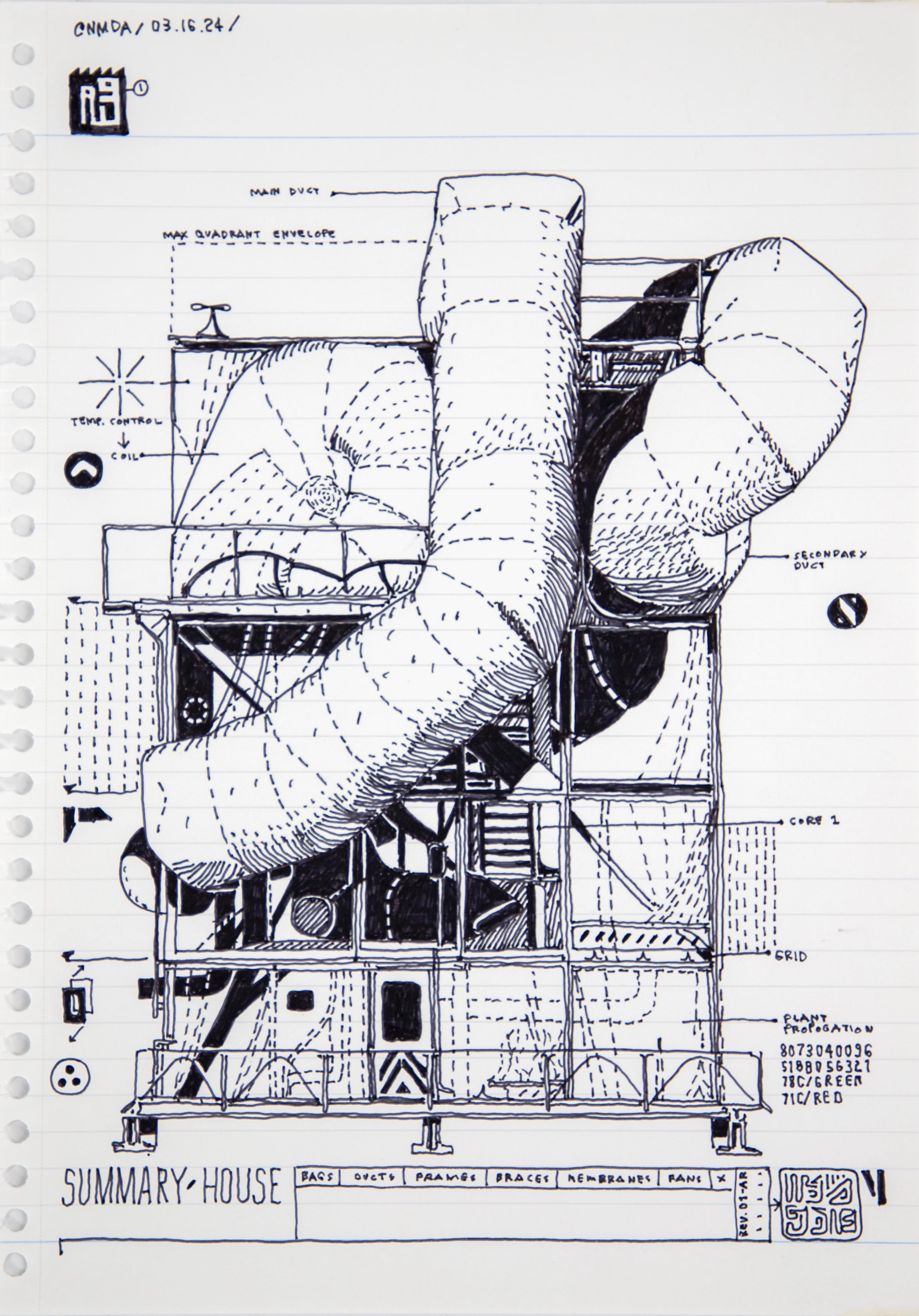
Notebook Drawing by Neil Denari (pen on a lined sketchbook page). Image courtesy Pratt Institute
But somehow, the everything-at-once curation feels appropriate. The noise and mess of wrinkled papers and stained notebooks fade away into the background as you lock on to the individual artifacts one after another. The tension between the deeply personal drawings and the crowded room amplifies the sacredness of the work.
The aesthetic qualities range from unidentifiable scribble to Rembrandt-level study, and each inclusion finds its power through various associations and connotations: Laurel Consuelo Broughton (Welcome Projects) references children’s book illustrations, Mariel Collard Arias turns to folk art embroidery, and Neil Denari shapes architectural forms using HVAC systems. The gamut of history and culture is contained across the exhibition. There is so much here that opinions and takeaways will likely vary as widely as the work itself, emphasizing the complete and total subjectivity of the sketch.
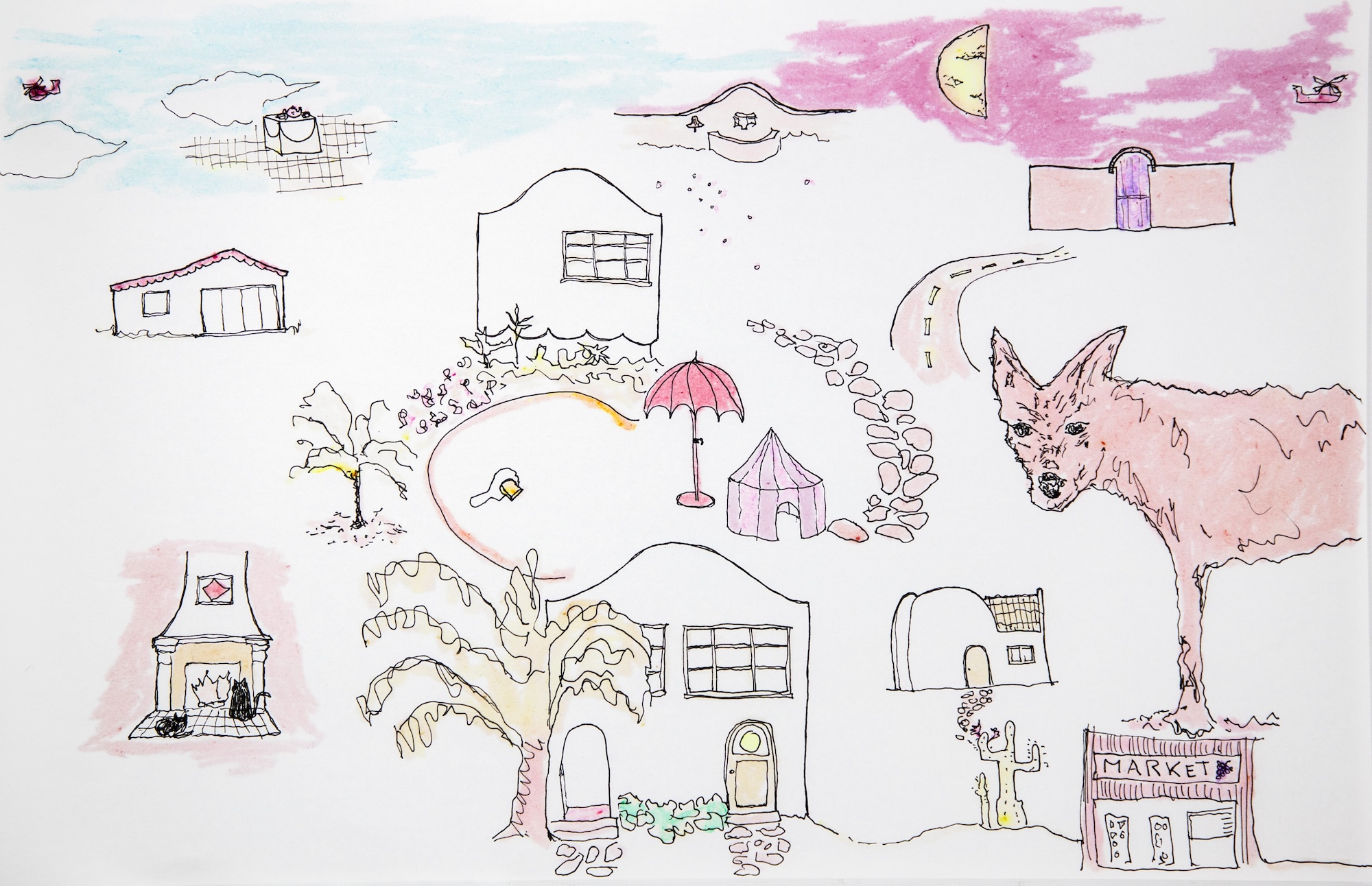
A Peculiar Garden Map Sketch by Laurel Consuelo Broughton of Welcome Projects (pen and paint on paper). Image courtesy Pratt Institute
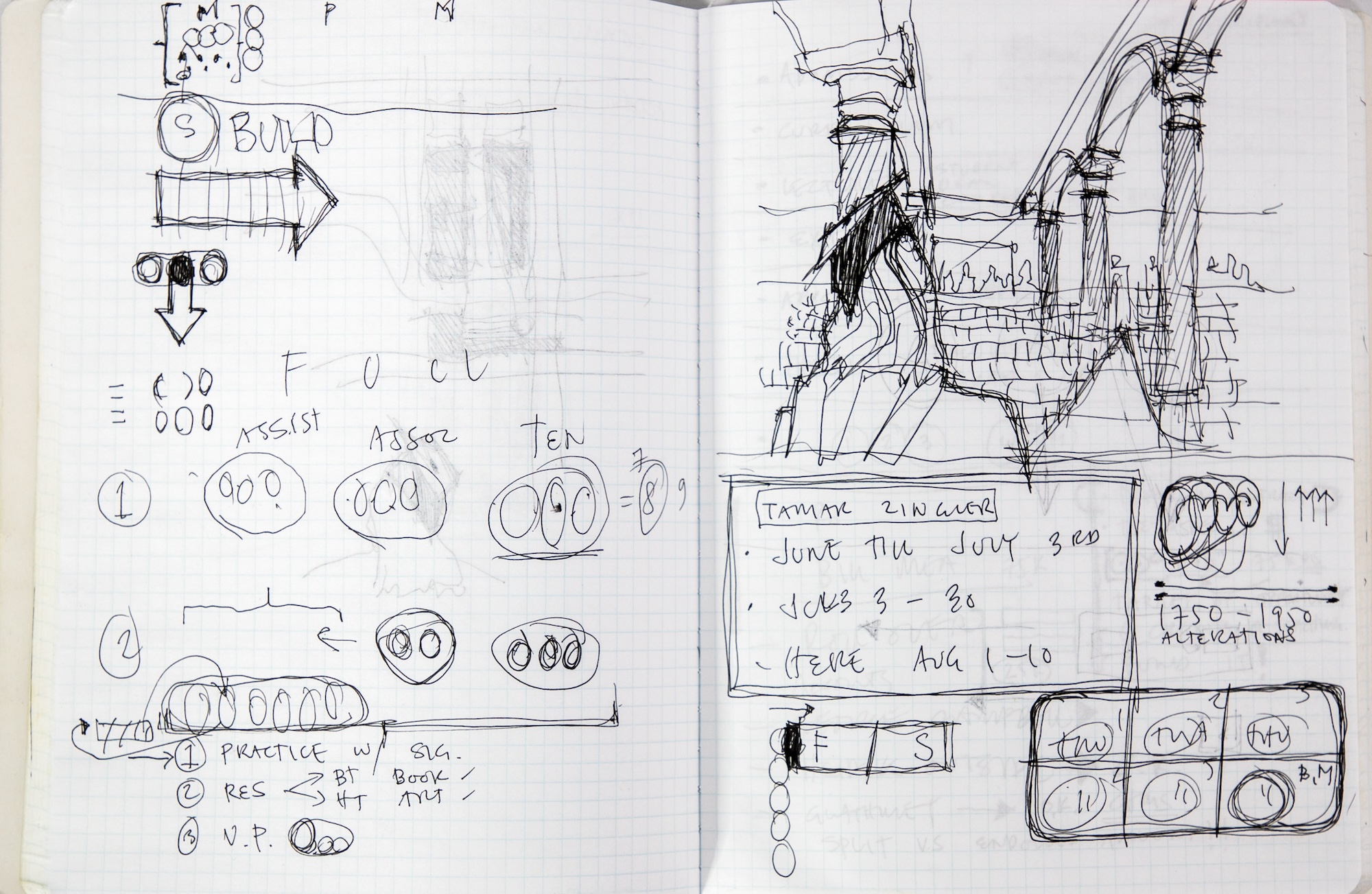
The Met Museum, Ancient West Asia and Cypriot Wings by Nader Tehrani of NADAA (pen drawing on gridded sketchbook). Image courtesy Pratt Institute
Particularly powerful moments arrive with breakdowns in meaning, when the artifact is clearly part of a larger conversation to which we are not privy. In the case of Efimero’s contribution, screenshots and photographs can be imagined sandwiched between text messages, or, in the case of Nader Tehrani’s (NADAAA) or Michael Meredith’s (MOS) additions, drawings can be pictured as vehicles of discussion between a firm partner and a junior architect. The endless possibilities contained therein make the exhibition’s point. To sum up the exhibition in a single sentence: The sketch contains a life far richer and more sophisticated than its unpolished appearance might suggest.