
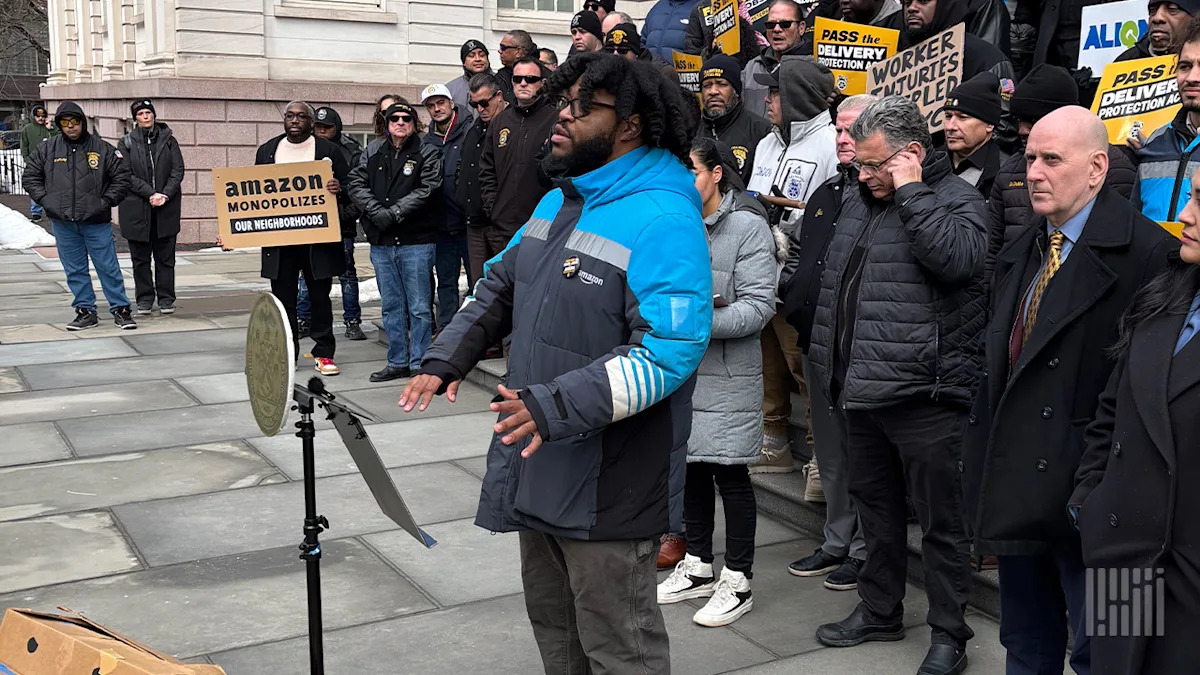
New York–A Teamsters-led rally on the steps of New York City’s city hall Thursday marked the reintroduction of a law that would require final mile delivery companies such as Amazon to be licensed by the city, and by extension face the possibility of more regulation than they encounter now.
But while the proposed Delivery Protection Act would apply only to deliveries in a city of 8 million people in a country of 330 million, it can be seen as such a microcosm of numerous legal battles over independent contractor and joint employer status, as well as the ability to regulate interstate commerce, that its likely passage is almost sure to kick off lengthy litigation with potentially national consequences.
The Delivery Protection Act was introduced in the New York City city council last September. The council finished its term at the end of 2025 without the bill ever receiving a committee hearing, much less a full council vote. Its backers said the calendar simply ran out before the bill could be passed.
With a new council in place, it needed to be introduced again. The legislation’s primary sponsor was and is Tiffany Caban, a Democrat. She was the key speaker at the city hall rally.
A Council official at the rally said the latest version of the bill has only minor changes in its wording.
Lots of backers in the council
When Caban’s prior legislation died at the end of 2025, it had 41 co-sponsors out of a City Council of 51 members. Immediately upon its second introduction, it had 27.
Although there are plenty of last-mile facilities and delivery companies in New York City, the 100+ Teamsters members standing and chanting on the steps of city hall at the rally, and the speakers who addressed them, spoke of only one: Amazon (NASDAQ: AMZN).
The various speakers, including several drivers from the Direct Service Providers (DSPs) that are separately-owned companies delivering goods out of Amazon warehouses, talked of the demands of the job.
Jerome Sloss, a driver with a New York-area DSP, said that Amazon “continues to grind drivers into the dust with their unrealistic expectations and their policies.” He said the job of a DSP driver is “extremely taxing on our mental and physical health.”
But the Delivery Protection Act has no specific rules on how a delivery driver should be treated.
How the regulation would work
What it does have is a process where a license would need to be granted to a delivery service by the city’s Department of Consumer and Worker Protection. That department, if it finds a “pattern of practice of violations,” would have the ability to deny an application for a license, or revoke a license already granted.
The violations would need to be “of any city, state or federal law relating to workplace safety, road or highway safety, environmental protection, unfair or deceptive trade practices, or workplace or worker protections in connection with operating one or more last-mile facilities.”
In other words, it’s a kitchen sink of potential violations.
The proposed bill appears to be written carefully so as to not catch up every company that offers last-mile delivery services. Rather, it would apply to “operators of certain warehouses and storage facilities from which goods are delivered to final consumers in the City.”
That definition doesn’t only fit Amazon. But the speeches at the city hall rally made clear that the company is the bill’s chief target. No other companies were mentioned, not DHL, not UPS (NYSE: UPS), which is unionized by the Teamsters, nor FedEx (NYSE: FDX), which has facilities in the Big Apple but is not unionized.
What the definition of a company impacted by the law does not appear to include would be a last mile delivery company that is fully independent and not tied to the operator of a facility.
This is where the legislation starts to get tricky and wades into a long-standing battle over independent contractor status and the issue of who is a joint employer.
The question: is an independently-owned DSP operating out of an Amazon warehouse truly independent and not a facility operator, or is it simply an extension of a “last-mile facility operator” as defined in the legislation…like Amazon?
Who employers the DSP drivers?
The raging battle between the Teamsters and Amazon has been fought out on many fronts. But the biggest issue might be whether those delivery drivers work for the owners of the DSP–whose name would be identified as the employer on an employee’s W-2 form–or are they effectively Amazon employees?
Sloss summed up the argument that the DSP drivers ultimately are Amazon employees. “You see us wearing the Amazon uniforms (he was wearing an Amazon jacket), you see us driving Amazon vans, and we are subject to their oversight policies,” Sloss said in his address to the crowd. “They label us as third party contractors, but nothing could be further from the truth.”
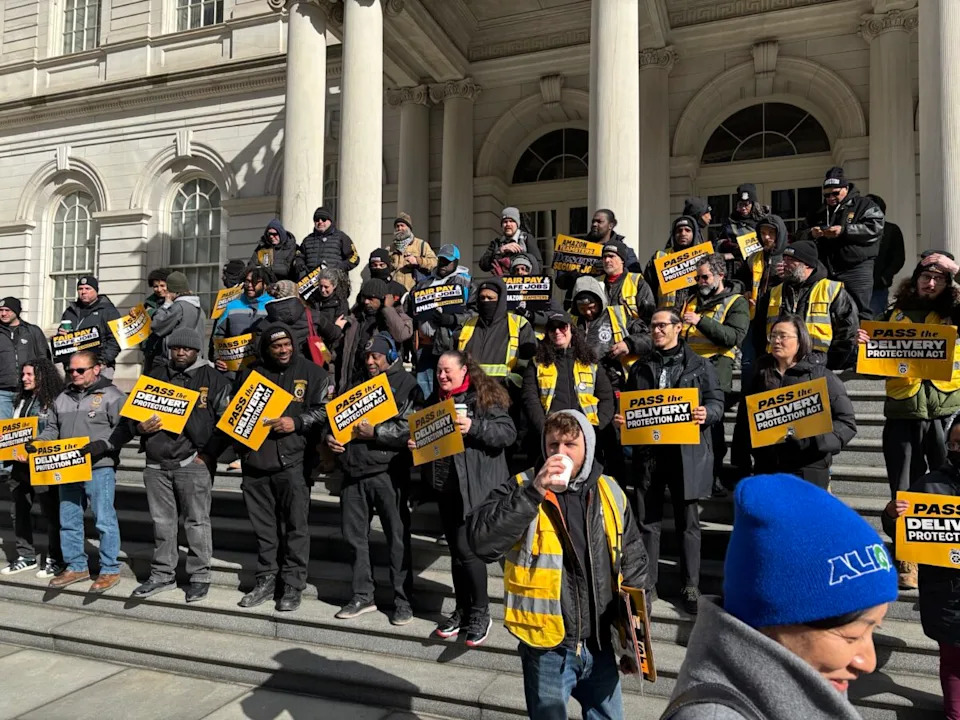
What Sloss said were “bad business practices” are excused by Amazon, he said, “by pointing their fingers at the DSPs, rather than taking accountability for the way they do business.”
A coalition has come together involving several chambers of commerce, some logistics companies and other business groups called the NY Delivers Coalition. Its webpage does not explicitly say it was formed to fight the Delivery Protection Act, but all signs point to that being its driving force. (Amazon is not listed as a member.)
In a statement sent to FreightWaves a spokesperson for the coalition took aim at the bill.
“(The Delivery Protection Act) would drive many of these businesses out of the city or out of business entirely, resulting in the loss of thousands of jobs, higher prices, slower delivery, and increased congestion and pollution,” the group said in the statement. “At a time when New York City faces an affordability crisis in child care, health care, and housing, eliminating the small businesses that enable last-mile delivery solves none of these problems while making essential goods and services more expensive for all New Yorkers.”
If the bill becomes law, its implementation would almost certainly become entangled with a question that was at the heart of some of Sloss’ comments: is Amazon a joint employer with the DSPs?
California case could impact New York City
Amazon and the Teamsters are now locked in a case before an administrative law judge (ALJ) in National Labor Relations Board (NLRB) Region 31 on the West Coast over that question.
The case involving a DSP called Battle Tested Strategies (BTS) is considering among other questions whether Amazon is a joint employer of a DSP’s drivers as a result of the control it has over a DSP’s activity.
The trial before the ALJ started in September following an earlier opinion in the BTS case that Amazon was a joint employer. The process has been stop-and-start since it began in September, and a Teamsters official at the rally said it is ongoing, months later.
What has happened in the case so far has mostly gone the Teamsters’ way. Beyond the initial opinion about Amazon as a joint employer, the agency, in a potentially surprising step, maintained that view in the opening days of the hearing before the ALJ, even though it was a Trump NLRB doing the arguing and not the Biden administration. A side battle in federal court also recently was favorable to the Teamsters.
Whatever decision the NLRB ultimately concludes in that case could be an issue in any litigation that comes out of the Delivery Protection Act.
If the DSP drivers are not Amazon employees–which is the company’s argument–then how can New York City take action against Amazon via the licensing process for employee practices implemented by DSPs if those drivers don’t work for Amazon?
But if the NLRB process ultimately concludes with a finding that the Amazon-DSP link marks a joint employer relationship, how much more teeth would that give the city of New York if it seeks to use the Delivery Protection Act to address the kind of issues raised by the DSP drivers at the city hall rally?
Supreme Court case looms
Another ongoing legal case that could become part of any court battle over the Delivery Protection Act will be center stage at the U.S. Supreme Court on March 25. That is the date for oral arguments In the case known as Flowers Foods, a commercial baker whose products include Tastykakes and Wonder Bread.
The question in Flowers Foods is whether a final mile delivery driver, even if their vehicle never crosses state lines, is part of interstate commerce because what they do is at the tail end of an interstate commerce process.
If the court rules those drivers are part of interstate commerce–and the immediate practical outcome to the decision would be whether disputes with their employers can be litigated in court as interstate commerce workers or must go through arbitration if they aren’t–it could become a legal point for the delivery companies that are likely to challenge the Delivery Protection Act. Their argument would presumably be one of jurisdiction, that the city of New York is out of its lane in trying to regulate interstate commerce on a local level.
More articles by John Kingston
SCOTUS to decide fate of bread drivers: are they interstate?
New territory: RXO debt rating from Moody’s now below investment-grade cutoff
Annual employment report revision shows huge decline in truck transportation jobs
The post The high-stakes fight over New York City’s renewed delivery regulation law appeared first on FreightWaves.