
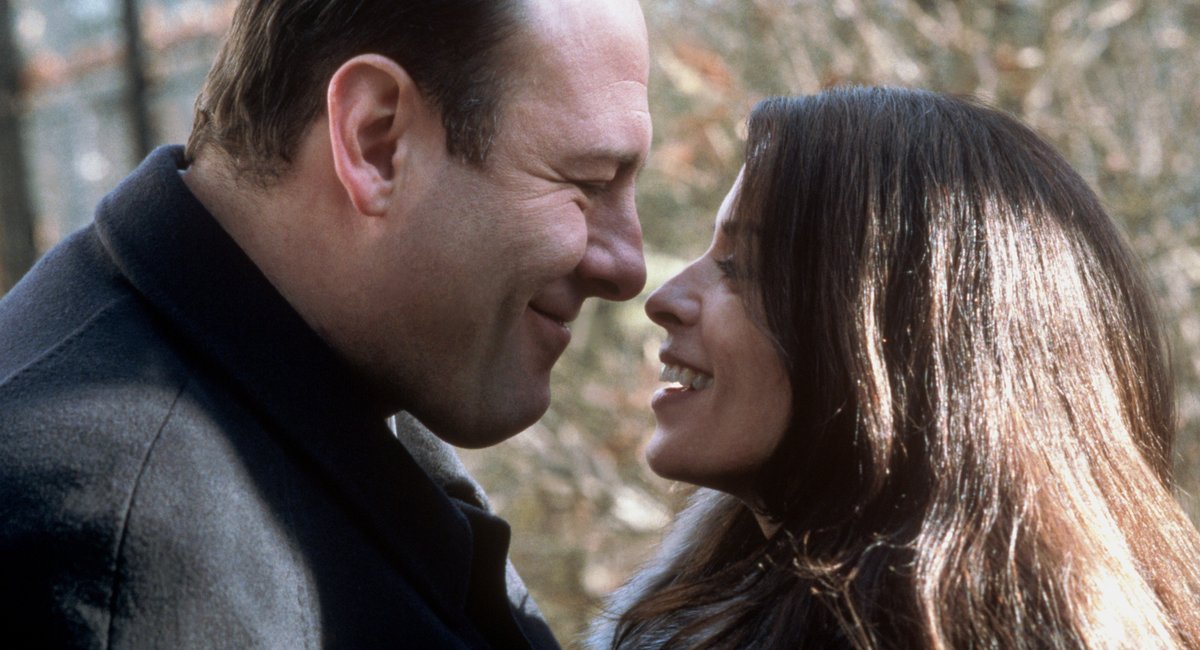
The Museum of the Moving Image in Astoria, Queens is looking west — all the way to New Jersey.
Starting this weekend, the groundbreaking television series “The Sopranos” is being celebrated with a new exhibit. There’s also an upcoming series of special screenings, with show creator David Chase and several key actors, including Steven Van Zandt, who played Silvio Dante, Edie Falco, who played Carmela Soprano, and Dominic Osei, who played Uncle Junior.
WNYC’s David Furst spoke recently with two curators from the museum, who helped put it all together — Barbara Miller, deputy director for curatorial affairs, and Michael Koresky, senior curator of film.
A lightly edited transcript of their conversation is below:
David Furst: Barbara, you organized the exhibition “Stories and Set Designs for ‘The Sopranos’,” which opens today. “The Sopranos,” the HBO series that ran from 1999 through 2007, follows the story of New Jersey mob boss Tony Soprano and his family, and is so iconic now. Give us a sense of what made it groundbreaking then, and how it reshaped American television.
Barbara Miller: I mean, “The Sopranos” kind of deserves its iconic status in all ways. You know, I think, it really is this moment of excellence. The writing is impeccable, the performances are astonishing. The casting was just so spot on. Everybody sort of inhabits their character so well, so the world that it creates is so compelling, and it’s so believable in itself.
But, you know, I think also, it was one of the first times where kind of a visionary series creator had the opportunity to make something outside of broadcast TV, which had much more narrow conceptions of what was what they wanted to do and what was acceptable. So HBO at the time was kind of an upstart. It was a cable TV upstart that was looking for groundbreaking shows, and they were willing to take a chance on something like this, that the broadcast networks had said no to.
When you talk about some of the set designs and the locations from the show, I’m thinking of maybe the Bada-Bing strip club — they don’t exactly sound like they would lend themselves to your typical museum exhibits, right?
Barbara Miller: Well, you know, design is design, right? I mean, you know, whether it’s a strip club or is it a church, you know what I mean? All of these practices are done by people with a tremendous amount of talent, and it’s all about sort of creating the appropriate environment for action to take place regardless of where it is.
What we’re able to do in the exhibition is tell a story about how these things came together, how those environments were designed, how it was a combination ultimately of purpose-built sets at Silver Cup Studios in Queens and shooting on location in New Jersey. And it was very, very clear that David Chase did not want to shoot any locations outside of New Jersey. They had to get on a van and go out to New Jersey to shoot the locations.
Michael, you are organizing three evenings of screenings each night, featuring an episode from season three of the series. Why the focus on season three?
Michael Koresky: Well see, this whole thing really began because I was organizing this brand-new screening series, which is actually starting this weekend as well. The series is called “2001, the Year, Not the Movie,” because in my opinion, 2001 is one of the great years for movies. Probably not [for] the world, but definitely for cinema.
And as I was coming up with a list of all the really essential films, I kept coming back to “The Sopranos.” I truly believe, and I’ve believed this for many years, that season three of “The Sopranos” is where the show really accelerates into masterpiece territory.
Obviously there’s so much that’s so enrapturing about seasons one and two, especially with the relationship between Tony and Livia, his mother. But season three, something really switches. It becomes quite dark and it’s where David Chase starts to question the show’s motivations, his audience’s sympathies. It becomes a very self-reflective show, and it’s just one incredible episode after another in that season. I really wanted to pay tribute to that because I feel like this is where “The Sopranos” becomes the greatest show of all time, which I believe it is.
I know the focus is on season three, but Michael, is there ever an event where David Chase is on hand where he doesn’t have to answer questions about the way the series ended and that mysterious last shot?
Michael Koresky: I think he’s probably quite used to it at this point. I think he knows how to deal with it. This year will be 20 years since that finale, and the fact that we’re still talking about it, the fact that we’re still puzzling over it, is a really, really good sign.
A lot of shows have come and gone in the interim, and we don’t really talk about those endings anymore because they were too pat. The Sopranos really has us talking all these years later.
It is an ending that leaves you with a very particular feeling that I still feel now.
Michael Koresky: Well, that’s the thing about “The Sopranos” in general, and one of the reasons why I wanted to do these screenings and pay tribute to this show. I have never been able to shake “The Sopranos.” I think about “The Sopranos” a lot and you know, those kind of obsessive people you hear about? I’m one of them. I hate to admit that I’m one of them.
I think about “The Sopranos” all the time. It kind of gets inside your brain the way that the show questions everyday morality, and the way that it uses these extreme people, these extreme situations to get you to think about your own life. These characters have never left me.
I think about them all the time.
Tell us a little bit more about these screenings. They’re happening three nights in a row at the very end of the month — Feb. 26, 27 and 28. Show creator David Chase is going to be on hand for all of these. I should mention though, these are all sold out.
Michael Koresky: Yes, this turned out to be a popular screening series.
As we hoped and predicted, at the last minute, some tickets might be released. So, you know, keep a lookout on our website in case that happens. But we are very excited to have David here all three nights, along with select cast members. We’re gonna be screening the episodes “University,” “A Second Opinion” and “Amour Fou.” Steven Van Zandt and Ariel Kiley, who are both in the amazing episode “University,” will be here. We’re going to have Edie Falco and Dominic Chianese here for “A Second Opinion,” and Annabella Sciorra here for “Amour Fou.”
And anyone who remembers that episode, or that season three arc, remembers that Annabella Sciorra’s performance as Gloria Trillo, the somewhat doomed love affair with Tony — it’s a truly spectacular performance.
“Stories and Set Designs for The Sopranos” begins Feb. 14 and runs through May 31 at the Museum of the Moving Image’s Amphitheater Gallery. “Celebrating The Sopranos Season 3: Three Evenings with David Chase and Special Guests” runs Feb. 26-28. More information is at movingimage.org.