
Mapping narratives: ‘The Rhumblineage of Penelope Steel’ by Remiiya Badru
During her Lloyd’s Register Foundation Creative Research Fellowship (2024-25), Remiiya Badru encountered the little-known mapmaker Penelope Steel (c.1768 – 1840). Born in Jamaica to a free Black woman and a white slave owner and merchant, Steel later migrated to the City of London, where she ran a chart and nautical book-publishing business on Union Row, Little Tower Hill, with her husband, David Steel. Following his death in 1803, she took over the business, known for Steel’s Navy List.
Commissioned to create an artwork on Steel’s life for a display in the Queen’s House, Badru worked to reconstruct the gaps in the fragmentary and incomplete archive, by reimagining Steel’s life, relationships and spiritual ancestry.
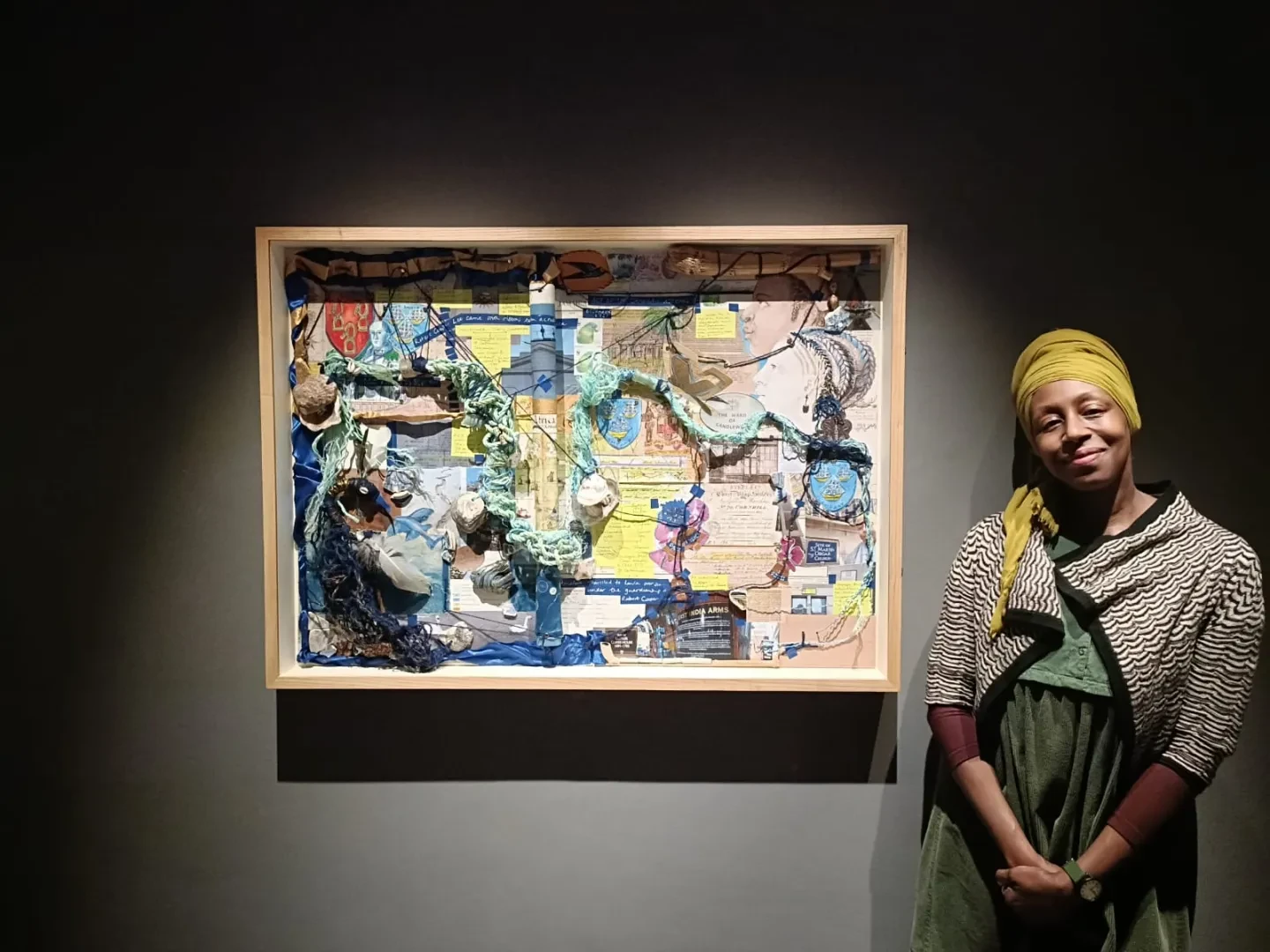
Artist Remiiya Badru next to The Rhumblineage of Penelope Steel on display in the Queen’s House
She retraced the sites in London that Steel would have inhabited, to explore what it might have meant for Steel to navigate race, gender and commerce in the City at the turn of the nineteenth century. This included questioning whether Steel’s mixed heritage meant she was “passable” as white, and how this impacted her inheritance, status, agency and wealth.
In The Rhumblineage of Penelope Steel, Badru weaves together Steel’s personal archival traces against broader geopolitical contexts of trade and empire through the concept of ‘rhumblineage’. Drawing on rhumblines – navigational tools used to plot a ship’s course on a chart – Badru uses materials including wool, fragments of found rope, and other textiles to craft a map of both tangible and intangible connections across Steel’s life.
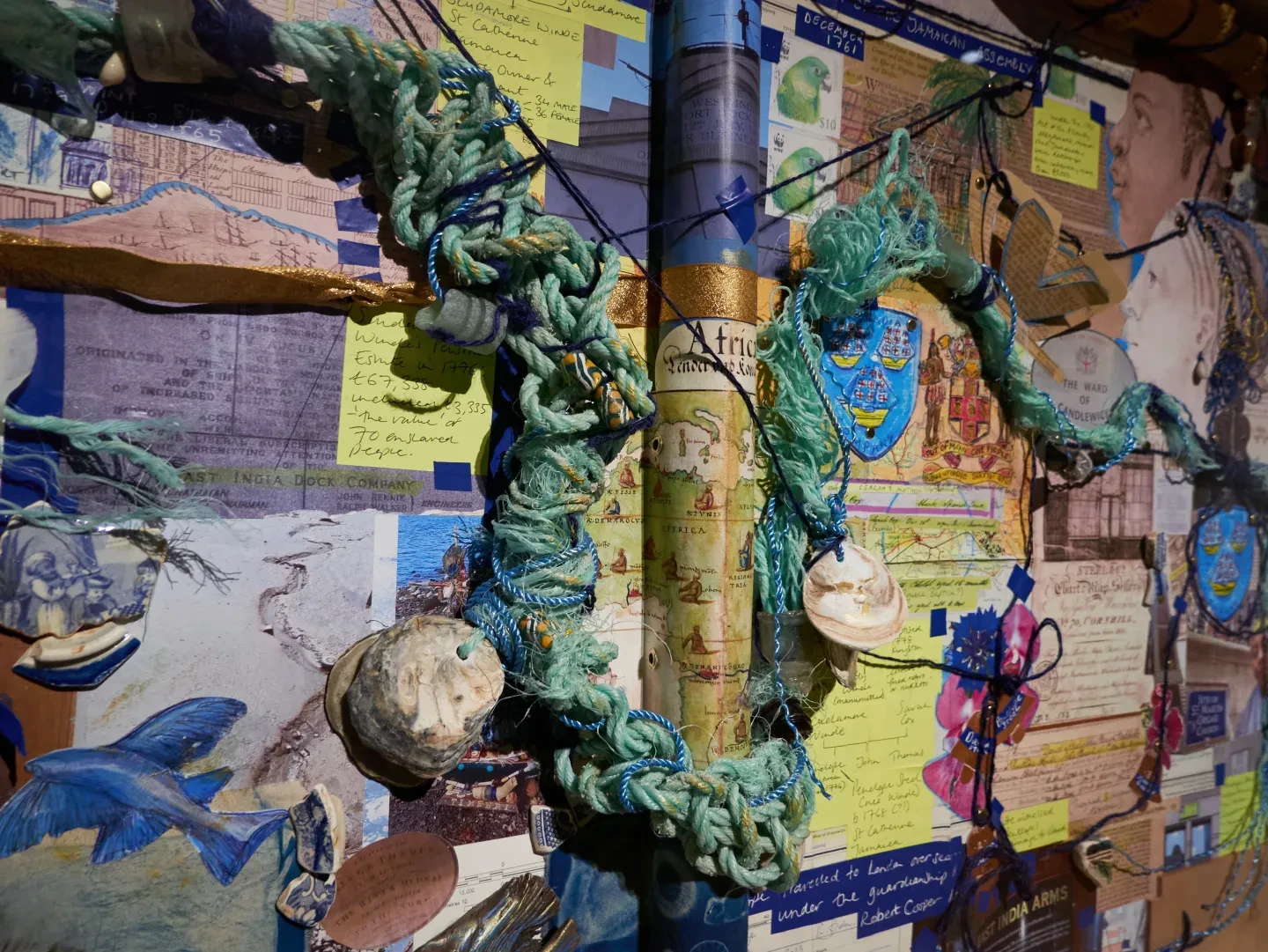
Ropes and shells are just some of the materials used in Remiiya Badru’s The Rhumblineage of Penelope Steel
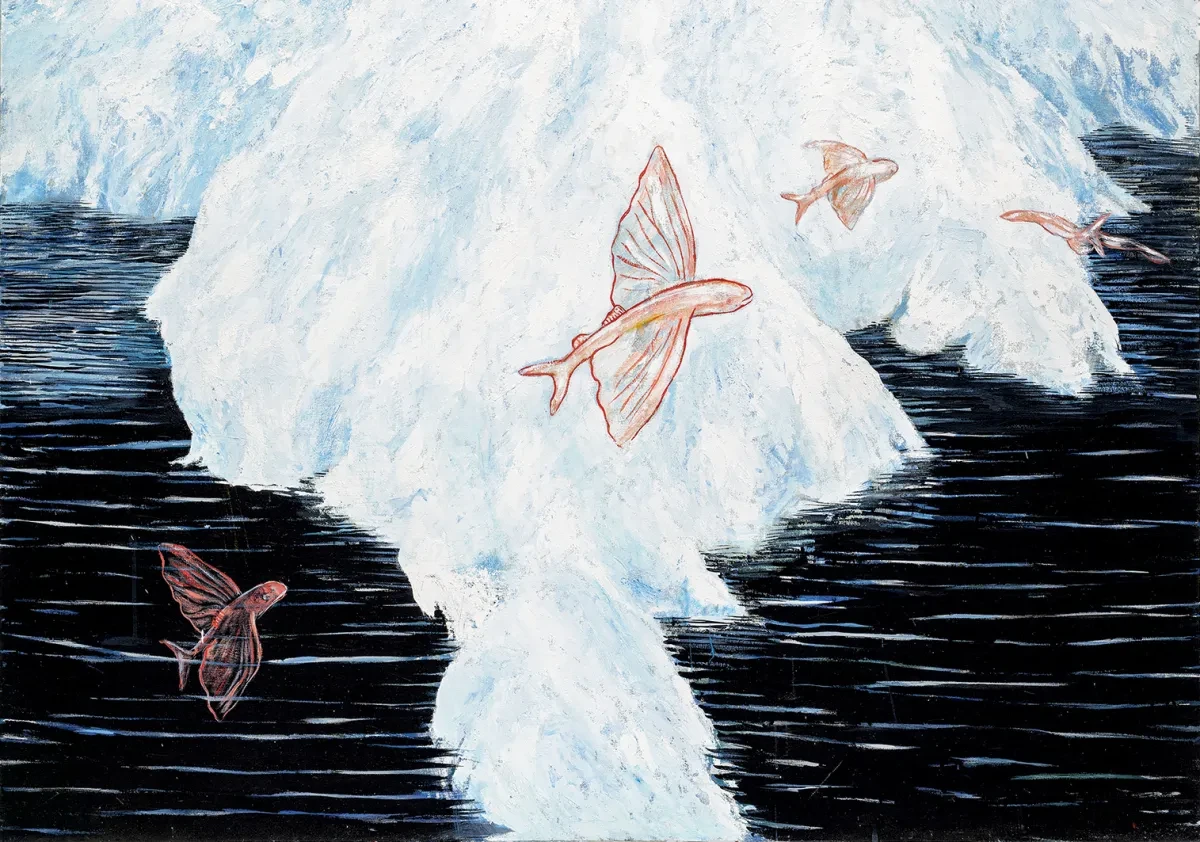
Her practice recalls the image of flying fish as seamstresses in Grace Nichols’ 2006 poetry collection Startling the Flying Fish. Nichols creates a mythical figure of the Cariwoma – a hybrid of Caribbean and woman – who “watched history happen” and whose all-seeing gaze ebbs and flows, like the rhythms of the sea. She moves between the violence of enslavement and the diasporic present, where her children, “sucked abroad”, have “stamped themselves / with the ink of exile”.
Like the Cariwoma, Badru imbues her work with mythic and spiritual dimensions of African diaspora womanhood, incorporating the flying fish and other symbols in The Rhumblineage of Penelope Steel.
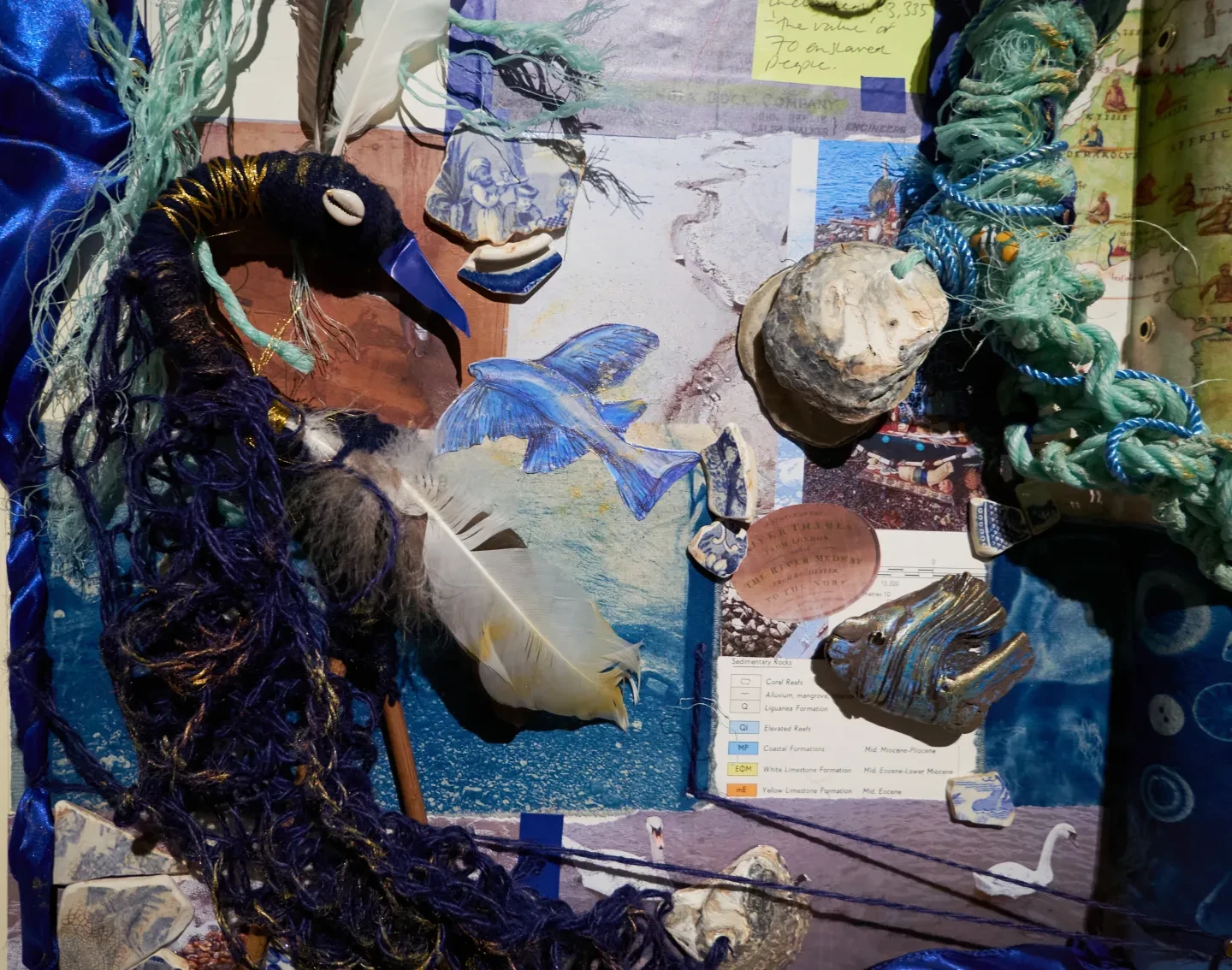
Details of flying fish and the Sankofa bird within the artwork
Badru recalls “the pure joy of witnessing the magic of flying fish whilst sailing from Carriacou to Grenada. They were like ‘taliswomen’ leaping out of the water – momentarily journeying in between worlds… pure magic. Freedom. To me, the oceans embody multilayered and multisensory mythic narratives connecting many realms of rhumblines, which are timeless and boundless.”
Badru’s work, like Nichols’ Cariwoma, declares:
I sing of Sea self
a glittering breathing
in a turquoise dress
Constantly stitched and restitched
by the bright seamstresses of flying-fish.