
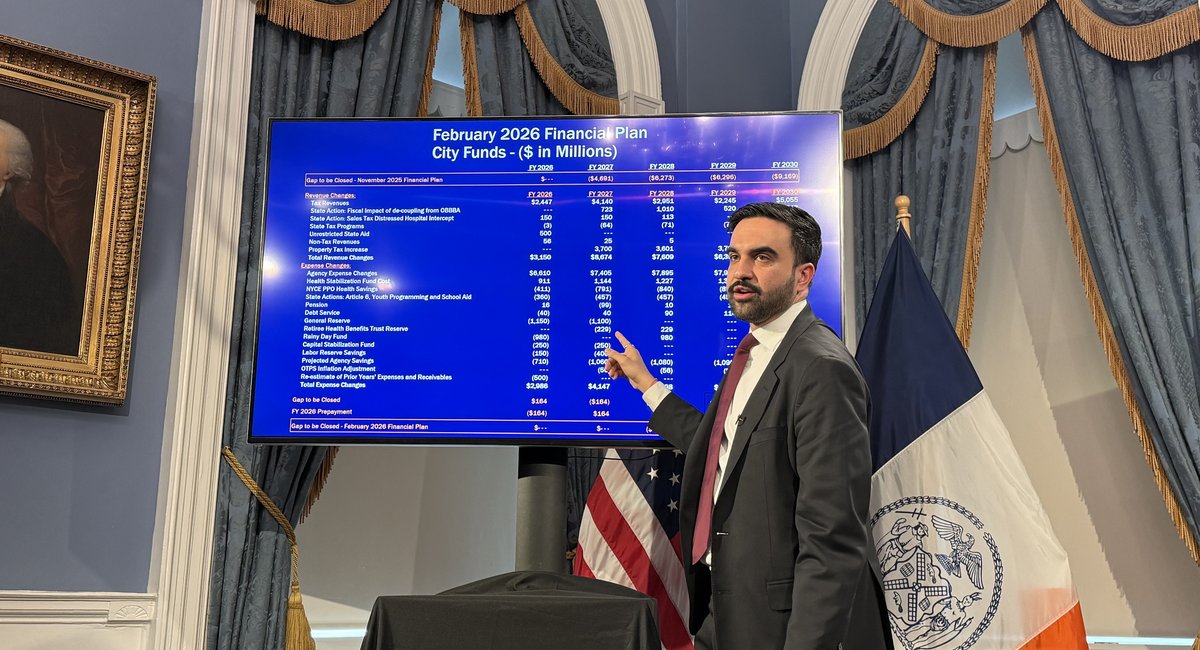
Mayor Zohran Mamdani on Tuesday said New York City may have to raise property taxes to close a multibillion-dollar deficit if Albany does not impose new taxes on the rich or corporations, as he unveiled a $127 billion budget.
The mayor’s threat signaled the democratic socialist remains committed to raising taxes on the wealthy, even as he forges an alliance with Gov. Kathy Hochul on expanding child care, a popular initiative with voters.
The governor, a moderate Democrat who is seeing re-election, would have to sign off on any tax increases. She has been steadfastly opposed to any kind of tax hikes.
The last time the city significantly raised property taxes was in 2003 under former Mayor Michael Bloomberg, in response to the 9/11 terrorist attacks that led to a recession.
“We do not want to have to turn to such drastic measures to balance our budget,” Mamdani said during a press conference at City Hall. “But faced with no other choice, we will be forced to.”
The mayor’s preliminary budget is the first step in a monthslong process. The City Council must approve the budget by June 30, before the start of the next fiscal year.
Prior to the mayor’s budget presentation on Tuesday, Hochul told reporters she did not believe raising city property taxes was necessary.
But Mamdani is clearly intent on pressuring Albany, one day after he and the governor announced the state would give the city an additional $1.5 billion to help stabilize its finances.
Because the city is required to balance the budget by law, the mayor’s proposed budget bridges a $5.4 billion shortfall over the next two years by assuming a 9.5% property tax increase.
The tax would affect more than 3 million residential owners and more than 100,000 commercial property owners, according to city officials.
The mayor’s “last resort” proposal would also draw nearly $1 billion from the city’s reserves and $229 million from a fund to pay for health benefits for municipal retirees.
Mamdani is also canceling his predecessor Eric Adams’ phased hiring of 5,000 additional police officers. His budget proposes a $22 million decrease to the NYPD’s $6.4 billion budget next year.
George Sweeting, a fiscal policy expert at the New School’s Center for New York City Affairs, questioned the logic of taxing the rich to help close a budget gap. The mayor could not use the revenue to fund other parts of his agenda that proved popular with voters, like free buses and city-owned grocery stores.
“You can’t use the money twice,” Sweeting said.