
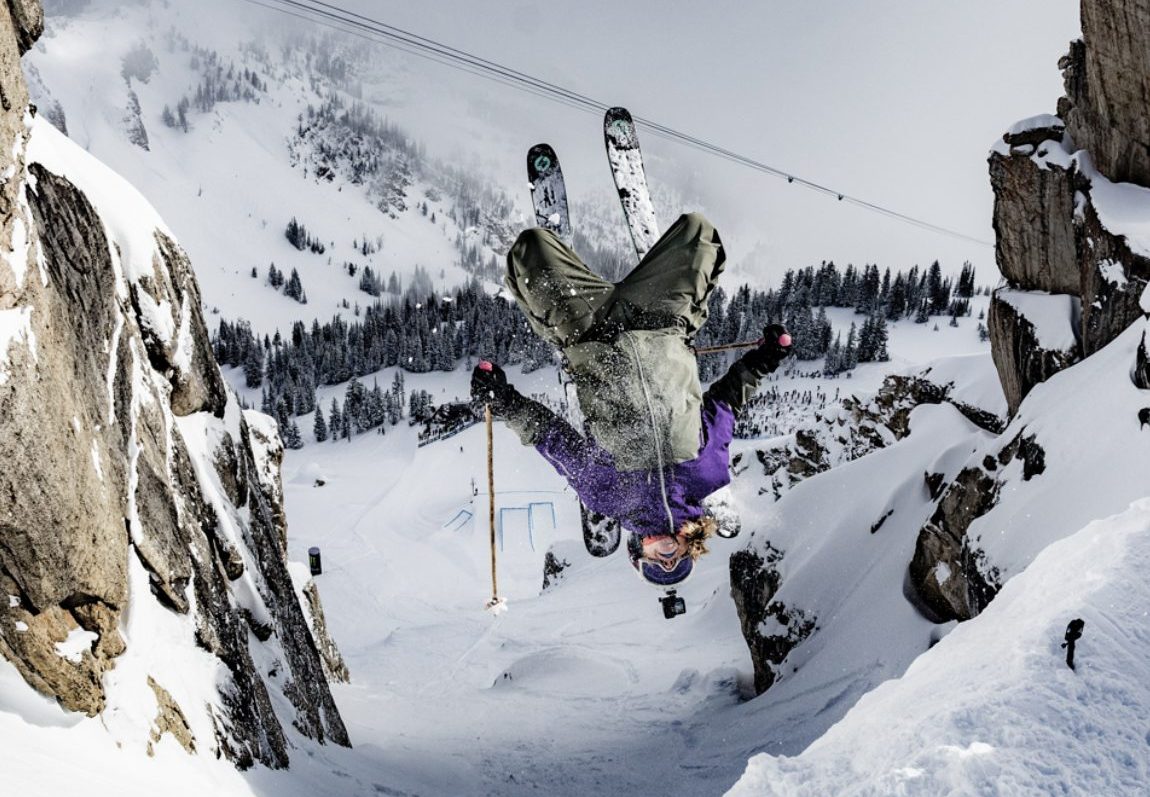
 Piper Kunst sending a huge backflip at Kings & Queens. Photo: C Burkesmith/JHMR
There was a tense excitement in the air as athletes, media, and ski patrol embarked on the 8:24 a.m. tram, headed for “The Top of the World” at Jackson Hole, Wyoming. 12 men and 12 women were preparing to huck themselves off a 40-foot cliff into a feature-filled, 50° couloir while traveling at near-highway speeds…pretty scary, right? Despite the task at hand, during the eight-minute ride up, I sensed little in the way of nerves. Competitors excitedly discussed different lines, tactics, and tricks they had in mind. Veterans of Kings & Queens reassured new contestants, and jovial riders hyped up those feeling less certain of themselves. There was no vibe at all that these athletes were competing against one another, but rather that they were competing together—to push the possibilities of skiing and riding on the biggest stage imaginable.
 Athletes departing the foggy early tram. Photo: C Burkesmith/JHMR
While I stared up at the hazy couloir, awaiting clear skies from the nature gods so the competition could get underway, I was met with a sense of disbelief. Were there actually people in the world crazy enough—and skilled enough—to launch themselves into this mammoth chute? How could one take that type of impact? How could someone huck themselves off something that looks like it could kill you? I don’t know…but they did it.
 The Tram soaring high above Corbet’s Couloir. Photo: C Burkesmith/JHMR
As the stoke built and Monster flowed in the finish corral, athletes began dropping. Snowboarder Sarka Pancochova kicked off the competition with a bang, airing into Corbet’s, then sending a backflip in the middle of the couloir and a 720 on the crowd-pleasing money booter. A few riders later, it was Piper Kunst’s—our eventual Queen—turn to huck herself off the lip. The crowd erupted as she became just the second woman ever to land a backflip into Corbet’s. As she raced down the chute, spectators cheered her toward the massive money booter, where she slightly overcooked a huge frontflip, before being met with a massive ovation from the finish corral.
Next came Jackson-born-and-raised Wyatt Gentry. After starting with a huge 360 off the lip and then another further down the couloir, he made his way far skier’s right toward the massive bottom cliffs. Wyatt stomped the drop, pulled around a cork-7 on the money booter, and skied into the celebrating crowd after what seemed to be a kingly run. The King, however, wouldn’t be crowned until later that afternoon.
 Wyatt Gentry racing into the finish coral. Photo: C Burkesmith/JHMR
After the first round was complete, I made my way up to the top of Corbet’s itself, just in time to see Tristen Lilly’s winning run. After Tristen sent a massive frontflip into the apparent abyss, it was nearly impossible to catch even a glimpse of the rest of his run. However, judging by the roaring crowd hundreds of feet below, you could tell he’d put down something special. Tristen followed up his initial drop with a huge mid-couloir backflip, a Wyatt Gentry-esque cliff drop, and a flat seven on the money booter to take home the 2026 crown. People at the top were stunned and excited, yet as soon as Lilly’s run was over, an air of intense focus and anticipation resumed—the same tension that had preceded his run when I arrived.
 Tristen Lilly’s massive frontflip off the lip. Photo: C Burkesmith/JHMR
The atmosphere among athletes preparing to drop was entirely different from the loud, celebratory vibe of the finish corral. The top of the lip felt more like a golf match than a ski comp, as competitors quietly visualized lines and contemplated whether to even risk dropping for a second time. From the bottom, it’s nearly impossible to get a sense of what the skiers and riders are going through. Those in the spectator area see amped-up, adrenaline-filled athletes pumping their fists and giving triumphant high-fives. What you don’t see are those same athletes, just moments prior, anxiously willing themselves—in silence—to do something unimaginable to the average skier. Something that, despite all the stoke and pageantry surrounding Kings & Queens, could have very serious and dangerous consequences.
 Quinn Boutot visualizing his huge drop, far skier’s right of the main lip. Photo: C Burkesmith/JHMR
It became clear to me that winning, while nice, did not seem to be the end goal for many of the athletes. Kings & Queens is more about pushing your own limits and helping others push theirs. Competitors are hucking themselves off one of the scariest and most infamous runs in the world; making it to the bottom in one piece is a win in and of itself. This is a competition against your nerves, your limits, and yourself—not against others. That sense of athletes not competing, but collaborating to make the impossible possible, is what makes Kings & Queens so very special.
Congratulations to Tristen, Piper, and all the other athletes, staff, and fans who made this event happen. I can’t wait to see what’s in store for 2027.
 The King and Queen of 2026. Photo: C Burkesmith/JHMR