
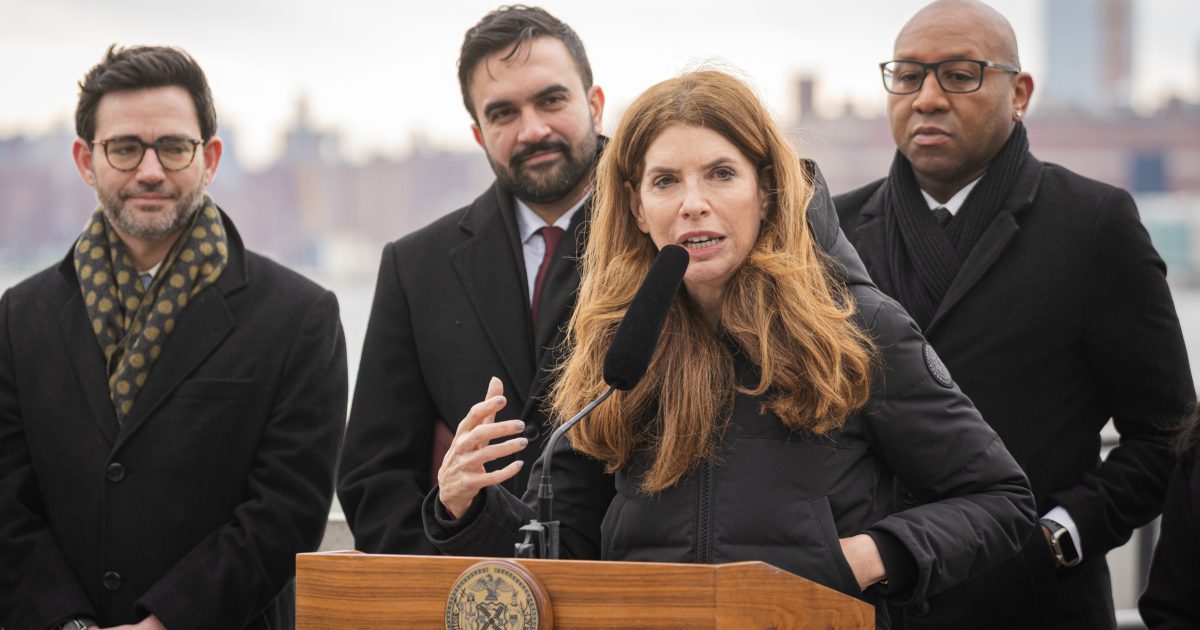
A New York City Council hearing slated for next Wednesday marks the formal start of Council Speaker Julie Menin’s push for a law that would allow police to restrict protests outside of city synagogues and other houses of worship.
The question of how the city should respond to synagogue protests promises to be the first major Mamdani-era legislative showdown over questions of Israel, antisemitism, and Jewish safety—the same issues that inflamed the mayoral election last fall. It’s an early test of the respective influence in Menin’s Council of the city’s ascendant Jewish left, which generally opposes the bill, and the centrist and right-wing Jewish groups, which support it.
Menin’s proposal directs the New York Police Department to implement a plan to address “interference” or “intimidation” outside religious sites, and would allow law enforcement to establish barriers up to 100 feet from a house of worship. It comes after two recent demonstrations outside city synagogues: one at a synagogue hosting an event promoting property sales in Israel and a West Bank settlement, the other at a synagogue hosting a group that supports immigration to Israel and the West Bank. Protesters outside one event chanted, “We support Hamas here,” which city and state officials described as antisemitic.
Mayor Zohran Mamdani himself has yet to come out with a position on Menin’s bill. Early this year, he ordered the city’s law department and the NYPD to review the legality of proposals to restrict protests outside houses of worship. That review appears to still be underway.
Progressive Jewish organizations and civil liberties experts have criticized Menin’s proposed 100-foot barriers as potentially unconstitutional. “It’s baffling to me that anyone would seek to further empower law enforcement to crack down on protests,” said Sophie Ellman-Golan, the director of strategic communications for Jews for Racial and Economic Justice.
The criticism may be getting through to the speaker: On Friday, Menin told the publication City & State that she was working to amend the bill, which she insisted “doesn’t restrict anyone’s right to free speech.” An NYPD spokesperson told the outlet that police Commissioner Jessica Tisch herself has concerns about the bill, and that Tisch was “working closely with the speaker’s office” to ensure “the NYPD’s flexibility to both protect houses of worship and facilitate First Amendment rights.”
Other Jewish groups, meanwhile, have supported the bill. Menin’s January announcement of her “plan to combat antisemitism”—which includes the synagogue protest bill and a proposal for a hotline to report incidents motivated by hate, among other things—came with the endorsement of both the UJA-Federation of New York and the city’s Jewish Community Relations Council. “A buffer zone is necessary in the climate we have today,” Rabbi Joseph Potasnik, the executive vice president of the New York Board of Rabbis, told Jewish Currents.
The bill puts the Council’s large progressive bloc in a difficult spot, squeezed between civil liberties concerns, Jewish institutional support for the bill, and a reluctance to get off on the wrong foot with the Council’s new leader.
In an interview last week with Jewish Currents, Tiffany Cabán, a Democratic Socialists of America-backed Queens councilwoman and one of two co-chairs of the Progressive Caucus, said she was firmly opposed to the Menin bill. “Jews are on heightened alert at synagogues because they are being targeted for violence. But I do not believe that this legislation achieves the goal of Jewish safety,” Cabán said. “The NYPD cannot be trusted with the kind of decision making ability that this legislation would give them.”
But other Progressive Caucus members were more open to the bill. “Having perimeters to allow people to go in and out of houses of worship makes a lot of sense,” said Manhattan councilman Harvey Epstein, though he suggested that the bill might need to be amended for First Amendment reasons. “We do have to work on the details of what this says and make sure that we’re not impacting anyone’s freedom of speech or expression.”
Other progressives have yet to lay out their positions. Opposing this bill risks incurring the wrath of Menin, who as speaker controls what bills come up for a vote and who runs council committees. Members who oppose the bill risk being accused of coddling antisemitism, or of tacitly supporting protesters’ incendiary rhetoric.
Menin’s synagogue protest bill is the first item on the agenda for the February 25th meeting of the council’s Committee to Combat Hate, where it will be voted on before going to the wider council. (A similar bill co-sponsored by Menin to restrict demonstrations outside educational institutions is also on the agenda.) If the bill does garner enough votes to pass, it will be a significant headache for Mamdani, who has had to navigate between his own anti-Zionist politics and a pro-Israel Jewish establishment that still wields significant influence in the city. It will be up to Mamdani’s allies in the Progressive Caucus to build a large enough coalition to keep the bill off his desk.
Cabán said her progressive colleagues are approaching the issue with a desire to increase the safety of Jews in the city and preserve core democratic norms. “We were elected into office to do hard things and to navigate these things with principle,” she said.