
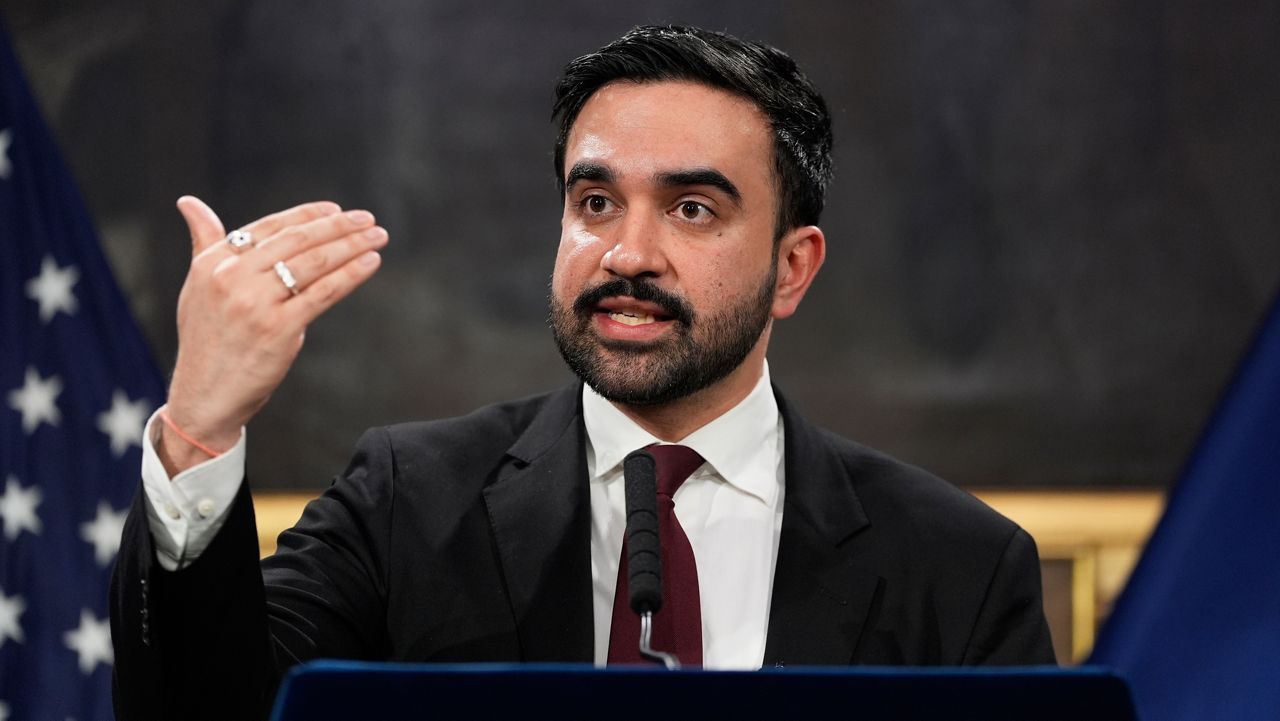
In his first city budget plan presented Tuesday Mayor Zohran Mamdani argued if Gov. Kathy Hochul doesn’t agree to a tax hike on the rich, then he will have to raise property taxes on millions of city homeowners to help pay for current city expenditures as well as new expenses.
“Nothing about this is typical, that’s why our solutions won’t be either,” Mamdani said during a nearly hour-long budget presentation at City Hall with reporters.
What You Need To Know
In his first city budget plan presented Tuesday Mayor Zohran Mamdani argued if Gov. Kathy Hochul doesn’t agree to a tax hike on the rich, then he will have to raise property taxes on millions of city homeowners to help pay for current city expenditures as well as new expenses
Painting a picture of financial doom and gloom for the Big Apple, Mamdani argued last month’s budget gaps stood at $12 billion over two years – blaming former Mayor Eric Adams’ financial planning
After giving City Hall an extra $1.5 billion on Monday, Hochul said, at a separate event Tuesday, that Mamdani needs to go back to the drawing board
Painting a picture of financial doom and gloom for the Big Apple, Mamdani argued last month’s budget gaps stood at $12 billion over two years – blaming former Mayor Eric Adams’ financial planning.
“If we cannot follow this first path, we will be forced onto a much more damaging path of last resort, one where we have to use the only tools at the city’s disposal, raising property taxes and raiding our reserves. The second path is painful,” said Mamdani.
Threatening the first across-the-board property tax rate increase since Mayor Michael Bloomberg in the early 2000s, Mamdani argued: his preferred way to close the two-year, multi-billion budget holes now standing at $5.4 billion.
Also, directing city agencies to cut the fat by March 20th according to an executive order.
“We believe that 2.5% is the highest level of savings that we can anticipate agency wide without starting to inhibit city services,” he explained.
Mamdani also said he’s unwilling to cut more – despite announcing plans to hire more workers and increase NYPD spending on FIFA World Cup security preparations.
After giving City Hall an extra $1.5 billion on Monday, Hochul said, at a separate event Tuesday, that Mamdani needs to go back to the drawing board.
“Mayors are having to do what they have to do. I’m not supportive of property tax increases. I don’t know that that’s necessary,” Hochul, who also opposes tax hikes on the rich, said.
He also got pushback, not only from budget critics but fellow Democratic City Council leaders who think he should reign in city spending first.
“There is a third option. It should be on the table, in fact it should be the first option that should be on the table identity where you can save money in the city budget because it’s not improving New Yorkers’ lives,” said Citizens Budget Commission President Andrew Rein, arguing the city should not only ask the state legislature for a reprieve in meeting the strict and expensive smaller class size” mandate and also reassess spending in schools facing closure due to the law.
City Council Minority Leader David Carr, a Staten Island Republican, said Mamdani is also pressuring state lawmakers to approve his tax hike by threatening their constituents with property tax increases.
“That’s why I say: it’s tax mail. It’s black mailing the New York City elected officials to say either give me what I need in Albany or I’ll be raising taxes on your constituents here at home,” he told NY1.
Queens Borough President Donovan Richards, a Democrat, argued the plan could also hurt minority homeowners.
“The impacts on Black and Brown communities! We talked a lot about how the affordability agenda would impact everyone – this is absolutely a nonstarter for me,” he said.
“Raising property taxes would be no one’s preferred option, partly because the system is so flawed, riddled with inequality,” City Comptroller Mark Levine, a Democrat, told NY1 in an interview after exiting a closed-door briefing Tuesday with Mamdani and his budget aides.
“It’s essentially a regressive tax as it’s currently structured, hitting homeowners and communities of color much more than it hits homeowners in wealthier areas. So, this should not be anyone’s choice of how we solve this, nor, by the way, should drawing down reserves,” he added.
Any property tax increases would need City Council approval, but both City Council Speaker Julie Menin and Council Finance Chair Linda Lee said higher property taxes are a nonstarter.
“The Council believes there are additional areas of savings and revenue that deserve careful scrutiny before increasing the burden on small property owners and neighborhood small businesses, which could worsen the affordability crisis,” the pair said in a statement.
The city’s budget is due by June 30.
“This agenda is not simply one to protect the city services that we already provide, it’s to advance an agenda that makes it easier for working class people to live in this city,” Mamdani said when asked why he’s considering plans that could contradict his affordability promise.
According to the city’s preliminary budget documents, Mamdani’s budget would be an estimated $122 billion by the end of fiscal year 2026 and grow to $127 billion by 2027.