
Tuesday, Feb. 17, marks the 48th day of Zohran Mamdani’s term as mayor. amNewYork is following Mamdani around his first 100 days in office as we closely track his progress on fulfilling campaign promises, appointing key leaders to government posts, and managing the city’s finances. Here’s a summary of what the mayor did.
Mayor Zohran Mamdani sharpened the stakes of New York City’s budget negotiations Tuesday, proposing a 9.5% property tax rate increase while warning it could be unavoidable unless Albany agrees to raise taxes on the city’s wealthiest residents and most profitable corporations — even as City Council leaders said property tax hikes should not be on the table.
Releasing his $127 billion Fiscal Year 2027 Preliminary Budget on Feb. 17, Mamdani framed the city’s $5.4 billion two-year budget gap as a choice between securing new state-authorized taxes on millionaires and corporations or relying on the city’s limited tools — including higher property taxes and reserve drawdowns — to legally balance the books.
The mayor framed the proposal as a response to what he described as an inherited fiscal crisis. Upon taking office, the administration said it identified underbudgeted essential services — including rental assistance, shelter operations, and special education — that widened projected gaps to roughly $12 billion across fiscal years 2026 and 2027.
After launching savings initiatives, incorporating updated revenue data, and securing additional state support, the city said it reduced the remaining two-year gap to $5.4 billion.
“There are two paths to bridge the city’s inherited budget gap,” Mamdani said in a statement. “The first path is the most sustainable and fairest: raising taxes on the wealthiest and corporations, and ending the drain by fixing the imbalance between what the City provides the State and what we receive in return.”
If Albany does not authorize new revenue tools, Mamdani said, the city would be forced to rely on “more harmful” options: raising property taxes and drawing down reserves.
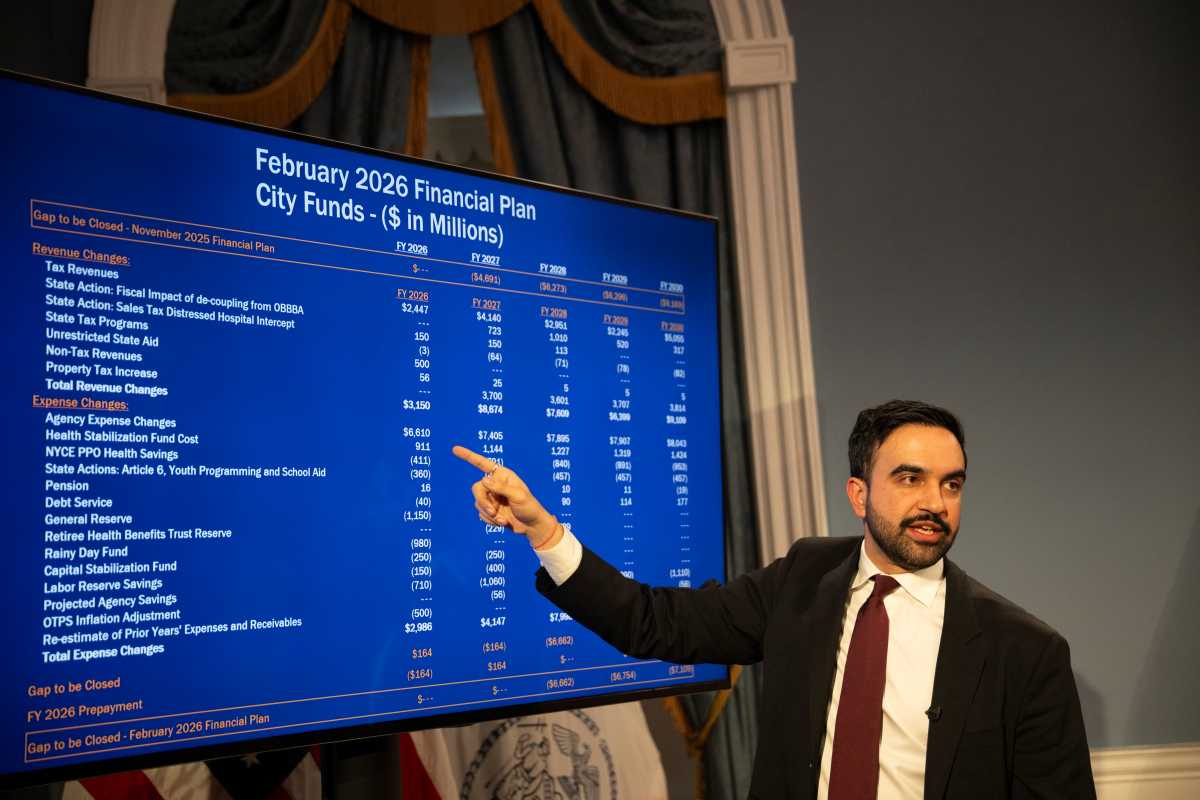
Budget documents show that the mayor’s February 2026 Financial Plan balances the city’s budgets for fiscal years 2026 and 2027, but does so by relying on one-time actions, reserve drawdowns, and increased revenues, while projecting multibillion-dollar gaps in later years.
The plan assumes billions of dollars in additional property tax revenue beginning in fiscal 2027, totaling roughly $3.6 billion to $3.8 billion annually through 2030.
Despite that assumption, the plan still projects out-year shortfalls of $6.7 billion in 2028, $6.8 billion in 2029, and $7.1 billion in 2030.
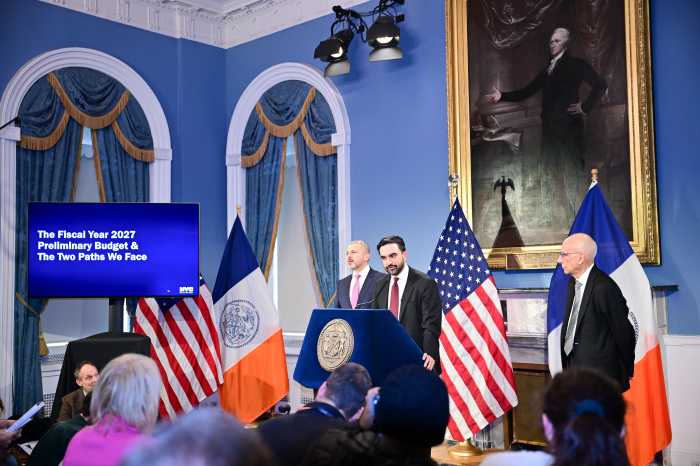 Mayor Mamdani, joined by First Deputy Mayor Dean Fuleihan and Budget Director Sherif Soliman, speaks at a City Hall briefing in the Blue Room on the city’s preliminary budget and proposed fiscal strategies.Photo by Lloyd Mitchell
Mamdani, who has repeatedly said he inherited a much larger deficit from the previous administration, has made raising taxes on wealthy residents and profitable corporations a centerpiece of his broader fiscal strategy. At ‘Tin Cup Day’ in Albany, he urged state lawmakers last week to adopt a 2% personal income tax increase on those earning more than $1 million a year, alongside a corporate tax hike, as a “fair” way to preserve city services without deep cuts.
“We want to work with Albany to raise personal income taxes by 2% on the 33,000 New Yorkers earning more than $1 million a year, and to raise corporate taxes on the most profitable corporations,” Mamdani said at Tuesday’s press conference.
He added: “If we cannot follow this first path, we will be forced onto a much more damaging path of last resort, one where we have to use the only tools at the city’s disposal, raising property taxes and rating our reserves. The second path is painful.”
He repeatedly reiterated that the preferred route is structural reform through Albany: “The course that we believe is not only the fairest course, also the most sustainable course is by ensuring that we end the drain and that we increase taxes on the richest New Yorkers as well as the most profitable corporations.”
Hochul repeats opposition to tax increases
Such changes would require Albany’s approval, and Gov. Kathy Hochul has so far resisted new taxes, even as she approved $1.5 billion in additional state funding to help close New York City’s budget hole.
Speaking at an unrelated press briefing Tuesday morning, Hochul voiced her opposition to a possible property tax hike and emphasized that the mayor’s budget release marks the start, not the end, of negotiations.
She also said updated revenue data has already improved the city’s fiscal outlook.
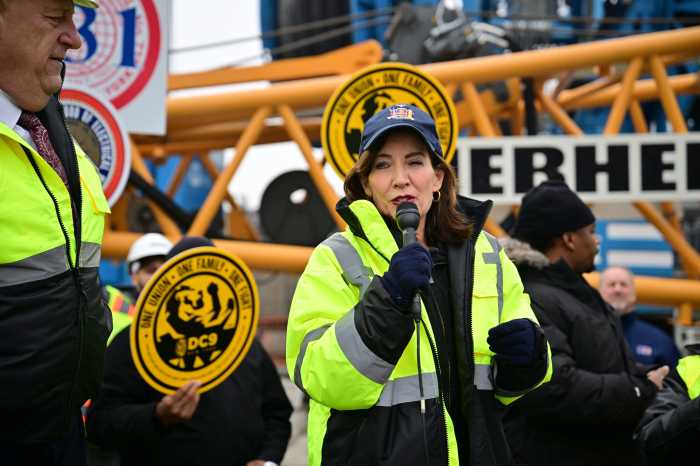 Gov. Kathy Hochul on Tuesday, Feb. 17, 2026Photo by Lloyd Mitchell
“That picture is now complete,” she said, citing sales tax revenue as well as income taxes tied to stock sales and bonuses. “So it looks like the deficit came down to about $7 billion, down from $12 billion. That’s progress, but I know there’s a long way to go
Asked specifically whether she would push back on a property tax increase, Hochul said, “I’m not supportive of a property tax increase. I don’t know that that’s necessary, but let’s find out what is really necessary to close.”
She added that such decisions ultimately fall to city leaders. “That’s between the City Council and the mayor,” Hochul said. “That’s their prerogative to look at that as an option.”
City Council, property owners push back
The Preliminary Budget assumes a 9.5% increase in the property tax rate beginning in fiscal year 2027, generating $3.7 billion that year. The administration also applied $980 million from the city’s Rainy Day Reserve in fiscal 2026 and $229 million from the Retiree Health Benefit Trust in fiscal 2027 to meet the city’s legal obligation to balance its budget.
City Council Speaker Julie Menin and Council Member Linda Lee, chair of the Committee on Finance, signaled strong resistance to Mamdani’s proposal, particularly to the proposed property tax hike.
“At a time when New Yorkers are already grappling with an affordability crisis, dipping into rainy day reserves and proposing significant property tax increases should not be on the table whatsoever,” the Council leaders said in a joint statement.
They argued that additional savings and revenue options should be scrutinized before increasing the burden on small property owners and neighborhood small businesses, warning such steps could worsen the affordability crisis.
The Council said it will release its own fiscal projections ahead of preliminary budget hearings and conduct a thorough review of the administration’s financial plan.
The mayor’s projected property tax hikes also drew immediate backlash from small rental property owners. Ann Korchak, board president of Small Property Owners of New York (SPONY), said in a statement that raising property taxes while freezing rents would be “crushing to small owners, driving us into foreclosure and bankruptcy.”
She added, “Owners of small rental properties are sick and tired of being treated like ATM machines every time the city needs to balance the budget… A Mayor who has never run a business knows nothing about the economic struggles and daily grind of small immigrant property owners.”
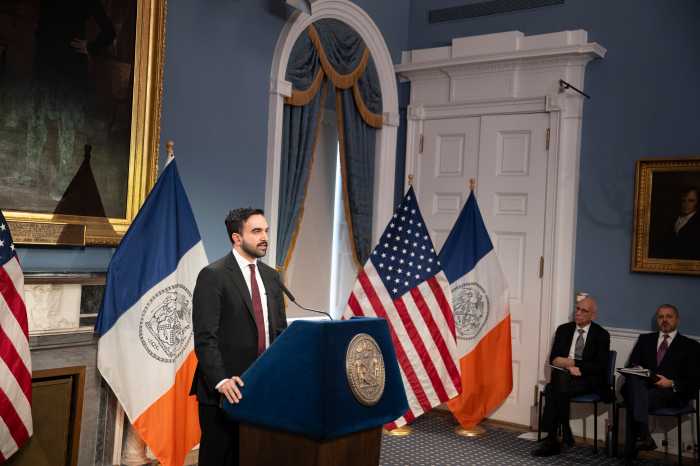 Photo by Lloyd Mitchell
Mamdani stressed at Tuesday’s press briefing that the preliminary plan is only the first stage of negotiations.
“This is the preliminary budget, we will obviously have an executive budget, and then we will have an adopted budget. We are showcasing the tools at our disposal that we can use to reach the legal requirement of a balanced budget over the next few months.”
He pledged to pursue an adopted plan that protects working families. “We will use every single day to ensure that we are building an adopted budget that reflects our desire for this to be a budget that not only reckons with the fiscal crisis that New Yorkers are facing, but also doesn’t resolve it on the backs of working and middle-class New Yorkers.”
Queens Borough President Donovan Richards also voiced his opposition to the potential property tax hike, saying he told the mayor it was a “nonstarter.”
“Under no circumstance should we consider balancing our budget on the backs of working-class New Yorkers, especially seniors on fixed incomes and workers who keep our city running,” Richards said.
Separately from the potential rate increase, Mamdani and his team also plan to address structural reforms to the property tax system.
“We need to reform the real property tax system,” Mamdani said. “It’s a system that is unfair, it’s a system that is inequitable, it’s a system that can barely stand up in court.”
Sherif Soliman, Mamdani’s budget director, added that legislation to pursue reforms would be modeled on the New York City Advisory Commission on Property Tax Reform and would address inequities, such as assessed-value caps. Soliman previously served as the commission’s executive director, which recommended changes to the property tax system.
Comptroller warns of ‘no easy options’; fiscal watchdog calls plan a ‘false choice’
New York City Comptroller Mark Levine offered a more measured response, praising the administration for ending what he described as the long-running practice of underbudgeting known expenses but warning that the city faces its most serious fiscal strain since the Great Recession.
Levine cautioned that the plan relies on aggressive revenue projections, unspecified efficiency savings, and the assumption that the expansion of CityFHEPS rental assistance will be halted.
“To rely on a property tax increase and a significant draw-down of reserves to close our gap would have dire consequences,” Levine said, arguing that the property tax system is “profoundly unfair and inconsistent” and that an across-the-board increase would be regressive.
He also warned that drawing down reserves during a period of economic growth could leave the city vulnerable in an economic downturn.
Levine said his office will release a full updated analysis of the city’s revenue outlook and financial plan on March 11.
The Citizens Budget Commission sharply criticized the mayor’s framing, calling the proposal a “false choice” between raising state income and business taxes or increasing city property taxes and tapping reserves.
Andrew Rein, president of the Citizens Budget Commission, argued that the better path is to eliminate spending that does not improve New Yorkers’ lives and make city government more efficient before asking taxpayers to pay more.
“$1 billion is a good start, but there’s much more to be saved,” Rein said, referring to the administration’s projected savings.
The group warned against the proposed 9.5% property tax increase, arguing that although the city has the authority to raise the levy, it should not. Such an increase would make the city more unaffordable for homeowners and could worsen financial pressures on pre-1974 rent-stabilized buildings if paired with a rent freeze. For commercial properties, the commission cautioned that a multibillion-dollar tax hike could undercut a real estate market still recovering from the pandemic.
The commission also criticized the administration’s plan to draw roughly $1.2 billion from the Rainy Day Fund and the Retiree Health Benefits Trust, calling it the type of one-shot budgeting that helped create the city’s current structural imbalance. Using nearly half of the Rainy Day Fund to balance the budget, the group argued, creates a new fiscal cliff — especially with projected out-year gaps of $6.7 billion and beyond.
By reducing in-year reserves to about $100 million, the city leaves itself with virtually no cushion next year if federal cuts or an economic slowdown disrupt revenue collections, the commission said. It also described the administration’s upward $6.6 billion tax revenue revision over two years as optimistic, noting that economically sensitive taxes account for nearly 60% of city tax revenues.
As alternatives, the commission pointed to potential savings of up to $1 billion by securing relief from the state’s class size mandate, $400 million from adjusting school funding to reflect declining enrollment, $200 million from consolidating union welfare benefit funds, as well as procurement reforms and additional efficiencies identified through the mayor’s Executive Order 12 initiative.
Despite its concerns, the commission credited the Mamdani administration for presenting a more transparent budget that corrects prior underbudgeting and more accurately reflects the cost of current service levels.
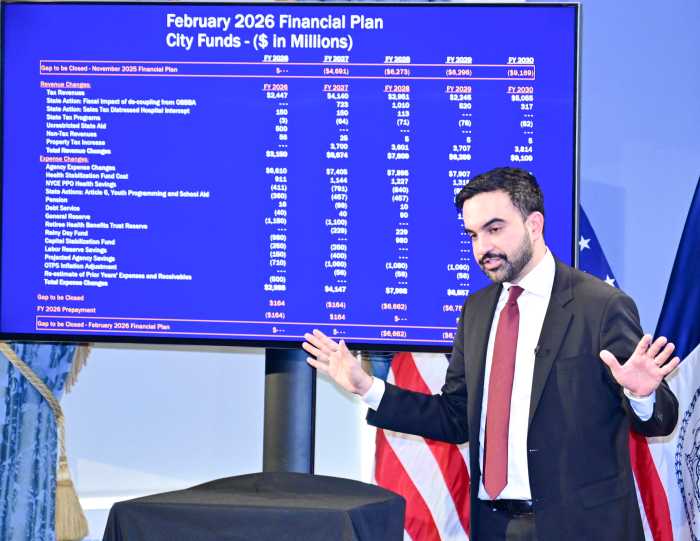 Photo by Lloyd Mitchell
In response to a reporter pressing Mamdani on the decision to draw down reserves typically intended for recessionary periods, he noted that the administration plans to replenish reserves in later years.
“So what the second path forces us to do is to utilize the Rainy Day Fund and the retiree health benefits trust reserve,” Mamdani said. “As you can see, in fiscal year 28 we do put investments back into those very reserves because we want the city to be on firm financial footing.”
The budget presentation reflects a $980 million withdrawal from the Rainy Day Fund in fiscal year 2026 and $229 million from the Retiree Health Benefits Trust reserve.
Mamdani emphasized that the administration had already pursued aggressive savings before proposing revenue increases.
“That is why we put forward an aggressive savings plan. That’s why we have CSOs [Chief Savings Officers]. That’s why we’re looking at every potential efficiency, at every opportunity to eliminate waste.”
He outlined specific savings targets for agencies. “These are the savings goals that we are putting to them, 1.5% in this year, 2.5% in next year, and so these are the most aggressive savings that we can pursue without inhibiting the functioning of city government.”
He also clarified that the reductions were not across-the-board service cuts.
“What we are talking about is eliminating inefficiencies and waste and ensuring that we’re still a fully functioning city government.”
The plan also details additional steps, including hiring “50 new auditors” expected to generate $100 million annually and adding “200 lawyers to the law department” to reduce tort liability.
Additionally, Mamdani said the administration will end the city’s long-standing “two-for-one” hiring rule and allow agencies to begin filling long-vacant positions.
“We are eliminating the two-for-one rule that agencies have been subject to for prior years,” Mamdani said. “We’re allocating funding so agencies can hire for 50 percent of long-standing vacancies in city government.”
He said the move is aimed at restoring basic government capacity after years of hiring constraints.
“What these rules — and the inability of agencies to hire for vacant positions — have done is grind government to a halt,” Mamdani said. “We’re committed to delivering the most efficient and excellent city government possible, and this will be part and parcel of that approach.”
With reporting from Ethan Stark-Miller