
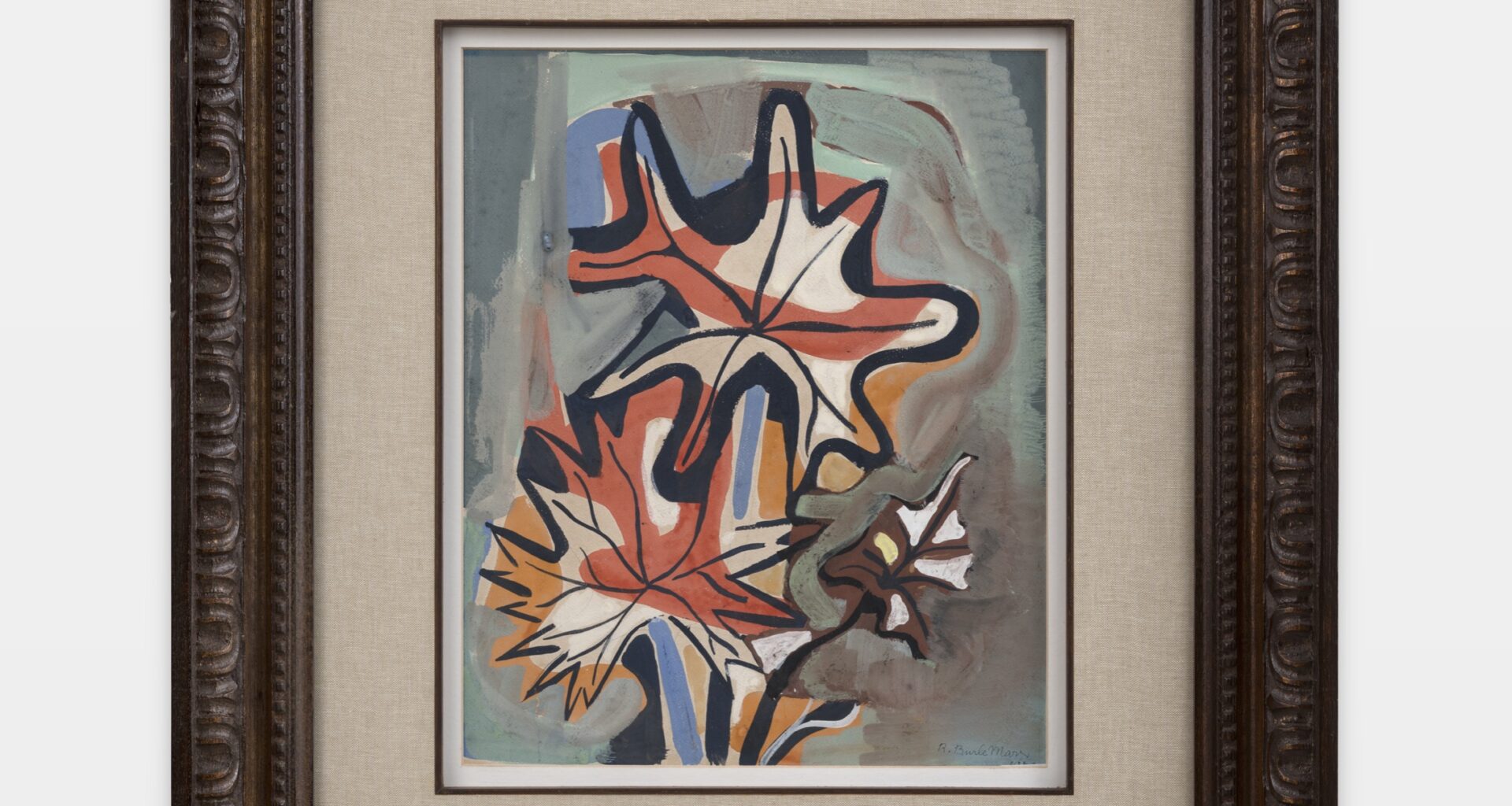
Works, 1940–1993
Andrew Kreps Gallery
January 9–February 28, 2026
New York
Roberto Burle Marx liked to recall the origin of his concern for Brazilian flora in his 1928 visit to a Berlin botanical garden, which launched a career in research and landscape design that would lead him to name fifty new species, complete world-celebrated public gardens, and have his own private garden in Rio de Janeiro named a UNESCO World Heritage site, even as the Amazon ecosystem he sought to preserve remains imperiled. But it should not eclipse the simultaneous impact of modern painting, of the first large exhibition of Vincent van Gogh’s work, whose vivid materiality “invaded” him. Study of avant-garde art combined with scientific curiosity about Brazilian flowering plants, once regarded as weeds, nurtured Burle Marx’s exceptional visual imagination and sustained both the expansive compositions of his gardens and the inwardly meditative construction of his oil paintings, of which Roberto Burle Marx: Works, 1940–1993, provides a broad sampling.
On returning to Brazil from Germany in 1928, Burle Marx studied with Leo Putz, a German figurative painter schooled in Art Nouveau, who was also attracted by the lushness of the country. Putz may have encouraged his use of color—to move him beyond the tonal portraits he’d produced in Europe—but the earliest oil painting in the show, Vaso de flores (1940) remains rooted in tonal depiction. Burle Marx’s early garden commissions, on the other hand, exposed him to architects Oscar Niemeyer and Le Corbusier, and their architectural spaces seemed to liberate expanded improvisational energy, taking the shapes and colors of tropical flora into tapestries, murals, wall reliefs and even jewelry. For a 1952 retrospective in São Paulo, his workshop produced large garden diagrams, painted in gouache on cardboard panels, featuring his playful patterns of abstract flower shapes in curved “beds” that resisted the formal symmetry of European gardens. Diffused in exhibitions abroad with the support of Brazil’s government, these inventive compositions came to define his public identity.
Viewers attuned to those images may be surprised by this exhibition, which focuses on oil paintings. While his oeuvre ranged widely across media, Burle Marx was conservative in his respect for the integrity of materials and techniques. A small, calligraphic rendering of a common flower, Begônias (1950), hanging near Vaso de flores, dramatizes the material contrast between his oils and his flatter, more improvisatory gouaches, highlighting the color dynamics of the garden and the meditative investigations of the studio. Oil offers richer material effects than gouache, but only through a slower process of blending and layering, which Burle Marx exploits throughout the show. The gallery’s generous spacing reinforces the aesthetic autonomy of the framed works on walls, selectively painted ochre and blue. In these pieces, intense colors emerge from somber, Cubist chiaroscuro like the gemstones set in his jewelry. The expressive impulse works its way more slowly through layered pigments; the oils articulate private, interior spaces inspired by an ideal of plasticity indebted to Cubism and recalling the interiors of Georges Braque, anchored in submerged armatures of still-life objects.