
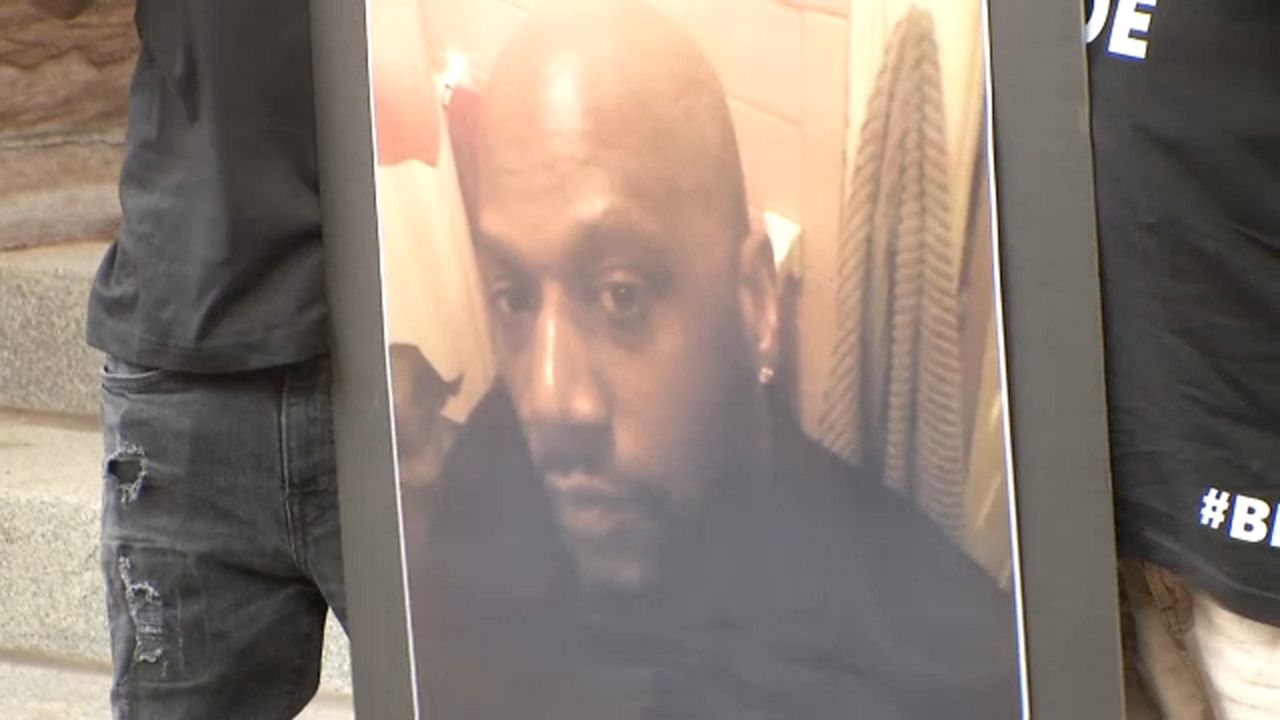
The campaign to pass Daniel’s Law, or at least bolster funding for its gradual implementation, continues at the New York state Capitol.
Daniel’s Law is named for Daniel Prude, who died in Rochester police custody while experiencing a mental health crisis in 2020. The bill seeks to create peer-led health based crisis response teams to replace a traditional police response in cases where the presence of law enforcement could escalate such a situation.
Eight million dollars was allocated in last year’s state budget to establish three pilot programs and develop a statewide Behavioral Health Technical Assistance Center for communities with non-police crisis response teams was considered a win by advocates and lawmakers who support Daniel’s Law, but with budget negotiations looming, they say the time has come to push for more.
Luke Sikinyi, vice president for public policy for the Alliance for Rights and Recovery, told Spectrum News 1 that last year’s investments, which must be spread over three years, are not enough to ensure that counties can keep the programs running. Gov. Kathy Hochul did not allocate any additional funding as part of her executive budget.
“Counties are going to be the ones who are working in conjunction with these programs,” he said. “They don’t want a program to start up and for a community to begin relying on it and then have to close the program, so we want to make sure these programs are invested in now.”
Sikinyi points out that for communities to set up the complicated infrastructure required to transform that response, the money allocated for pilots should fall in line with the $1.5 million to $2 million per year recommended by the Daniel’s Law Task Force at the end of 2024.
“Split between three groups, that means that each group is likely getting less than $1 million, which is significantly less than the recommendations outlined in the task force report,” he said.
Advocates like Sikinyi hope state lawmakers will successfully push Hochul to expand funding once negotiations heat up, and lawmakers, including Assembly sponsor Harry Bronson and Mental Health Committee Chair Jo Anne Simon, have been supportive.
Bronson called last year’s funding a “good start,” but acknowledged the need for more.
“We need to make sure we continue to fund pilots, we expand those pilots across the state, and that we continue to move forward,” he said.
Sikinyi emphasized that, in addition to more funding for the pilot programs, and ideally fully passing the bill, more money is needed for the technical assistance center, which works with communities that have non-police crisis response teams establish best practices and explore solutions. The center is seen as crucial to exploring what a full implementation of the law would look like.
“If they can operate 24/7, or operate on a wider range, more ZIP codes to see how it works when they have a wider plot to cover, or to look at having more pilot programs,” he said.
In response, Hochul’s office pointed to the investments made last year and expressed a broader commitment to addressing the issue.
“The Governor is committed to advancing efforts that aim to develop a more robust behavioral health crisis response system to safely and effectively provide support to New Yorkers in need,” said Deputy Press Secretary Nicolette Simmonds. “That’s why she’s directed the Office of Mental Health to implement pilot programs across the state that prioritize health-led responses to show how peers can be effectively used to create a more compassionate response system and save lives. Governor Hochul will continue to negotiate in good faith with the state legislature to deliver a budget that makes New York state safer and more affordable.”