
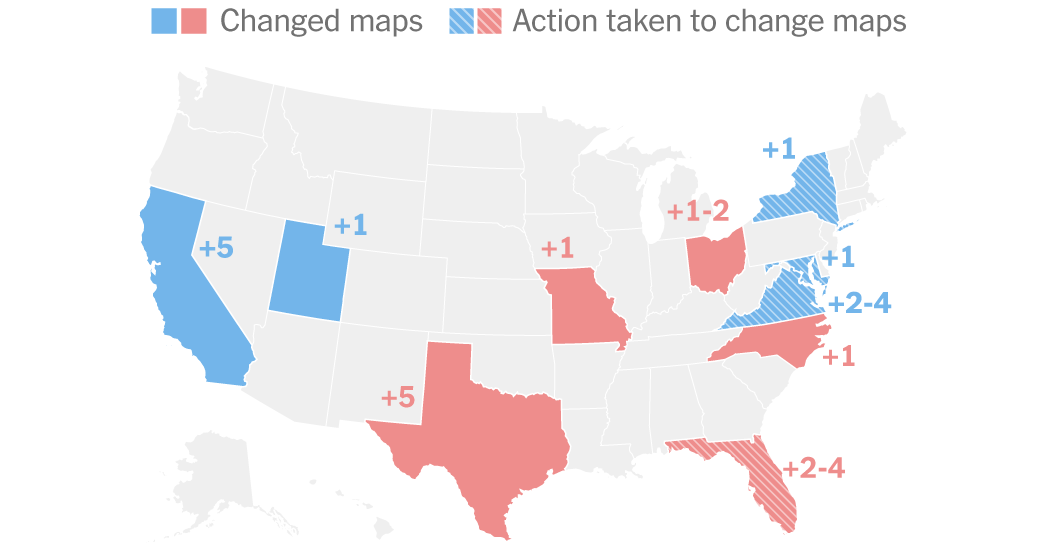
The first primaries for the 2026 midterm elections are scheduled for early March. For Republican and Democratic state lawmakers still trying to redraw district maps for the U.S. House of Representatives, where Republicans have a razor-thin margin, there is not much time left.
While legal challenges remain — including a potentially seismic Supreme Court decision on the Voting Rights Act — here is a breakdown of states where maps affecting November’s election have already been redone, or states have taken action to make changes.
These states have changed their maps
 Texas could add 5 Republican seats in the midterms
The first group to heed President Trump’s call last year to reshape Congress was the Republican majority in Texas.
Democrats staged a two-week walkout, arguing that the new districts would illegally dilute Black and Hispanic representation. But Gov. Greg Abbott, a Republican, signed the measure into law in August, and the Supreme Court upheld the map in December.
 California could add 5 Democratic seats
In response, Gov. Gavin Newsom, a Democrat, persuaded the legislature in August, and voters in November, to counterpunch.
The Supreme Court, echoing its Texas order, upheld California’s new map in February, dismissing Republican claims that it illegally favored Latino voters.
 Missouri could add 1 Republican seat
Gov. Mike Kehoe, a Republican, in late September signed into law a new map that would split Kansas City, a Democratic stronghold, into rural and largely Republican districts.
Republicans hope to oust the longtime Representative Emanuel Cleaver, who was the first Black mayor of Kansas City. But lawsuits are in progress.
 North Carolina could add 1 Republican seat
The Republican-controlled legislature approved a new map in October that imperils the re-election chances of Representative Don Davis, a Democrat, who represents the northeastern corner of the state.
Under the state Constitution, Gov. Josh Stein, a Democrat, cannot veto the new map.
 Ohio could add 1 to 2 Republican seats
Even before Mr. Trump’s push, Ohio was required, under its state Constitution, to redraw its congressional maps. So in October, a state commission approved plans to dilute Democratic-held districts near Toledo and Cincinnati.
 Utah could add 1 Democratic seat
A state judge in November tossed out a map drawn by the Republican-dominated legislature as being unfairly tilted against Democrats. The judge then adopted an alternative proposed by a centrist group that preserved a Democratic-leaning district surrounding Salt Lake City.
The Utah legislature has appealed to the Utah Supreme Court, while two of state’s congressional Republicans have filed a federal lawsuit to void the map.
These states are trying to change their maps
 Florida could add 2 to 4 Republican seats in the midterms
Gov. Ron DeSantis, a Republican, has proposed that a special legislative session be convened in late April on redistricting. Republicans, who control most of the state’s congressional seats, are eyeing a gain of two to four more in central and South Florida.
 Virginia could add 2 to 4 Democratic seats
The Democratic legislature has passed a constitutional amendment allowing lawmakers to redraw congressional districts before the midterms. If voters say yes to a referendum on April 21, the Democrats could net between two and four seats under a proposed new map.
A state judge initially blocked the effort to change the map. But the Virginia Supreme Court has allowed the referendum to proceed, and says that it will rule afterward on whether the plan is legal.
 New York could add 1 Democratic seat
A state judge has ruled that a district represented by Nicole Malliotakis, New York City’s only Republican member of Congress, disenfranchises Black and Latino voters. The judge has ordered an independent redistricting commission to come up with new maps for the district, which includes Staten Island and part of Brooklyn. Republicans are appealing.
 Maryland could add 1 Democratic seat
In Maryland, a latecomer, the House of Delegates has approved a plan that would ask voters to ratify new congressional boundaries in November — while also choosing the candidates to represent those districts.
The State Senate appears reluctant, so far. But if the plan proceeds, Democrats could turn what is now a 7-1 advantage into 8-0.
Reporting contributed by Nick Corasaniti.