
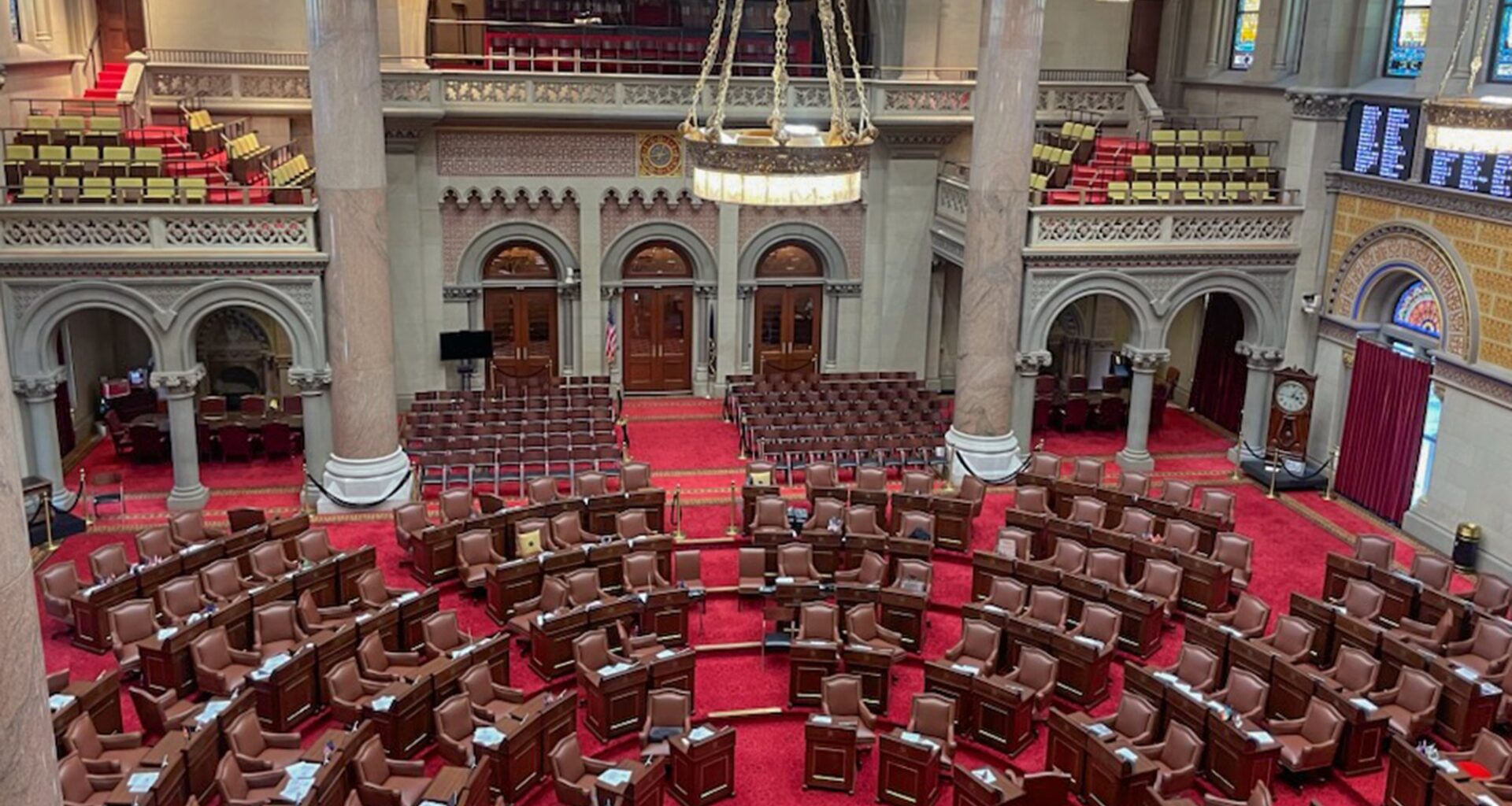
The empty NYS Assembly Chamber located in Albany, N.Y., where Assemblymembers deliberated on the MAID Act. Photo Courtesy of Aster Senft
Gov. Kathy Hochul signed into law the Medical Aid in Dying Act for New York State on Feb. 6, allowing terminally ill patients to end their lives with the assistance of a doctor.
The MAID Act has a contentious and storied history, first being introduced in 2016 and then shot down for 10 consecutive years. Though it has been passed, the MAID Act will not go into effect until Aug. 5.
According to ny.gov, the bill specifically intends to “make medical aid in dying available to terminally ill New Yorkers with less than six months to live,” and has a number of safeguards in place to prevent people from being “coerced into utilizing medical aid in dying.” These safeguards include statements requiring patients looking for medical aid in dying to record an audio or video request that can be reproduced upon request, mandatory mental health evaluations of the patients and a five-day waiting period between the initial decision and the administering of the medication.
One safeguard relates to a patient’s ability to decide on the follow-through of the administration of the medication, which is described in the bill as “decision making capacity.” Decision making capacity is defined as “the ability to understand and appreciate the nature and consequences of health care decisions, including the benefits and risks of and alternatives to any proposed healthcare, including medical aid in dying, and to reach an informed decision.”
There are also important legal considerations in the bill, preventing insurance companies from denying coverage based on the use of the MAID Act. According to Albany Law, “third parties, such as insurance companies . . . cannot use any of these concepts to affect a contract or any other obligation.”
Additionally, there are a number of other regulations in place, including regulations on the circulation of medicines used to administer medical aid in dying, such as midazolam, propofol and rocuronium, meaning that any leftover materials after the MAID Act is administered will be properly disposed of by medical professionals.
According to the MAID Act supporters, these regulations are an attempt to lessen concerns about the possibility of pressure from family members, religious leaders or other parties to persuade the terminally ill patient from continuing with medically assisted death and the general possibilities for abuse of medically assisted dying.
The MAID Act has the power to reduce the suffering of those dying, but many are concerned about the ethics of what Assemblymember William Barclay refers to as “legalized suicide.”
Barclay is among the most vocal openly anti-MAID speakers, publishing a column on the Assembly Minority Conference website, stating that the MAID Act “does not honor the needs of those facing the end of their lives” and worries that the bill “ignores the reality that not every terminal diagnosis is accurate and, worst of all, will put into circulation a deadly poison with no safeguards against its misappropriation.” This is the position that many opponents of the MAID Act share, worrying that the bill is cruel and could prematurely end the lives of the falsely diagnosed.
Bodily autonomy is one of the more contested aspects of this debate. On one side, anti-MAID proponents caution that “frustrated family members [will] pressure patients to consider suicide to avoid having to pay for care,” or that other pressures will arise that will impair the judgement of the dying.
Supporters of the MAID Act, however, state that the option of medically assisted suicide is important for bodily autonomy and that the existence of the option to end one’s suffering should be legal.
Many legislators have also shared personal stories related to the MAID Act, including the sponsor of the MAID Act in the New York Assembly, Amy Paulin. In a statement to The Oracle, Paulin expressed her experience with “watching [her] sister suffer greatly at the end of her life, begging for death, which reinforced [Paulin’s] belief that no one should be forced to endure unbearable pain when death is imminent.”
Hochul also shared personal connections that furthered her support for the MAID Act, stating in a press release, “My mother died of ALS, and I am all too familiar with the pain of seeing someone you love suffer and being powerless to stop it.” She also hoped that the bill would “shorten not their lives, but their deaths.” The Oracle reached out for additional comment from Hochul but received no reply at the time of publication.
Paulin corroborated this sentiment, stating, “my hope for the Medical Aid in Dying Act is that it brings comfort, dignity and peace to terminally ill New Yorkers and their families.”
Assemblymember Sarahana Shrestha has also expressed support for the MAID Act and co-signed the bill. Shrestha expressed relief towards the passing of the bill to The Oracle, stating, “I’m extremely relieved, on behalf of my constituents who have had to witness their loved ones die an unnecessarily painful death.”
Sen. Michelle Hinchey, the representative for New Paltz, Ulster County and the surrounding area also co-sponsored the MAID Act, but did not reply in time for publication when asked to comment on the reasoning behind her support.Outside of the U.S., 15 other countries have already legalized medical aid in dying. Additionally, according to Shrestha, “the bill we passed has much tighter guardrails compared to Canada’s, and only applies to exceptional circumstances where a terminally ill person with less than six months to live can opt for a compassionate death.”
Post Views: 32