
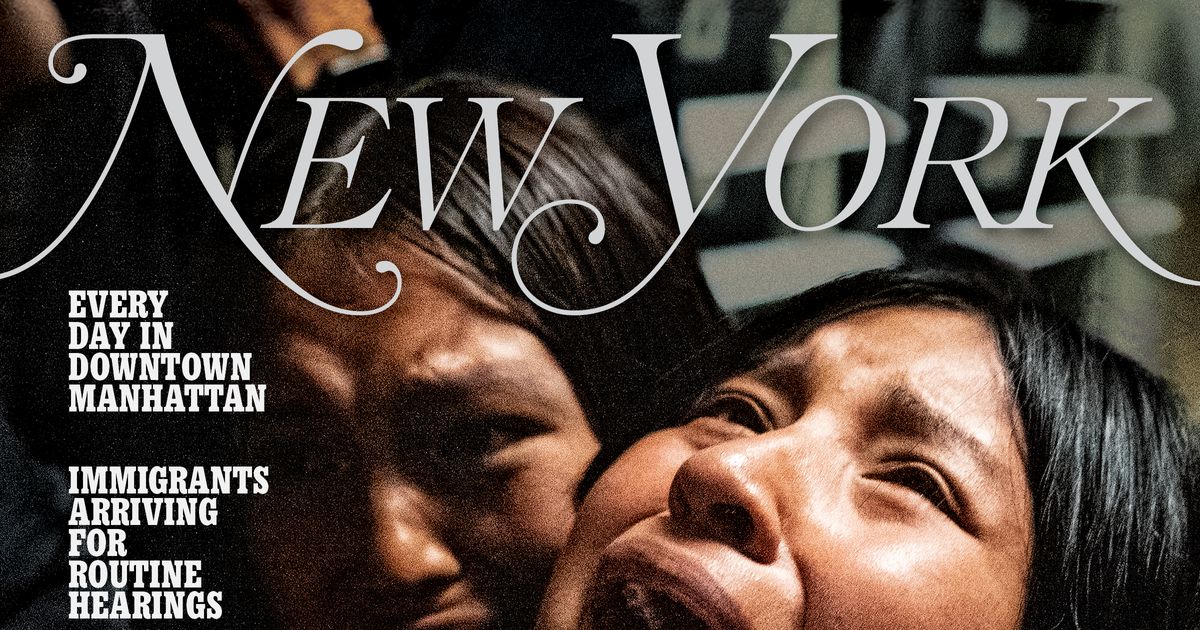
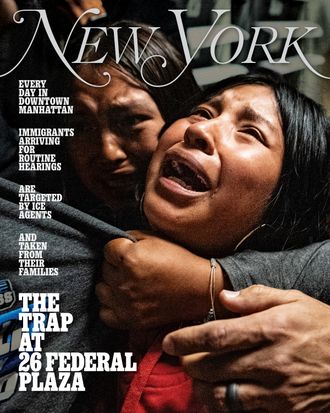
In October 2025, New York published a series of photographs taken by Stephanie Keith inside of 26 Federal Plaza, where, for months, migrants appearing for routine court hearings were, seemingly at random, detained by federal officers. Keith spent most days stationed in the hallways of the 12th and 14th floors, watching as people arrived, stepped inside their respective courtrooms, and, upon exiting, were muscled away by agents. Usually, they appeared shocked; inside the courtroom, a judge had moved their case forward and told them to come back later. Their families were, in some cases, literally ripped from them. Other times, relatives who weren’t informed of their arrest would wander the halls, looking for them. By the fall, Keith had around 25,000 photos.
This week, Keith received a George Polk Award for photojournalism. The number of migrants detained at the courthouse has dropped — many have simply stopped appearing for their hearings — but after briefly turning to other immigration stories around the country, Keith plans to return soon. “I have some other things I want to follow up on,” she says. “It’s really a never-ending story.”
What first brought you to Federal Plaza? What drew you to this story?
It was right after Donald Trump was reelected and was going to radically expand ICE’s budget. For me, that seemed like the No. 1 thing. He was transforming the country from a country of lawyers and judges and court appointments into this police state. So I felt like I needed to watch and see and try to show what this transformation was like and how it affected people. I started out thinking, Oh, I’m going to sit in my car and drive off and find ICE here and there. And so I subscribed to all these ICE-alert systems. But I never saw a single agent anywhere. And then one day there was a protest at the federal courthouse on Varick Street. And activists had figured out that ICE was operating inside the courthouses and arresting people. That was when I realized, Okay, here is this new policy of the United States. Here it is in action, right in front of my eyes.
And at that point, people didn’t really think this was happening in New York.
That’s right. Because it was happening inside this random bureaucratic building.
So upon arriving and being thrust into the chaos of it, what was your process like? How did you approach the actual day-to-day — and minute by minute — of actually taking these photos?
It was very chaotic — it’s a very tiny space. The hallways were very narrow, and there were a lot of people, a lot of press. You just had to learn what courtrooms were active on which days and at what time. The agents might be spread out on a bunch of different floors, and you just have to say, “Well, I’m going to follow this story, or I’m going to be here because there’s not a lot of other press here.” You just have to follow your gut.
How did you manage the tension between yourself and your subjects? You’re obviously there to capture a moment, but then this particular moment that you’re capturing is the worst moment of people’s lives. How did you deal with that?
Well, there was a certain point where I was like, Okay, I’ve photographed enough detentions. I wanted to try to tell more stories. So, you know, I started getting there a bit earlier so I could see who was arriving and create a kind of rapport with the subjects. Maybe nothing happened to them that day. But then maybe something heart-wrenching would happen later. The family that ended up on the cover — I was there the moment they arrived at the courthouse, and I tried to talk with them while they were waiting. When the father was actually taken away, I didn’t photograph the detention at all. I just photographed the family’s reaction.
The nature of the kind of photography you do means that you’re often in these really high intensity situations. But, on a personal level, did this assignment stand out for you in any way? Was there anything that made it particularly challenging?
Well, I mean, seeing these families being pulled apart — I have to admit, I’ve never experienced anything like that before. In the moment, you try to keep it together and just stay focused. You’re on a sort of emotional autopilot. But I remember that family in particular, I just burst into tears afterward. It was so sad, you know, they were such a happy family and they seemed so close. And from one minute to the next, they have a father and then they don’t have a father.
And then there were practical constraints. There was this man, Jamal, who was detained inside of a waiting room. And normally, you can’t photograph in there. But, you know, normally there isn’t extreme violence and chaos happening inside a waiting room. So I photographed it. Some photographers were afraid that if we published those photos, we’d lose access to the courthouse altogether. But I just felt like, if there’s something important happening, I have to document it.
Yes, Natalia, Jamal’s wife, said “the whole world came crashing down on him” in that waiting room. Did you end up following his story or any others after the article was published?
I did follow Monica. She’s the woman who is on the ground, and she was able to get her husband back. There’s an amazing group of volunteers and people who work at the courthouses who are really trying to help these people. There was one woman who was in the written article — we couldn’t publish her face because she had witnessed a gang murder back in Ecuador, and they were worried that she was going to be targeted if she was deported. She ended up being released and was reunited with her family. Her case actually became a precedent, and it has helped other people get out of detention.
Jamal won his asylum case. But then ICE appealed the decision, and now it’s under review. He wanted to be bonded out of detention, but the judge wouldn’t allow it. So he is actually still in detention in western Pennsylvania, where he’s been since the end of August. His lawyer did say that he thought that my pictures were really important in bringing that case to light and showing the entire arc of Jamal’s story. I think, ultimately, people just didn’t realize how brutal it really was.
Sign Up for the Intelligencer Newsletter
Daily news about the politics, business, and technology shaping our world.
Vox Media, LLC Terms and Privacy Notice