
Food in New York’s state prisons lacks nutritional balance, and issues with packages and commissary lead to minimal healthy options for those incarcerated, a report from the Correctional Association of New York found.
“Everyone will tell you the food is just terrible, and the reason they’re saying that is because nutrition-wise, it’s not enough to be sustainable,” said Cliff Ryan Jr., who served 10 years in five different state-run facilities.
The report from CANY, an organization designated by law to oversee New York’s prisons, surveyed 814 people in prison and found that the general confinement menu provides approximately 2,800 calories per day, as determined by the Dietary Guidelines for Americans, which is more than the recommended number of calories for “moderately active” men and women.
A key finding was that they do not provide enough fruits, vegetables or protein. It was found that correctional facilities serve about 50% of the recommended amount of fruit, and 80% of the recommended amount of vegetables and protein.

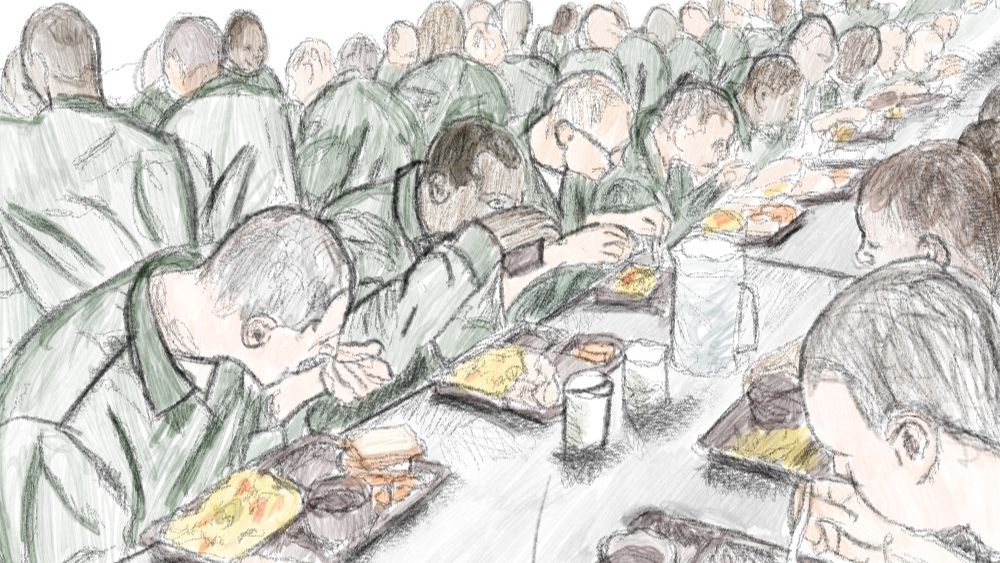
An illustration of a food tray in prison. (Emily Kenny/Spectrum News 1)
Mohawk Correctional Facility is home to a food processing department that supplies the state’s prisons with their meals. The food is batch-cooked and chilled, then sent to the other correctional facilities where it is reheated. Ryan used to work in the food processing sector while he was incarcerated there.
“The stuff that I used to see come through there, I don’t think nobody out here in society would want to eat. If you were in that processing department, you wouldn’t want to eat it because of how it came,” Ryan said.
Sumeet Sharma, director of policy for CANY, said they would like to see more fresh food preparation at a facility level versus this batch model.
“Even if they do have vegetables in that food, it hasn’t been freshly prepared. It’s essentially food that has been centrally created at Mohawk Correctional Facility and shipped around the state, Sharma said. “I imagine that the cook-chill process has some role in there being a higher sodium content in a lot of that food,” Sharma said.
A 2020 report from Impact Justice, a national accountability organization for law enforcement and prisons, found that in 2018, New York spent $2.84 per meal for each incarcerated person.
CANY suggested adding more cooking facilities to the prisons; however, DOCCS said in response to the report that it isn’t feasible due to security requirements.
“The department offers all incarcerated individuals, not serving disciplinary sanctions, with access to hot pots. Regarding access to cooking equipment, when appropriate and feasible, incarcerated individuals are afforded access to other amenities such as cooktops, toasters, microwaves, ice machines and refrigerators,” the department’s response said.
Michael Capers was incarcerated at the age of 16 and spent about 12 years in the prison system. He too spent time in a few different facilities, such as Franklin Correctional Facility, Upstate Correctional Facility and Fishkill Correctional. Because of his family history of heart issues, Capers said he always paid attention to the food he ate and his heart health.
“Once I got inside, I was working out consistently, and still I was having an increase in blood pressure. It was mostly because the food we eat is either hyper-processed or high in sodium,” Capers said.
He said he realized he had high blood pressure at the age of 24.
“I was like, in what a lot of people would call perfect shape. I was running a 5-to-6-minute mile and still I had this high blood pressure and imminent heart disease,” Capers said.
Even after trying a vegetarian diet, Capers said he ultimately had to go on medication to lower his blood pressure. Since his release, he has maintained his blood pressure through a healthy diet.
A 2016 report by the Department of Justice found that more than a quarter of state and federal inmates have high blood pressure, and it is the most common chronic condition among this population.

An illustration of a food tray in prison. (Emily Kenny/Spectrum News 1)
It was found that the daily meals in New York prisons contain, on average, 4,000 mg of sodium per day, which is 174% of the recommended amount of 2,300 mg.
The New York State Department of Corrections and Community Supervision said in a statement that their meals are analyzed by a DOCCS dietician to ensure they are following the Dietary Guidelines for Americans (DGA).
“The department cannot substantiate claims that an individual’s blood pressure worsened due to facility food. Blood pressure can be affected by many factors, including stress, preexisting medical conditions, activity levels and medications. Without specific medical evidence, it is not possible to attribute changes in blood pressure to facility meals,” the statement said.
Emily Gozy, a registered dietitian who runs her own private practice, said that while including higher-quality ingredients may be more expensive, it could reduce costs in other areas.
“The cost would absolutely go up with providing more nutritious meals, but I think that might help to reduce health care costs and reduce some of even the specialized diets that might have to occur due to someone’s dietary restrictions from health issues,” Gozy said.
The CANY report highlighted that DOCCS doesn’t provide enough fruits and vegetables. Gozy said she agreed with that assessment and made a couple of other recommendations.
“There was a lot of sugar-sweetened beverages that were offered with meals and that was offered in place of maybe offering a piece of fruit. Most meals were offered with dessert. Is that something we have to do? Can we focus on some other things and maybe it’s dessert at dinner time, but we don’t need dessert at lunch and dinner,” Gozy said.
Challenges with commissary
Commissary provides those who are incarcerated with the ability to purchase food, hygiene products, and other necessities that are not otherwise provided. In 14 of the 17 prisons that housed inmates who responded to CANY’s survey, more than half said the commissary is not adequately stocked.
Capers said his experience with the commissary options varied based on the facility he was in; for example, in Franklin Correctional Facility, they stocked vegetables.
“They always had mixed vegetables, and potatoes and carrots and stuff that you could actually cook and try to maintain a healthy diet, but when I got to Fishkill, they have a small commissary but a big population, so there’s limits on almost everything,” Capers said.
Often, Capers said he could order four packs of corn, but then when he would go pick it up, they wouldn’t have the items he ordered.
“And you can’t get a makeup buy to receive the stuff that you wanted, you just gotta wait till the next commissary,” he said.
Ryan said during his time incarcerated, there were complaints about a lack of produce in the commissary and that over time, he saw improvements, but it still presented issues.
“For commissary, they have their contract with their local farmers, but the majority of the produce that’s stocked in the commissary areas, some of it’s spoiled, and they try to get it out as fast as they can, depending on who’s buying and ordering,” Ryan said.
Under Gov. Kathy Hochul, New York implemented Executive Order 32, which requires state agencies, including prisons, to purchase 30% of their food products from New York farmers and producers. In 2024, DOCCS purchased $9.1 million worth of New York food products, according to a report from the state Office of General Services.
The top three food items purchased by DOCCS in 2024 include 277,172 pounds of potatoes, 174,070 pounds of frozen apples and 514,774 pounds of cabbage.
CANY’s report found that only 7% of food and drink items listed in the commissary were fruits or vegetables.
Additionally, the report stated that prices of items in the commissary rise at rates above inflation, while the wages paid to those incarcerated are decreasing when adjusted for inflation. Between 2020 and 2025, commissary prices rose at twice the rate of the Consumer Price Index. Sharma said CANY found that some wages are incredibly low.
“We’re dealing with prison wages that are as low as 10 cents, 12 cents an hour, essentially for some jobs. You can imagine it’s very difficult to afford anything from the commissary, let alone enough food to supplement a diet,” he said.
Delays in receiving packages
With what they called a lack of nutritious meals and the availability of food in the commissary, both Capers and Ryan said they turned to their family to receive packages, but items in the packages would spoil or they would be missing.
“You get a 40-pound package sent, and you go to the package room, and you look, and it weighs only 20 pounds,” Ryan said.
Capers said he told his loved ones not to send certain things because he knew they would spoil, despite them sending them with priority shipping.
“It would get there the next day, and then they’ll take four or five days, sometimes even longer than that, to get you a package, so by the time you get it, they tell you that you have to throw [things] away because it was spoiled as if it was your fault,” Capers said.
Almost half of the respondents to CANY’s survey said they experienced spoilage in their packages. Some facilities contain refrigerators, but not all, which can lead to inconsistencies among the different prisons.
DOCCS referred to Directive No. 4911, which lays out guidelines for packages and articles sent to their facilities.
“The department is not responsible for articles received in spoiled condition. An incarcerated individual can file a claim to recover the value of the personal property,” the statement said.
Culturally relevant foods
Over half of New York’s prison population identifies as Black, and about 20% identify as Asian, according to data from the New York Department of Justice. However, Capers said there isn’t food that is culturally relevant. Since his release in 2022, he has worked with Sweet Freedom Farm to improve this issue.
“We grow culturally relevant, nutrient-dense food. This year, we had a heavy emphasis on heirloom seeds that are historically relevant to our communities,” Capers said.
Sweet Freedom Farm, based in Columbia County, operates a monthly farm stand outside of Sing Sing Correctional Facility, and they are now working on a program that provides produce directly to those who are incarcerated. Capers now serves as the director of advocacy and organizing for the farm.
“The reactions are phenomenal. It’s warming. It feels good to be able to impact people in those ways,” Capers said.
This year, Capers led a pilot program called FTP, which allowed the farm to provide food directly to people who are in prison rather than going through family members. The organization can provide fresh produce to people who are incarcerated using packages. He hopes to expand the reach of that program in the coming year.
“I would just implore people to understand that most people who are in prison in New York state are coming home from prison and if we don’t invest in them now, we’re asking that they replicate the same harms that they committed prior to going to prison,” Capers said.