
Mayor Zohran Mamdani made six appointments to the Rent Guidelines Board on Wednesday, giving his choices a two-thirds majority on the body that sets annual rent increases for New York City’s 1 million rent-stabilized apartments.

Bisnow/Sasha Jones
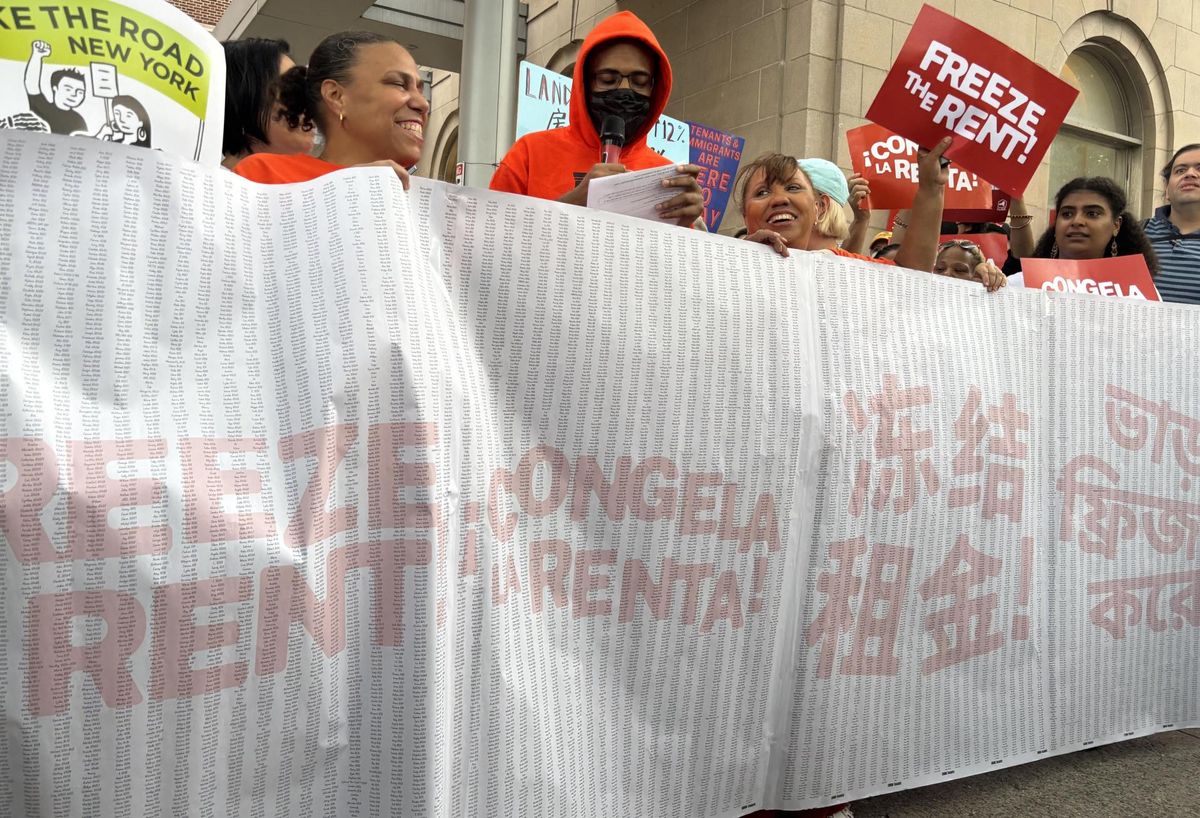
Tenant advocates display signatures of New Yorkers in favor of a rent freeze prior to the Rent Guidelines Board vote in 2025.
Mamdani campaigned on a promise to freeze the rent on those apartments for all four years of his term, a policy that many of the buildings’ owners say poses an existential threat. In making the announcement Wednesday, the mayor stopped short of reiterating plans for a freeze.
“I’m confident that, under the leadership of Chantella Mitchell as chair, the board will take a clear-eyed look at the complex housing landscape and the realities facing our city’s two million rent-stabilized tenants, and help us move closer to a fairer, more affordable New York,” Mamdani said in a statement.
Mitchell will oversee board deliberations and invite external testimony. She is a program director at the New York Community Trust, where she heads grantmaking in community development and housing. She is also a former executive director with the city’s Department of Housing Preservation and Development.
Maksim Wynn will step in as an owner representative. He is the director of development at Procida Development Group, a Bronx-based affordable housing developer, and previously worked at the New York City Department of Homeless Services, as well as HPD.
For the RGB’s public board members, Mamdani named Jain Family Institute Senior Research Associate Sina Sinai, The New School’s Center for New York City Affairs Director of Economic and Fiscal Policy Lauren Melodia and United Auto Workers Region 9A Director Brandon Mancilla.
Adán Soltren, a supervising attorney in the Legal Aid Society’s Housing Justice Unit Group Advocacy practice, was renamed as a tenant representative.
Mamdani was handed the ability to nominate the majority of the board after Alex Armlovich resigned on Tuesday. Armlovich, who is a senior housing policy analyst at the Niskanen Center, was appointed by then-Mayor Eric Adams in March.
Armlovich follows other RGB members Doug Apple, Reed Jordan and Alex Schwartz out the door. Schwartz, an appointee of former Mayor Bill de Blasio, was already replaced by Adams in his final days in office. In December, Adams made four appointments in an attempt to hinder Mamdani’s ability to freeze rents.
Merrill Lynch senior financial adviser Lliam Finn was set to replace Schwartz as public representative but opted out of the role two weeks after his appointment was announced.
If Adams’ nominees had stuck, Mamdani still would have been able to make four appointments this year. But he would have had to wait until 2027 to nominate a majority.
Each representative serves on terms ranging from two to four years. Smyth Law PC founder Christina Smyth, Legal Services NYC Deputy Director Sagar Sharma and New York University Stern School of Business associate professor Arpit Gupta — all Adams appointees — remain on the board.
Landlord groups on Wednesday blasted Mamdani’s appointments and reiterated their stance that a rent freeze would be devastating for rent-stabilized landlords.
“Many of the city’s heavily rent-regulated buildings are facing severe financial distress, which continues to lower apartment supply and deteriorate the city’s housing stock,” Real Estate Board of New York President James Whelan said in a statement. “While it plays well on the campaign trail, a rent freeze is an ill-advised approach to addressing a complex issue.”
Bisnow/Sasha Jones
Protestors shout at members of the Rent Guidelines Board during its 2025 vote.
In his resignation letter, first reported by The City, Armlovich attributed his departure to his new role as a program officer at the philanthropy group Coefficient Giving. He added that he believes housing production will be more effective in solving the housing crisis than rent regulation.
“Rent regulation is a short-term patch that provides valuable certainty and consumer protection for tenants, but only insofar as a tenant’s life circumstances never change and they never need or want to move for the rest of their lives,” Armlovich wrote.
Additionally, he cited a “slumlord freeze” proposal from Gupta as an option he hopes the new board will give “a serious look.” Doing so would prevent increases by landlords with substantial housing code violations but allow others to raise rents.
“It directly ties a landlord’s revenue to their performance as a housing provider, and it addresses the legitimate concern that blanket guidelines reward negligent owners and responsible ones alike,” Armlovich wrote. “I think giving landlords both the means and the incentive to reinvest cost-based RGB guideline increases into tenant quality of life is the single best reform the RGB could adopt.”
Apple similarly told The City his decision to leave the board was not political but simply because he is “ready to move on to new things.” He is the president and CEO of 1811Consulting, which advises on affordable housing.
In an interview with Gothamist, Apple added that he expects the board to assess all of the data presented without “automatically” deferring to a rent freeze.
The RGB undergoes a monthslong process that entails public hearings and financial data analysis from landlords and tenants before an annual vote. Last year, the board approved a 3% increase in a heated 5-4 vote.
Rents were raised a cumulative 12% under Adams’ tenure, although landlords have argued that those increases still have not kept pace with rising insurance and maintenance costs amid a higher interest-rate environment.
Nearly 60% of rent-stabilized buildings were operating in the red as of 2024, according to a study by nonprofit affordable housing groups National Equity Fund and Enterprise Community Providers.
“Data show that tens of thousands of rent-stabilized buildings are in severe fiscal distress,” New York Apartment Association CEO Kenny Burgos said in a statement. “This is a generally accepted fact among academics, housing experts, and former Rent Guidelines Board members.”
While the mayor appoints the RGB, the board is required by law to consider economic data as well as the income and margins of rent-stabilized landlords. The lack of a mention of a rent freeze in Mamdani’s announcement is notable considering legal threats that have been lobbed by the real estate industry around a predetermined RGB course of action.
Burgos said if the new board chooses to “ignore the consensus view, then they will be opening up the process to legal scrutiny. Worse, they will be responsible for the deterioration and eventual destruction of thousands of rent-stabilized buildings.”
A day before Mamdani announced the RGB appointments, he released his proposed budget for fiscal year 2027, which included a property tax hike of nearly 10%. The mayor is pressuring Gov. Kathy Hochul to hike taxes on corporations and the wealthy instead.
“I think they should weigh, as every board does, the needs of the tenants and the needs of the landlords,” Apple told Gothamist. “The mayor has made his position clear, but this is an independent board.”