
Real journalists wrote and edited this (not AI)—independent, community-driven journalism survives because you back it. Donate to sustain Prism’s mission and the humans behind it.
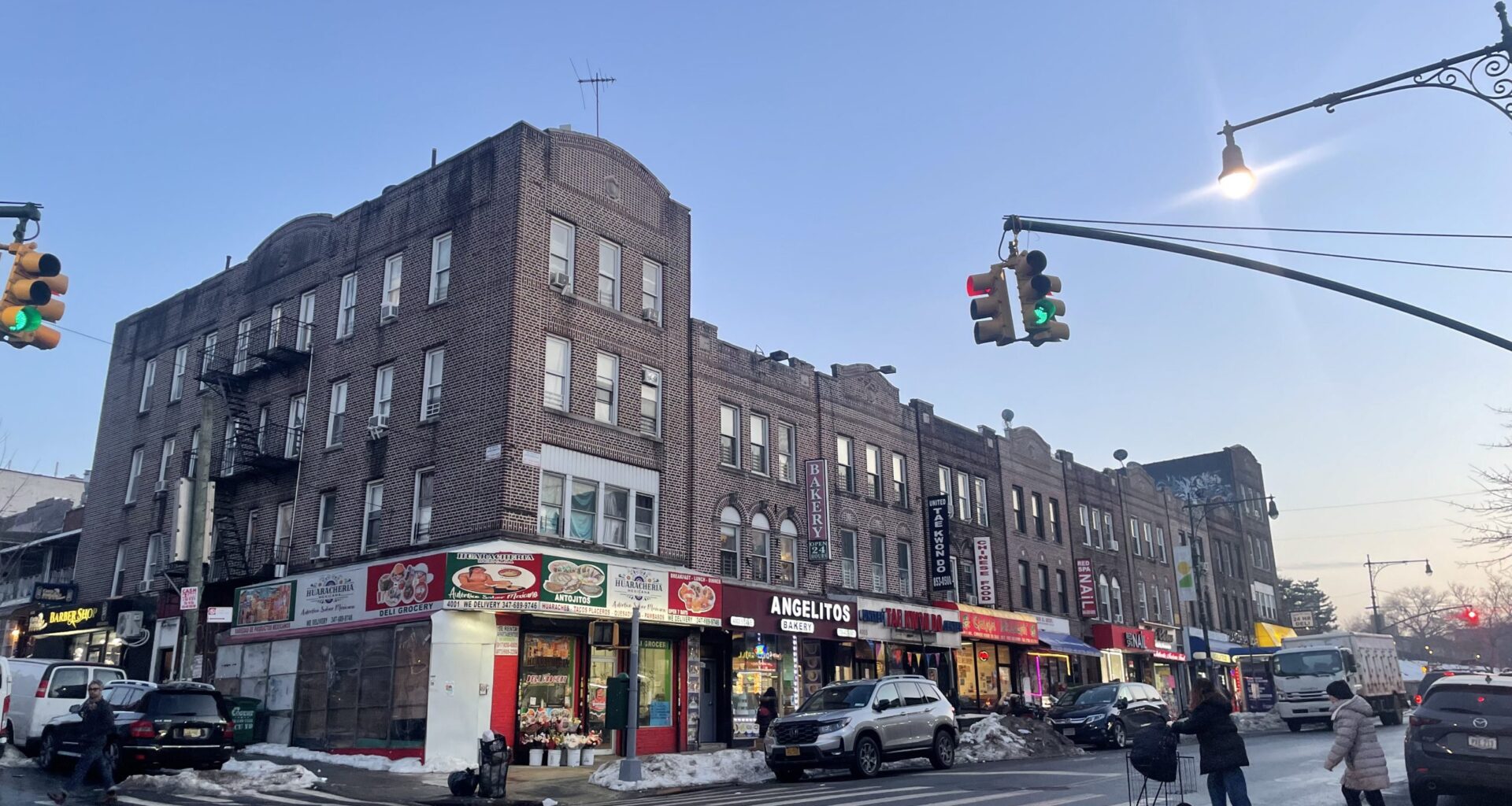
On warm summer afternoons, families gather on Sunset Park’s sloping lawns to share home-cooked dishes while children fly kites and play volleyball. Framing the horizon are cargo ships on the Upper New York Bay, the skyscrapers of Manhattan, and the Statue of Liberty. Taquerias line Fifth Avenue alongside Colombian bakeries, El Salvadoran and Ecuadorian restaurants, and Guatemalan groceries. A few blocks away on Eighth Avenue, Brooklyn’s first Chinatown bustles with activity.
For decades, Sunset Park in Southwest Brooklyn has been home to people seeking a foothold in the U.S. Its multigenerational, brick row houses tell the stories of working-class Latino and Asian families striving to build better lives in a city full of possibilities.
Yet beneath the neighborhood’s vibrancy lies a heavy environmental burden. On Third Avenue, traffic from the Brooklyn-Queens Expressway roars overhead and is a major source of air pollution. Along the gritty waterfront, aging and mostly idle power plants fire up during periods of high demand, releasing harmful pollutants into a community surrounded by factories and warehouses.
Because of the concentration of environmental hazards, the city government designated parts of Sunset Park as “disadvantaged communities,” areas that are disproportionately affected by pollution, poor public health outcomes, and climate risks.
The neighborhood is trying to rewrite that legacy.
Even in the face of the Trump administration’s attack on clean energy and climate programs, Sunset Park is home to a community-owned solar project and a major offshore wind assembly hub. These initiatives are the result of decades of grassroots organizing and community-driven planning—an alternative to the top-down development models that have reshaped other New York neighborhoods.
And unlike other areas that pushed to shut down industry, Sunset Park residents could not afford to walk away from the jobs that polluting industries create. Even after decades of neglect, the neighborhood’s waterfront remains one of New York City’s most significant maritime and industrial zones. Instead of totally abandoning that identity, the community has also pushed to preserve Sunset Park’s industrial character.
“It’s unfair for the community to choose between having to put food on the table and having to die from the emissions that come from these polluting industries,” said Elizabeth Yeampierre, who serves as the executive director of the Sunset Park-based environmental justice organization UPROSE.
With the help of organizations such as UPROSE, the focus in Sunset Park is to green the neighborhood, retrofit facilities, and direct resources to help businesses operate in a cleaner, less harmful way. But as large-scale green projects arrive, there are concerns about whether these developments align with community priorities or push working-class residents out.
A new vision for working-class residents
Known as Brooklyn’s oldest Latino community-based organization, UPROSE has served the neighborhood for around 60 years. Founded as the United Puerto Rican Organization of Sunset Park, it began as a social service agency. When Yeampierre, a civil rights lawyer, took the helm in 1996, the group shifted its focus to addressing environmental injustice. Yeampierre has deep roots in the community. Due to economic disinvestment in communities of color, her family moved from Red Hook, another historic port neighborhood in Brooklyn, to Sunset Park in the 1980s.
Under her leadership, UPROSE has fought the expansion of an expressway, blocked a power plant from being built, pushed for lead abatement legislation, and spearheaded efforts to plant hundreds of trees across the neighborhood. The organization’s office on 36th Street is also home to a center that connects Sunset Park residents to opportunities in the green economy.
In 2023, UPROSE released a 150-page community plan to decarbonize Sunset Park in a just and equitable way. Known as GRID 2.0, the plan outlines strategies to strengthen maritime and industrial development while integrating climate resilience, adaptation measures, and local workforce training.
The plan is the product of community consultations and organizing, and was spurred by residents after Superstorm Sandy battered New York City in 2012. “This is a comprehensive plan with a lot of layers that comes from over 10 years of community-based planning,” said Yeampierre, noting that residents know best where traffic and pollution are concentrated and where health burdens are the highest.
Yeampierre made clear that UPROSE only acts as the facilitator of the neighborhood plan.
“The community is made up of people working two or three jobs, raising two or three children, and they don’t have the same kind of time that Park Slope parents have to participate in doing this,” Yeampierre said, referring to the affluent, brownstone-lined neighborhood north of Sunset Park. “They trust we’re going to listen to them, we’re going to create something for them, and give it back to them so they can tell us we can move forward with it.”
For Julio Peña III, a Sunset Park resident and chair of Brooklyn Community Board 7, a volunteer group that advises the city on neighborhood issues, GRID 2.0 is a huge and complex proposal that has a real potential to make positive impacts in the community.
By 2035, Grid 2.0 envisions Sunset Park as a model for clean and inclusive economic development where working-class residents can live in affordable, energy-efficient housing; clean energy systems have replaced fossil-fueled plants along the waterfront; green streets help protect residents from heat and pollution; and locals are employed in sectors such as clean energy, urban agriculture, and green transportation.
To fully realize the vision of a just transition, UPROSE is advocating for Sunset Park to be designated as a “special purpose district” that has specific planning and urban design objectives. In the case of the neighborhood, a zoning overlay would control land use to prioritize green manufacturing and transportation corridors, and guide equitable economic development.
Solar and wind hub
One of GRID 2.0’s goals is to expand rooftop solar across the neighborhood—a vision that is already taking shape. The construction of Sunset Park Solar, New York City’s first cooperatively owned, community-led solar project, completed in November; about 95% of the project’s enrollment slots have been subscribed to.
Installed on the roof of the Brooklyn Army Terminal—a sprawling warehouse complex and former military supply base—the 725-kilowatt solar array will lower electricity costs for roughly 200 households and small businesses. Over its lifetime, the project is also expected to save participants about $1.34 million on their energy bills and offset 13,000 tons of greenhouse gas emissions.
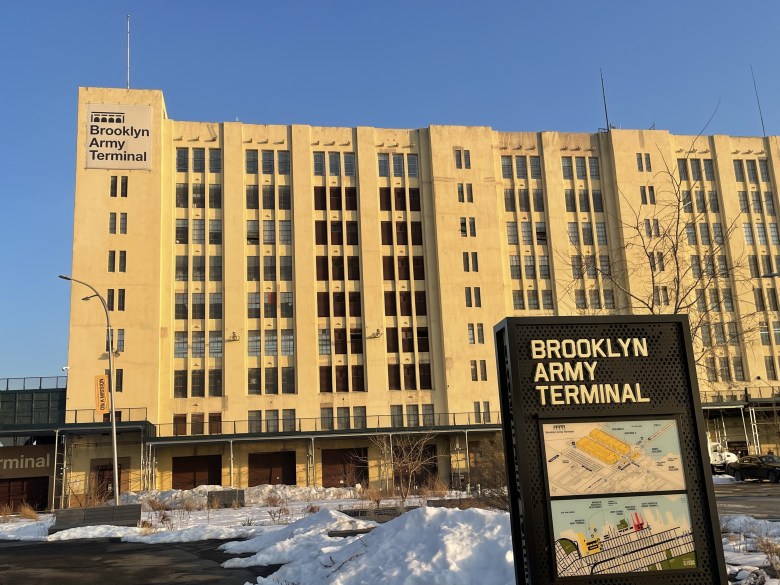 Brooklyn Army Terminal, a former military supply base, now hosts Sunset Park’s community-led solar rooftop project and a climate innovation hub. Credit: Gaea Katreena Cabico
The project offers a community-scale alternative to the Gowanus and Narrows fossil-fuel burning facilities. To prevent blackouts on the hottest summer days, these plants sit atop barges and are dispatched during peak demand. Although these plants run only a few days a year, they emit disproportionately high levels of pollution, including nitrogen oxide that can worsen respiratory conditions such as asthma.
The solar array is co-owned by UPROSE and Working Power, a developer and financier that partners with community-based organizations to build clean energy projects centered on economic and racial justice. Revenue from the project will flow into a community wealth fund, allowing residents to invest in projects they want to prioritize.
“The fact that the benefits go back to the neighborhood, that the community is going to save up to 25% on their bill is massive at a time when there are economic challenges and people can’t buy groceries,” Yeampierre said.
But community solar is just one piece of Sunset Park’s vision for a low-carbon future.
On the waterfront, a much larger energy transformation is taking shape: offshore wind. Sunset Park serves as the hub of Empire Wind, a project of Norwegian energy company Equinor. The turbines set to be installed off Long Island will be preassembled at South Brooklyn Marine Terminal in the neighborhood, while an onshore substation will connect 810 megawatts of wind power to the Gowanus substation.
“It is supporting alternatives to fossil fuel,” said Peña. “It’s creating jobs that are sustainable and that will be in demand. It creates really important skills for people to connect to that industry. It’s the exact thing that we’re looking for in this community and absolutely want to see more of.”
Empire Wind is expected to be the first offshore wind farm to deliver power directly to New York City. In 2019, the New York state passed a law mandating that 70% of the state’s electricity come from renewable sources by 2030 and that the grid be fully carbon-free by 2040.
Yet, natural gas still dominates New York’s electricity mix, and the state government is also looking to expand nuclear power to meet rising demand. The past year has also been particularly turbulent for offshore wind, with the Trump administration repeatedly blocking or intentionally delaying projects.
It is no secret that President Donald Trump despises wind farms, calling them “ugly” eyesores and claiming, without evidence, that they kill birds and whales, and cause cancer. Beyond attacks on wind and solar projects, the administration has rolled back environmental and climate protections, including repealing the endangerment finding, the legal basis for regulating greenhouse gases. Environmentalists said this move will increase planet-warming emissions and harm people’s health.
In December, the Interior Department ordered work to halt on Empire Wind and four other wind farms. But last month, a federal judge ruled that construction could resume, citing potential “irreparable harm” if the stop-work order remained in place.
Empire Wind has said that more than 1,000 people will be involved in the construction of the South Brooklyn Marine Terminal and the offshore wind farm, and the project will generate “substantial economic activity” in the neighborhood and beyond. Yet community advocates are wary. Yeampierre has raised concerns that “offshore wind is not looking like an environmental justice solution,” because it is unclear how many Sunset Park residents have been hired.
Equinor did not respond to Prism’s request for comment.
Unintended consequences
The environmental and climate justice victories that UPROSE helped secure have also had unintended consequences. As conditions in Sunset Park improve, developers are now marketing the neighborhood’s environmental gains—often accelerating gentrification and displacement in the process, Yeampierre told Prism.
“It’s almost like they’re telling us that in order to afford to live here, you need to live in an area that is surrounded by environmental stressors,” she said, “because the minute that you clean it up, the minute that you green it up and make it healthier, you won’t be able to live here anymore. The only people who deserve to live here are the privileged.”
Peña, who was born and raised in Sunset Park, describes the neighborhood as welcoming, with strong community ties and a dense ecosystem of small businesses. But over the past decade, he has watched wealthier, often white residents move to Sunset Park. “Folks who have been here all their lives are being pushed out and priced out because rents are so much higher [in addition to the] cost of maintaining homes,” he said.
Along the waterfront, the New York City Economic Development Corporation (NYCEDC)— which manages roughly 200 acres of city-owned land in Sunset Park, including Brooklyn Army Terminal and South Brooklyn Marine Terminal—is now in the early stages of planning BATWorks, a climate innovation hub for startups engaged in clean energy, zero-emissions transportation, and building decarbonization. But UPROSE argued that the project is moving forward without meaningful community input or consideration for GRID 2.0.
“There is no alignment when you’re helicoptering into a community that you’ve had no experience in and cementing yourselves as the decision maker in that community,” said Ahmad Perez, UPROSE’s infrastructure coordinator. BATWorks will be designed and operated by a consortium led by the Los Angeles Cleanteach Incubator (LACI) and the Cambridge Innovation Center (CIC).
LACI, a nonprofit backed by the city of Los Angeles, will advise on climate programming and run a pilot program allowing startups to test climate technologies in buildings.
“We believe BATWorks will become a thriving hub for the Sunset Park community—a place where cleantech solutions are tested and local workforce participants are provided with real opportunities to grow their careers,” said BATworks Senior Vice President Alex Mitchell in an email. “And businesses—whether scalable startups or local small businesses—grow and thrive as a result, creating economic opportunity for the community.”
CIC, meanwhile, will design the work and lab spaces. The City University of New York and New York University along with architecture firm Perkins&Will are also part of the consortium.
Peña agreed with UPROSE that the consortium is not reflective of the neighborhood. In response, a CIC spokesperson told Prism in an email that as a space and community operator, the company neither owns nor develops the buildings they operate and has no control over residential property markets, and that BATWorks seeks to “strengthen, not replace, Sunset Park’s working waterfront and industrial identity.”
BATWorks follows a familiar pattern, Yempierre said. She told Prism that what proponents of BATWorks are doing is “no different” from the transformation of Industry City.
Formerly known as Bush Terminal, Industry City is now home to tech firms, creative studios, and dozens of restaurants, after it was purchased by Jamestown, the developer behind the Chelsea Market food hall and shopping mall in Manhattan. In 2017, the developer proposed a major rezoning plan to add around 3.3 million square feet to the complex, but withdrew the application in 2020 after fierce opposition from local politicians, UPROSE, and other community groups over concerns that it would accelerate the area’s gentrification.
If they win, it’s not going to look any different than Williamsburg or Bushwick or Dumbo. It’s going to be homogenized: Both businesses and residents and the uses are going to be yoga, bagels, and beer.
Elizabeth Yeampierre, UPROSE executive director
“If they win, it’s not going to look any different than Williamsburg or Bushwick or Dumbo,” Yempierre said, referring to industrial Brooklyn neighborhoods reshaped by gentrification. “It’s going to be homogenized: Both businesses and residents and the uses are going to be yoga, bagels, and beer.”
NYCEDC disputes that framing. In a statement to Prism, the agency said that BATWorks will occupy existing vacant space at the Brooklyn Army Terminal, with no anticipated displacement of residents or industrial tenants. The project is projected to create around 600 green jobs, support 150 companies, and generate $2.6 billion worth of economic activity. The spokesperson added that NYCEDC and members of the consortium have also conducted outreach to stakeholders from Sunset Park and will continue to incorporate community feedback.
“In alignment with Grid 2.0 goals, and the city’s climate policies, BATWorks will connect New Yorkers—including residents in the Sunset Park community—to real economic opportunity while supporting green industrial growth, driving climate resilience along the South Brooklyn waterfront, and creating meaningful jobs and training opportunities in Sunset Park,” the NYCEDC spokesperson said in a statement. The organization also noted that NYCEDC has collaborated with UPROSE on various projects, including the community-owned rooftop solar and the offshore wind project.
UPROSE is not opposed to development, Yempierre said. But the community has its own plans for the neighborhood that must be respected, she said.
“Our people come from places where they had very little, and they come to the United States with this vision that they’re going to have white picket fence,” said Yempierre. But eventually, most realize the “American dream” is rooted in an “extractive capitalist system” built on marginalized communities such as theirs. “So we need to change that dream,” she said, adding that the dream needs to be reshaped by “people who come from struggle”—the working-class community of Sunset Park.
Editorial Team:
Tina Vasquez, Lead Editor
Lara Witt, Top Editor
Rashmee Kumar, Copy Editor
Related