
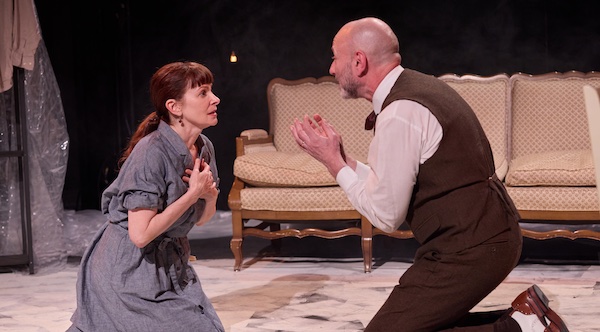
Warsaw. The Nazi invasion looms, and with it the decimation of Poland’s large and thriving Jewish population. A man is in a panic in a small apartment because “Vesuvius has erupted.” He dashes into the living room, lays a cello lovingly on the couch, continues flailing about. A bombing? No – a kitchen mishap. And a fiery, if comical, start to the world premiere production of Beneath the Ice of the Vistula.
Adam Kobylyansky (playwright Roman Freud in the performance I saw, alternating with Lev Grzhonko) is a secular Jewish composer and cellist who has left his religious community to join Europe’s progressive avant-garde. But clearly he can’t cook to save his life. When Lydia (three-time Emmy winner Cady McClain), a chipper, homespun Pole from the countryside, turns up in response to Adam’s ad for a cook and housekeeper, he hires her immediately. But Adam has an unusual requirement: Every three days without fail, Lydia is to shop for groceries, cook and clean, then leave and literally lock him in his apartment for three days so he can concentrate on composing a suite for cello.
Cooking up a Clash
And we’re off. Clashes of culture and personality seem inevitable between volatile Adam and optimistic, off-key folk-song-singing Lydia. But a bond develops that Freud’s story and Eduard Tolokonnikov’s staging illuminate with perspicacious sensitivity – and a good dose of humor that the cast, especially McClain, carries off beautifully (but which the mostly Slavic-language-speaking audience with which I attended didn’t seem to get or appreciate much of).
Beneath the Ice of the Vistula is essentially a two-hander. Brad Fryman makes brief appearances in dream sequences as several composers whom Adam idolizes. But it’s Freud and McClain who must shoulder this big play with its emotionally capacious story, and they deliver the sturdiness, fire, and multidimensional charisma it needs.
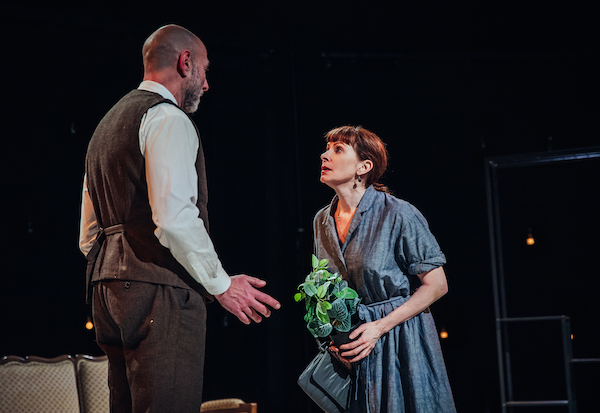 Roman Freud, Cady McClain (Alexandra Vainshtein)
Lydia is as much an artist as Adam – she in the kitchen, he in the music world. He consumes real food and drink on stage – no miming here, though I assume the “vodka” was water. (Indeed one of Lydia’s dishes was available for sampling during intermission.) He describes her cooking in effulgent poetic language. She identifies what’s missing from the music he’s been composing.
Appropriately, Innessa Zaretsky’s cello score encapsulates both Adam’s internal artistic struggle and the parallel external threat that’s closing in on Poland, on its Jewish community, and on individual Jews no matter how assimilated they consider themselves.
Adam is at first typical of the Jews who couldn’t imagine they’d be persecuted and murdered by the civilized Europeans they believed they had become. “To my colleagues, I’m first and foremost a musician, a human being, and only at the very end – a Jew,” Adam declares. “And that’s how it should be in the modern world.” As the evil side of that world manifests, Adam grows not only more delusional but irrationally self-absorbed – ironically fueled by his and Lydia’s deepening relationship. This is indeed a complex story, spun and played adroitly – and with something like the inevitable force of history.
Beneath the Ice of the Vistula, a presentation of Five Evenings Theater and New Wave Arts, is at the West End Theatre on West 86 St., Manhattan, through February 28, 2026.