
Ordinarily, one would not suspect that three established environmental groups would be in court to stop the city’s plans to treat stormwater contaminated by sewage.
But in a suit filed in Queens Supreme Court this week, Guardians of Flushing Bay, Riverkeeper, Inc. and Save the Sound say the Department of Environmental Protection’s supporting environmental study for two chemical treatment facilities in Flushing was not rigorous enough.
They also say the DEP did not consider alternative methods; and that the chosen one of chemical-based decontamination may cause harm to the environment and wildlife in and near Flushing Creek and Flushing Bay.
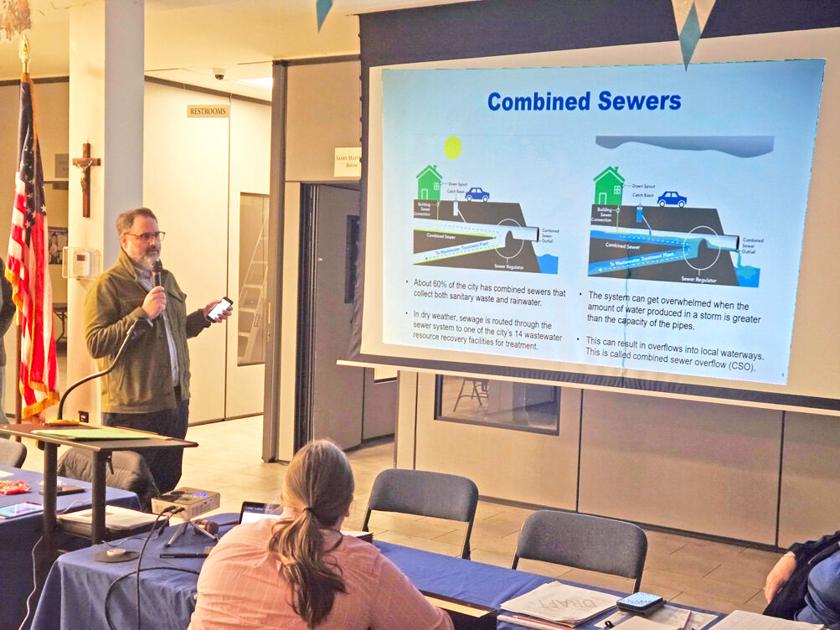
When rain in New York City is heavy enough to overwhelm the stormwater system, the water can go into the sewage overflow part of the system, which mingles the water with untreated effluent.
That can mean 1 billion gallons of untreated water each year being discharged out into city waterways, including Flushing Creek and Bay.
The city’s Law Department in an email to the Chronicle said the case is under review.
The DEP is proposing a site on Avery Avenue that would disinfect the effluent with chlorine-based chemicals before it would be sent downstream to a plant by 32nd Avenue, College Point Boulevard and the Whitestone Expressway that chemically removes the chlorine before the effluent is discharged into the creek and ultimately to the bay.
During a presentation to Community Board 7 last November, the DEP said its environmental assessment statement included a negative declaration in regard to potentially harmful environmental impacts of the decontamination.
The question-and-answer followup was lengthy and animated, with most speakers from the board and the audience in opposition.
CB 7’s Environmental Committee, which had seen the presentation days earlier, voted 12-3 to reject the proposal. Board 7 approved the DEP’s plan by a vote of 21-20,
In a joint statement, the environmental groups said a more stringent environmental impact statement study must be conducted and more long-term solutions be considered.
“New York City cannot solve a billion-gallon sewage problem by simply adding chlorine to it,” said Mike Dulong, Riverkeeper’s Legal Program Director. “This plan does nothing to reduce the actual volume of sewage and trash entering Flushing Creek, and it introduces new chemical risks to an already overburdened waterway.”
Dara Illowsky, a New York staff attorney for Save the Sound, said even residual levels of chlorine and other chemicals that could be released pose a threat.
“DEP must complete an Environmental Impact Statement to examine these and other potential impacts, and also to consider alternatives that actually reduce [combined sewer overflows] in Flushing Creek,” Illowsky said.
Rebecca Pryor, executive director of Guardians of Flushing Bay, also said there must be efforts that make the water clean.
“Instead, the City’s plan creates new risks without reducing the volume of sewage and trash pollution pouring into Flushing Creek,” Pryor said. “The plan fails New Yorkers of all stripes — from local Queens residents to migrating birds to native wetland grasses. We call on the City to do the right thing: conduct a robust study of the impacts of this project and assess discharge reduction solutions.”
The court complaint, dated Feb. 15, asks that the DEP’s negative declaration be vacated or annulled, and that the agency be ordered to conduct an EIS.