
“In southern Italy, where my grandparents had lived, there were few opportunities. The society was static, with rigid social classes. Poor people, like my grandparents, had little chance to improve their lives, no matter their talents or willingness to work,” said Supreme Court Justice Samuel Alito.
Justice Alito should know. His parents had roots from Roccella Ionica, (Greek name for Ionia) Calabria, and Palazzo San Gervasio in Basilicata (Greek name for royal) in Southern Italy. I often heard of the Greek speaking villages of Southern Italy that refused to assimilate and remembered their Greek roots. I had the unique opportunity of visiting Magna Grecia, Southern Italy on a Tsioros excursion that presented the Greek viewpoint, not a globalist perspective, this past summer.
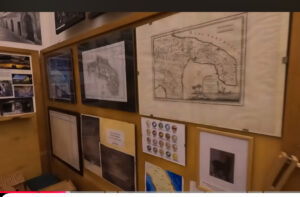
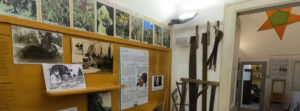
Calimera, is a small town in the Grecìa Salentina area of the Salento peninsula in the region of Apulia (Puglia), Italy. As we passed through the streets, we saw Greek names. Kalos Irthate (Welcome) and Greek Flags are prominently displayed. No graffiti, homelessness, or garbage in the streets. Our guide, Dimitrios Mitsopoulos, in fluent Italian, took our group to the House-Museum of Peasant Civilization and Griko Culture. The history and culture of the Salentine Greek area is preserved. Greek origins of the community are shown. Agricultural tools, domestic objects describing the work of craftsmen, traditions and publications describe the cultural origins of Griko Salentine towns.
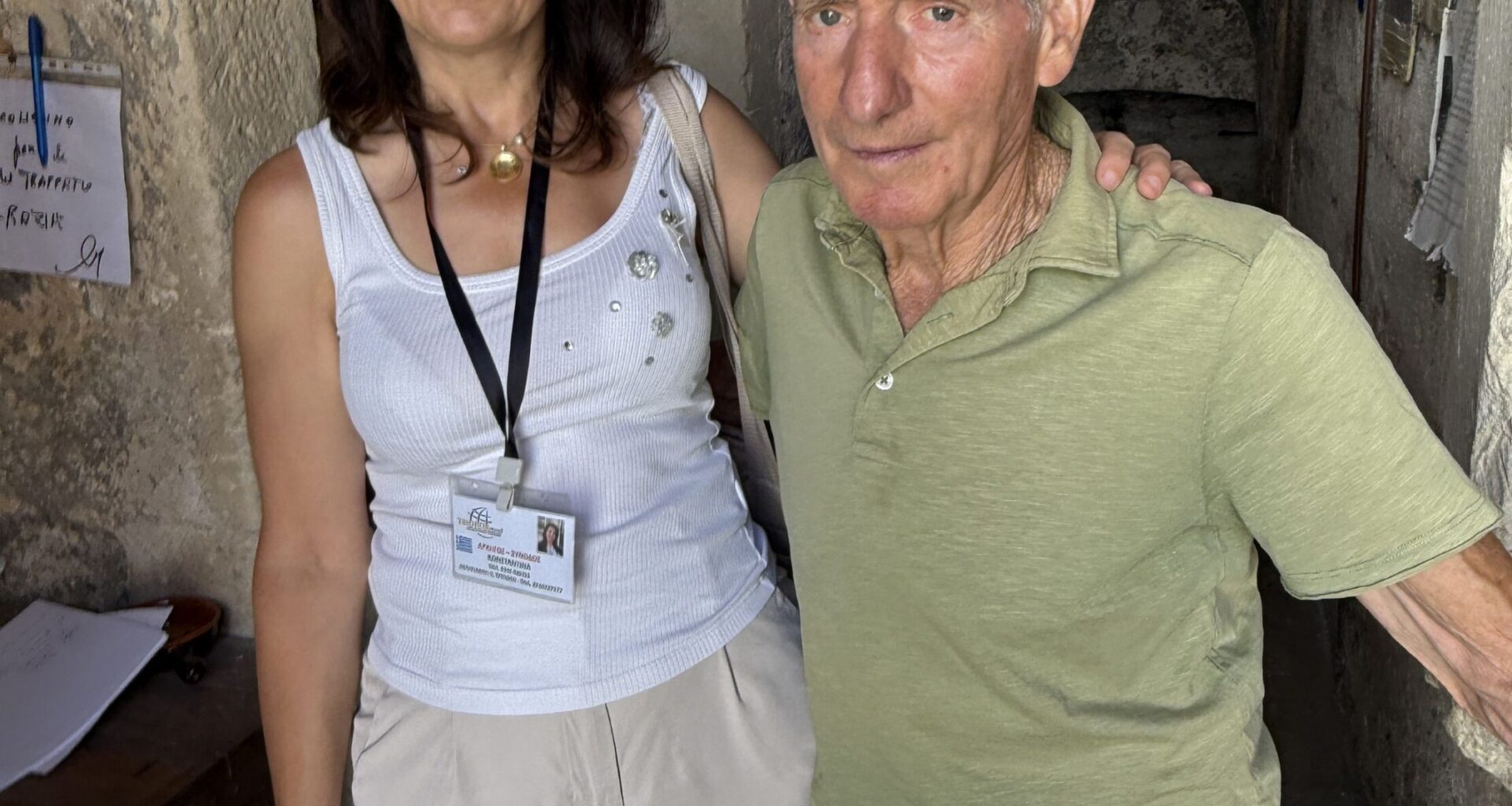
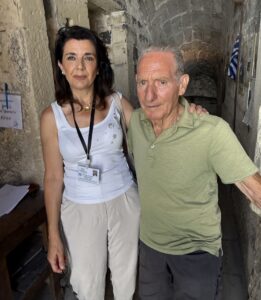
Mr. Gaetano, president of the Sternatia Church of St. George, described the background of Sternatia. “St. George Church of Sternatia had 13,000 people once,” explained Mr. Gaetano. “We believe strongly in holding on to the Modern Greek language. The Greek language is important to us first.” He is a retired 78 year old farmer who conversed to us in modern Greek. “The life of the farmer is hard. We get up at dawn and come home very late in the day. Hard, rigorous life with little money. We endure. Our families, country and keeping our Greek language alive is what we live for.” He recited these sentiments in an emotional poem of the Griko people.
The South is part of Magna Graecia, the historical Greek-speaking area of southern Italy. It encompassed the modern Italian regions of Calabria, Apulia, Basilicata, Campania, and Sicily. These regions were extensively settled by Greeks beginning in the 8th century BC. The settlers brought with them Hellenic civilization. This left a lasting imprint on Italy, including on Roman culture. Starting in the 8th century BC, Dorians, Achaeans, Messinians, and Cretans colonized and settled the eastern coasts of southern Italy, the heel of the boot of Italy, and Sicily. They built numerous Greek cities and earned this part of the ancient world the name Magna Graecia.
During the Early Middle Ages, new waves of Greeks came to Magna Graecia from Greece and Asia Minor, as Southern Italy remained part of the Eastern Roman Empire —Byzantium—after the fall of the Western Empire to the barbarians. When Byzantium fell a millennium later with the Ottoman conquest of Constantinople, large numbers of Greeks relocated to Venetian-controlled territories.
To this day, an ethnic minority called the Griko people reside within the borders of ancient Magna Graecia. The origin of the Griko dialect is a subject of debate, with two main theories offered. One suggests it originated from the Hellenistic Koine and was brought to Salento by Greek immigrants during the Byzantine era. The other proposes that it evolved locally from ancient Doric Greek. This distinct Greek dialect even managed to survive the end of the Byzantine era and evolve into a modern language. Although it differs from the standard Modern Greek spoken in Greece, it remains comprehensible to Greek speakers. In 1999, the Italian Parliament recognized the Griko community as a Greek ethnic and linguistic minority. Despite being officially Italian, residents of Greek-speaking villages identify strongly with their Greek heritage.
Until World War II, Griko, preserved through oral tradition by illiterate shepherds and farmers, was the primary language spoken. Italian became dominant post-war, but Griko teaching resumed in local schools in 1999, though later declined due to migration and lack of funding. The Greek government used to send teachers to the area but stopped in 2005 due to the economic crisis and waning interest. Today, around twenty thousand Greek speakers remain, most of them elderly. However, Griko, which is included in UNESCO’s Red Book of Endangered Languages, attracts interest as a pure and isolated version of Greek.
Efforts to preserve it have included the setting up of societies like the Union of the Towns of Grecia Salentina, promoting research, teaching, and publishing in Griko. EU initiatives like “Pos Màtome Griko” aim to teach Griko language and culture to both adults and children. Cultural associations like “Asteria” use music, dance and poetry to keep the dialect and culture alive, with some still create songs and poems in Griko.
In 2022, Greek President Katerina Sakellaropoulou visited several Greek-speaking villages in Salento to commemorate the 20th anniversary of the founding of the Union of Municipalities of Grecìa Salentina. Roberto Casaluci, the President of the region’s Union of Greek-Speaking Communities welcomed her warmly, saying how honored the community was by her presence and stressing the enduring connection between the Greek people and the region.”
Why is Southern Italy the poorest area of the country? There are political, economic, cultural factors. Justice Samuel Alito’s quote in the first paragraph describes the reasons for mass emigration. This was in the past. Everything is changing in Puglia. In the summer of 2025, when we visited, there was a big tourism boom. “In 2025, Puglia became one of the most popular tourist destinations in Italy and even in 2024 it exceeded 20 million tourists, with a sharp increase in foreign tourists. But how did it happen? This success is not the result of chance. In fact, the Puglia region began to invest in its tourism promotion about ten years ago, developing a strategic territorial marketing plan which, over time, has led to these results, making it a tourist destination of excellence.”
My deep appreciation to the exceptional work of Kosta Tsioros and Maria Papalou, owners of Tsioros Travel and Guide Konstandina Savvopoulou, as well as Kosta Tsioros and Maria Papalou, owners of Tsioros Travel who worked one year with us. Our fellow tourists from Canada, George Paraskevakos, Christina and Constantine Vastis, John and Georgia Colovos were examples of the finest excursion tourists. Also our Italian guide Dimitrios Mitsopoulos, who has a university education from Italy. He knows excellent Italian, communicating with Museum President Guiseppi with real feeling. He used WhatsApp to communicate with us. We were lucky to have Guide Dimitri to show us the soul of Salento, the last remnant of Mana Grecia.
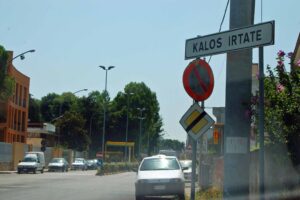
Greek sign in Calimera, Puglia.
House-Museum of Peasant Civilization and Griko Culture, Calimera, Puglia.
House-Museum of Peasant Civilization and Griko Culture, Calimera, Puglia.
Guide Konstandina Savvopoulou with Mr. Gaetano at the House-Museum of Peasant Civilization and Griko Culture, Calimera, Puglia.