
It’s the most cutthroat twist in RuPaul’s Drag Race history. The contestants rank each other from best to worst, while the judges have a relaxing kiki. But how does the Rate-A-Queen twist actually work?
MTV and the Drag Race producers have never revealed the specifics of the voting method used on the show, but two data scientists believe they have decoded the exact mechanics. And they have the receipts.
Chris Hughes, senior director of policy at the Ranked Choice Voting Resource Center, and Chris Donnay, data scientist at Ikigai Labs, are part of a nonprofit whose mission is to help make ranked choice voting elections successful. They were surprised when “no one on the internet” seemed to have looked into the Rate-A-Queen twist, which was first introduced at the beginning of Season 16 and recently returned during a two-week arc in Season 18.


“The election method used on their rankings is Borda,” Donnay confidently tells Gold Derby. “Borda elections assign points to different ranking positions. For example, on Night 1 when six queens were ranked, a queen ranked in first position gets 6 points, in second position gets 5 points, down to sixth place gets 1 point. You can see how many total points the queens got in the charts below. Highest points wins.”
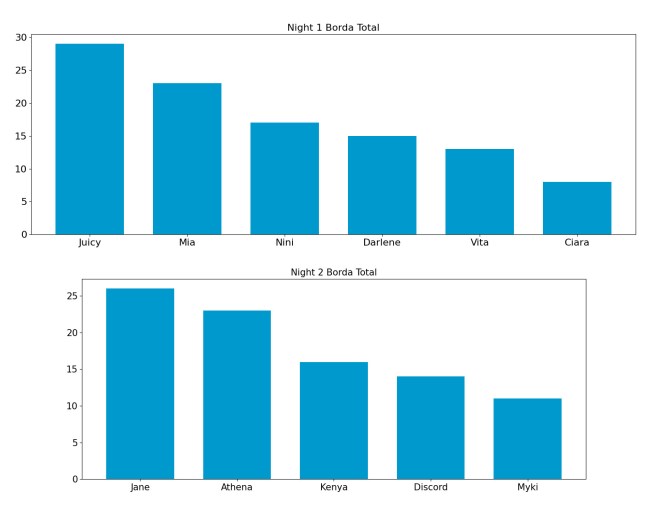 Rate-A-Queen ChartsGold Derby
Donnay explains, “You see some fun examples of strategic voting going on with the queens, particularly when Ciara Myst tries to ensure Discord Addams is her competitor for the elimination lip sync.” He adds, “A lot of other election methods agree with the top two queens from each night, but differ in how they rank the rest of the queens. This is why we’re confident it is Borda.”
Donnay and Hughes believe that Borda was also used in Season 17, since Drag Race “released all of the ranking data” for that cycle as well. However, “We’re not sure if they used Borda in Season 16 or in All Stars 10, since they never showed the queens’ individual rankings.”
Viewers of Netflix’s The Circle were already familiar with a similar voting method, as contestants live and die by the rankings of their fellow players. RuPaul’s Drag Race choosing a pink triangle for its logo is a fun wink to that show’s circular calling card. But Donnay and Hughes don’t know with 100 percent certainty that Borda is being utilized on The Circle, because it has “never released enough data.”
 ‘RuPaul’s Drag Race’ Rate-A-QueenMTV
Below, we dive a bit deeper into RuPaul’s Drag Race’s controversial Rate-A-Queen twist.
Gold Derby: What interested you in investigating the voting method to begin with?
Chris Hughes: I work on ranked choice voting and structural election reform, so any time someone is using a ranking method, I’m interested! Also because I work on reforms to elections for public office, I expect results and information about the counting process to be public and transparent — that builds trust in elections. So the fact that RPDR was not telling us how all the rankings got counted made me curious (and a little bit skeptical). I ran into Chris Donnay at a conference last fall and we got to talking about Drag Race and, being the people we are, wound up talking about Rate-A-Queen and how all the math of that works.
Chris Donnay: I used to work in the Data and Democracy Lab at UChicago, where we studied how to apply tools from data science to questions about democracy. One of the things that surprised me when I first started in the area was how many different types of ranked choice voting methods there are. So when Drag Race started using a ranked choice twist, I got super excited to learn which it was. The Lab sent me to a conference in Portland where I met Chris, and the rest is herstory!
Some of the queens say that the Rate-A-Queen twist is not fair. What is your expert take on that aspect?
Hughes: I think it can be, based on how the queens vote. I think the Night 1 results are fair. I’m not sure the Night 2 results are. That reflects how differently the two groups of queens voted — I’d argue Night 1 queens were judging mostly on the quality of the talent and how entertaining they found each show. The Night 2 queens were less consistent — there was more of a mix of judging the talent, weighing personal relationships, following through on alliances, and strategizing around who they wanted to wind up in the bottom/Lip Sync For Your Life.
I don’t think that means the Night 2 results are worse. Is the point of a reality competition show twist to be fair? Or is it to entertain you? The best way to get fair results is for queens to vote honestly, like they did on Night 1. But I don’t know if the show is built to get them to vote honestly. Queens can vote for who they thought did the best job but, especially when the twist gets thrown at them in the middle of the season and votes are gonna be public, there’s a whole other set of things for them to consider. They include their personal relationships with their fellow competitors (consider the Miami queens), their professional relationships going forward, and their storylines on the show so far.
Donnay: I think fairness is in the eye of the beholder! What we know was fair about the Rate-A-Queen twist was that the queens got to choose how to rank the others, and those rankings were converted to a winner and loser in a transparent way. Whether or not those rankings reflected the talent show … well, probably not. But that doesn’t make it unfair. It’s a competition after all.
If you could rate the best queens on Night 1 and Night 2 of Season 18, who would get your votes?
Hughes: Night 1 would be Mia Starr, and Night 2 would be Jane Don’t.
Donnay: Night 1 would be Juicy Love Dion, and Night 2 would be Jane Don’t.
For the record, that pretty much aligns with the overall results, with Juicy and Jane earning the most points on their nights.
Hughes: I think it’s a great twist! And I think it’s even better deployed in the middle of the season because there’s that much more for each queen to consider.
RuPaul’s Drag Race Season 18 airs Friday nights on MTV.