
Agency Preparations
Division of Homeland Security and Emergency Services
The Division’s Office of Emergency Management is in contact with its local counterparts and is prepared to facilitate any local requests for assistance. State stockpiles are ready to deploy emergency response assets and supplies as needed. The State Emergency Operations Center will be activated beginning Sunday and the State Watch Center, New York’s 24/7 alert and warning hub, is monitoring the storm track and statewide impacts closely. The State Fire Operations Center has also been activated.
Department of Transportation
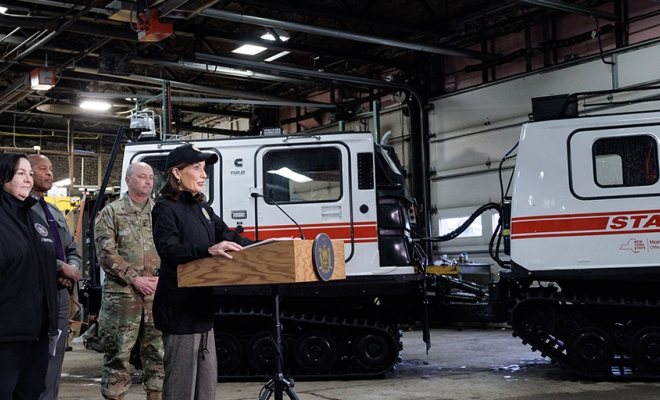
The State Department of Transportation is monitoring weather conditions and prepared to respond with 3,737 supervisors and operators. Regional crews are currently engaged in snow and ice response and preparation activities. All residency locations will remain staffed for 24/7 operations throughout the duration of the event and priority cleanup operations.
All available snow and ice equipment is ready to deploy. Fleet mechanics in affected areas will be staffing all main residency locations 24/7 to perform repairs and keep trucks on the road. To support response activities in critical areas, three loader-mounted snow blowers are being deployed to the Long Island Region.
To support critical snow and ice operations in the Hudson Valley and on Long Island, 127 staff will be deployed from other regions as follows.
Capital Region: sending 4 operators to the Hudson Valley and 4 operators to Long IslandMohawk Valley: sending 4 equipment operator instructors to the Hudson Valley and 21 Operators and 3 Supervisors to Long IslandCentral New York: sending 2 equipment operator instructors to the Hudson Valley and 16 operators and 2 supervisors to Long IslandFinger Lakes: sending 14 operators, 1 supervisor and 2 equipment operator instructors to the Hudson ValleyWestern New York: sending 12 operators and 2 supervisors to the Hudson ValleyWestern Southern Tier: sending 10 operators and 1 supervisor to the Hudson ValleyNorth Country – sending 2 equipment operator instructors to the Hudson Valley and 16 operators and 2 supervisors to Long IslandEastern Southern Tier – sending 8 operators and 1 supervisor to Long Island
In total, the Hudson Valley region is receiving 40 operators, 4 supervisors, and 10 equipment operator instructors (54 total staff).
In total, Long Island is receiving 65 operators and 8 Supervisors (73 total staff).
A previous deployment of 3 loader-blowers to Long Island has already been executed.
Statewide equipment numbers are as follows:
1,642 large plow trucks (Hudson Valley: 259, Long Island: 254)149 medium duty plows (Hudson Valley: 35, Long Island: 19)56 tow plows (Hudson Valley: 3, Long Island: 1)334 large loaders (Hudson Valley: 51, Long Island: 35)33 snow blowers (Hudson Valley: 1, Long Island: 1)
The need for additional resources will be re-evaluated as conditions warrant throughout the event. For real-time travel information, motorists should call 511 or visit www.511NY.org, New York State’s official traffic and travel information source.
Thruway Authority
The Thruway Authority is ready to respond with 691 operators and supervisors available. Statewide equipment numbers and resources are listed below:
345 large and medium duty plow trucks11 tow plows62 loaders105,000+ tons of salt on hand
Variable Message Signs and social media (X and Facebook) are utilized to alert motorists of winter weather conditions on the Thruway.
Drivers are reminded that Thruway snowplows travel at about 35 miles per hour — which in many cases is slower than the posted speed limit — in order to ensure that salt being dispersed stays in the driving lanes and does not scatter off the roadways. The safest place for motorists is well behind the snowplows where the roadway is clear and treated.
The Thruway Authority encourages motorists to download its mobile app which is available for free on iPhone and Android devices. The app provides motorists direct access to real-time traffic information, live traffic cameras, and navigation assistance while on the go. Motorists can also sign up for TRANSalert e-mails and follow @ThruwayTraffic on X for the latest traffic conditions along the Thruway.
Department of Public Service
The New York State Department of Public Service remains engaged with the regulated electric and gas utilities to ensure adequate preparations are being made for the winter coastal storm system. The Department’s priority remains on safeguarding reliable and resilient electric service for New Yorkers throughout this storm by maintaining regulatory oversight of the utilities’ preparedness and response to any outages that may occur.
New York’s utilities currently have approximately 5,600 workers available statewide to engage in damage assessment, response, repair, and restoration efforts across New York State. Utility crews are prepared to respond in these adverse conditions and are implementing resource plans, including shifting resources to support areas anticipated to receive the greatest impact. Department staff will continue to track utilities’ work throughout the event.
The Department has additional information available on Winter Preparedness, including Winter Safety and current consumer protections available at: Winter Preparedness | Department of Public Service. The public is encouraged to contact the Department’s Office of Consumer Services for complaints or concerns regarding their utility Contact Us | Department of Public Service.
New York State Police
State Police is closely monitoring the forecast and coordinating with our state and local partners as winter weather moves into New York. Extra patrols will be added to affected areas as the storm intensifies, and specialized units and equipment are staged and ready to respond to any weather-related emergencies.
Department of Environmental Conservation
The Department of Environmental Conservation’s (DEC) Emergency Management staff, Environmental Conservation Police Officers, Forest Rangers, and regional staff remain on alert and continue to monitor weather forecasts. Working with partner agencies, DEC is prepared to coordinate resource deployment of all available assets, including first responders, to targeted areas in preparation for potential impacts due to extreme temperatures, high winds, freezing rain, snow, and ice.
DEC reminds those responsible for the removal and disposal of snow to follow best management practices to help prevent flooding and reduce the potential for pollutants like salt, sand, oils, trash, and other debris from affecting water quality. Disposal of snow in local creeks and streams can create ice dams, which may cause flooding. Public and private snow removal operators should be aware of these safety issues during and after winter storms. Additional information is available at Division of Water Technical and Operational Guidance Series: Snow Disposal.
Hiking Safety
Hikers are advised to temporarily avoid all high-elevation trails, as well as trails that cross rivers and streams during major storm and extreme cold weather events. Hikers are encouraged to check DEC’s webpages for updates on trail conditions, seasonal road closures, and general recreation information. Unpredictable winter weather and storms in the Adirondacks, Catskills, and other backcountry areas can create unexpectedly hazardous conditions.
Visitors must be prepared with proper clothing and equipment for snow, ice, and cold to ensure a safe winter experience. Snow depths range greatly throughout the Adirondacks, with the deepest snow at higher elevations in the High Peaks region and other mountains over 3,000 feet. Lower elevation trails have mixed conditions of snow, ice, and slush including many trails in the Catskill Mountains where the potential for icy and dangerous trail conditions exist.
In an emergency, call 9-1-1. To request Forest Ranger assistance, call 1-833-NYS-RANGERS. While some waterways may appear frozen, anyone venturing on waterbodies should review ice safety guidelines before heading out.
Office of Parks, Recreation and Historic Preservation
New York State Park Police and park personnel are on alert and closely monitoring weather conditions and impacts. Response equipment is being fueled, tested and prepared for storm response use. Park visitors should visit parks.ny.gov, check the free NY State Parks Explorer mobile app or call their local park office for the latest updates regarding park hours, openings and closings.
Metropolitan Transportation Authority
The MTA is closely monitoring weather conditions to ensure safe, reliable service. MTA employees will be poised to spread salt, clear platforms and stairs where ice exists, and keep signals, switches, and third rail operating and attend to any weather-related challenges.
Customers are encouraged to check the MTA app, TrainTime app or mta.info for real-time service updates before traveling. Customers should also sign up for email or text service alerts.
Port Authority of New York and New Jersey
The Port Authority of New York and New Jersey is closely monitoring weather forecasts and is working with airport terminal operators and other airport partners in preparation. Air travelers should check with their airlines for updated information on their flights or check the Federal Aviation Administration website for any FAA programs that may affect flight operations at their departure airport before leaving for the airport and allow for additional travel time. Motorists who use the Port Authority’s six bridges and tunnels are strongly encouraged to sign up for email alerts, bus riders can use the MyTerminal app for real-time alerts on bus service at the Midtown Bus Terminal, or for PATH riders, check train service information via the PATH mobile app, RidePATH. To view the latest updates on service changes at Port Authority facilities, click here.