
Last week, we published The Athletic’s top 150 free agents for the 2026 offseason, including detailed scouting reports, contract projections and key statistics for all players.
That was a good exercise to stack this year’s free-agent class on a player-by-player basis. Now we want to take a look at the class from a different angle and assess the strengths, weaknesses and trends of each position group. Which positions are top-heavy? Which have the most depth? Where can teams find value? And what do these positional indicators show us about the league at large?
Below, we have the top 10 from each position. Because this year’s class is thin at center, we grouped centers and guards into one group for the interior offensive line. Ages are as of the projected season opener on Sept. 9. Overall ranks from the top 150 are in parentheses.
All salary and cap figures courtesy of Over the Cap.
Quarterback
Quarterback is always a fascinating position in free agency because the range of outcomes is enormous. Every year, there is value to be found in this market. Some of the highest-upside contracts in the sport are produced when quarterbacks sign bridge deals and perform well as starters. Baker Mayfield’s one-year, $4 million deal with the Tampa Bay Buccaneers in 2023 is one example. Sam Darnold’s one-year, $10 million deal with the Minnesota Vikings in 2024 is another. Last year, Daniel Jones’ one-year, $14.5 million deal with the Indianapolis Colts was the case study.
Shopping in the mid-market provides less upside. There are success stories, like the Super Bowl-champion Seattle Seahawks signing Darnold at a $33.5 million average per year last offseason. But there are also cautionary tales, like Kirk Cousins’ $45 million APY deal with the Atlanta Falcons and Derek Carr’s $37.5 million APY deal with the New Orleans Saints.
In this year’s class, there are players in both of those buckets. Even coming off a torn Achilles, Daniel Jones has positioned himself for a contract in the $40 million to $44 million APY range — though he will most likely return to Indianapolis. Malik Willis is the most interesting player in this class. The sample size of film is very small, not even two full games in 2025. But that film is very intriguing. Because the options are thin at this position, Willis should get a chance to start and exceed $20 million APY on his deal. He presents this most obvious opportunity for contract upside.
Aaron Rodgers and Joe Flacco are the best veteran options available for teams in need of a starter. Mitchell Trubisky is one name to watch in this market. The No. 2 pick in 2017, he started 50 games for the Chicago Bears over his first four NFL seasons. He got a bridge opportunity with the Pittsburgh Steelers in 2022 but was benched early that season for Kenny Pickett. Trubisky got a chance to play basically a full game for the Buffalo Bills in Week 18 this past season. The film was pretty solid. If a team is looking for the high-upside, low-risk one-year quarterback deal in the vein of Mayfield, Darnold and Jones, Trubisky is the optimal candidate this year.
We could see this market expand if teams part ways with quarterbacks on expensive deals, like Tua Tagovailoa in Miami, Kyler Murray in Arizona and Geno Smith in Las Vegas.
Running back
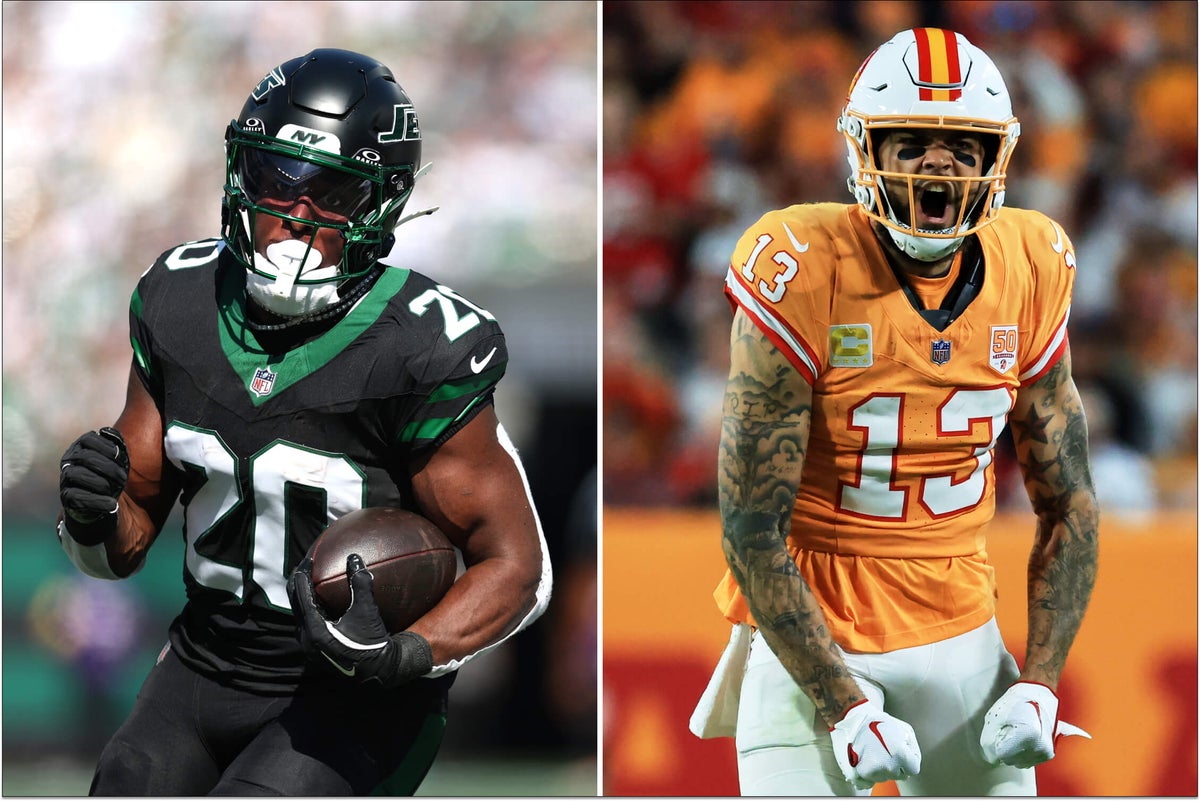
Running back is the strongest position in this year’s class, with exciting options at the top of the market and viable options through the middle. Breece Hall and Kenneth Walker III are game-changing talents. We will see if they actually end up hitting free agency. Both feel like franchise-tag or transition-tag candidates. The running back franchise tag is $14.5 million for 2026. That is a palatable cap hit for both players, though the tag is more often used as a mechanism to extend the shelf life of negotiations. The transition tag, which allows the player to negotiate with other teams while allowing their original team to match any deal, is $11.7 million.
For our rankings, Travis Etienne is also in a premium tier with those other two players. After him, the backs stack up relatively closely, and how the market shakes out will depend on what flavor each team is looking for. You have your physical bruisers like Rico Dowdle and Tyler Allgeier. You have a well-rounded doubles hitter in Rachaad White. You have a receiving-focused back in Kenneth Gainwell. There is value in this range of the market. A lot will come down to fit.
Javonte Williams was on our initial top 150 but does not appear above because he re-signed with the Dallas Cowboys this week.
Wide receiver
Shopping at the top of the receiver market in free agency can be a dangerous game. True No. 1 receivers almost never hit the open market. They are either signed to extensions or franchise-tagged. George Pickens, for example, would have been the No. 2 player in this entire class, but the Cowboys are planning on tagging him before the March 3 deadline.
Teams are usually left with solid No. 2 options whom they have to pay like No. 1 options to beat out other interested parties. That happened most recently in 2024 with Calvin Ridley and the Tennessee Titans. At the time, Ridley’s $23 million APY ranked in the top 10 at the position. He has 1,320 receiving yards combined over the two seasons since signing that deal.
This is my primary concern with Alec Pierce. He is a young, ascending player with a bright future. But will he provide a viable return on investment for a deal that could settle between $25 and $30 million in APY?
The better deals are in the mid-market, like Cooper Kupp’s $15 million APY deal with the Seahawks last offseason. There are some younger players with upside in this class, like Romeo Doubs, Jalen Nailor and Calvin Austin III. Nailor is one of my favorite free agents across all positions.
Tight end
This is a quality group of free agents with a diverse blend of skill sets. Teams looking for veteran pass-catching tight ends will, as of now, have plenty of options, including Dallas Goedert, Travis Kelce, Tyler Higbee, Noah Fant, David Njoku and Darren Waller. There is also a young collection of explosive playmakers, including Kyle Pitts, Chig Okonkwo and Isaiah Likely.
We tried to give some love to the blocking tight ends in our top 150. Charlie Kolar is the best blocker in this class, and he also has upside as a receiver. Other solid blockers who made the 150 included Adam Trautman and Austin Hooper, though they did not crack the top 10 at the position. The tight end class this year has a flavor for every taste.
Offensive tackle
Starting-caliber offensive linemen who hit free agency get paid. Demand is high. Supply is low. It is basic economics. This is especially true of starting-caliber tackles who hit free agency. Last offseason, the Titans gave Dan Moore Jr. a four-year deal worth $20.5 million per year. Most often, starting-caliber tackles do not hit free agency unless they are older and/or regressing.
It is a thin group. It will get thinner if the top three players — Rasheed Walker, Jermaine Eluemunor and Braden Smith — re-sign with their current teams. Banking on finding a starting tackle in free agency — particularly on the left side — is a high-risk strategy. However, there could be some functional options. Fred Johnson at right tackle is one. Jamaree Salyer at left tackle is another.
Interior offensive line
Is new Baltimore Ravens coach Jesse Minter really going to let a quality starting center walk out the door ahead of his first season? We will see. The Tyler Linderbaum sweepstakes might never even begin if he re-signs with Baltimore. Behind Linderbaum, the center market is top-heavy and lacking depth. Including Linderbaum, I gave out only four average starter or above grades at this position. Connor McGovern is a good player, but he could end up back in Buffalo.
The guard market, meanwhile, was thrown totally out of whack by the Aaron Banks deal last year with the Green Bay Packers. Banks is a below-average starter who signed for $19.25 million per year. As above-average starters like Isaac Seumalo, Zion Johnson and David Edwards hit the open market, they should be pointing to that Banks deal as a starting point. The guard market could get even wilder this year. Stay tuned.
Interior defensive line
John Franklin-Myers is by far the best pass rusher in this group, and that should be represented in his contract. Behind him, there are different rotational pieces with different skill sets for different roles. Da’Shawn Hand, Khyiris Tonga, Roy Lopez and Sebastian Joseph-Day are your run-stuffers. Denico Autry, Sheldon Rankins and Logan Hall are more pass rushers. David Onyemata can impact both phases but is getting older by NFL standards.
There is no top-of-market player at this position like Milton Williams last year. Williams signed a contract that ranked No. 2 in APY at the position. The shopping on the interior defensive line will be more in the mid to lower market.
Edge defender
This position has two of my top three players in the class in Trey Hendrickson and Jaelan Phillips. It also has five players in the top 30, though I would expect that to change before free agency begins. Khalil Mack is probably deciding between re-signing with the Los Angeles Chargers and retirement. Odafe Oweh is a candidate to return to the Chargers. The Philadelphia Eagles could keep Phillips. This position could thin out in the coming weeks.
Further down the rankings, there is a mix of imperfect young players and stopgap veteran options. K’Lavon Chaisson and Joseph Ossai are smaller speed rushers who lack some juice in run defense. Nick Bosa, Cameron Jordan and Jadeveon Clowney can all still play but fit better in No. 2 roles at this stage. The highest-upside player in this group is Boye Mafe, who has the traits to become a bona fide No. 1 if he is given a higher share of snaps away from Seattle’s loaded front.
Linebacker
Devin Lloyd is a beast, but the Jacksonville Jaguars have some work to do cap-wise if they want to re-sign him to a top-of-market extension. Jacksonville is $14 million over the cap. Lloyd is the best linebacker in this class by a considerable margin. Devin Bush is coming off a tremendous season in Cleveland and should be in line for a payday.
Behind those two, I think the veteran options like Alex Anzalone, Demario Davis, Eric Wilson and Kaden Elliss are safer bets than the younger players like Quay Walker, Nakobe Dean and Leo Chenal. It is a deep group.
Cornerback
There is a lot of upside in the cornerback group this year because a bunch of quality players 28 and younger are set to hit free agency. That means we could see some longer contracts at this position, with more total money committed.
Several cornerbacks on this list could be entering their primes, including Alontae Taylor, Riq Woolen and Jaylen Watson. Teams want to pay for future production, and there will be opportunities to do so in this year’s corner class.
Safety
Kevin Byard tops this list because of his elite ball production, but what I really love about this year’s safety class is that some of the young, up-and-coming safeties have very well-rounded skill sets. I think Kam Curl and Bryan Cook could both become true star players on their next deals. Cook, in particular, has untapped potential as a more versatile piece playing closer to the line of scrimmage. We will see if those two hit the open market.