
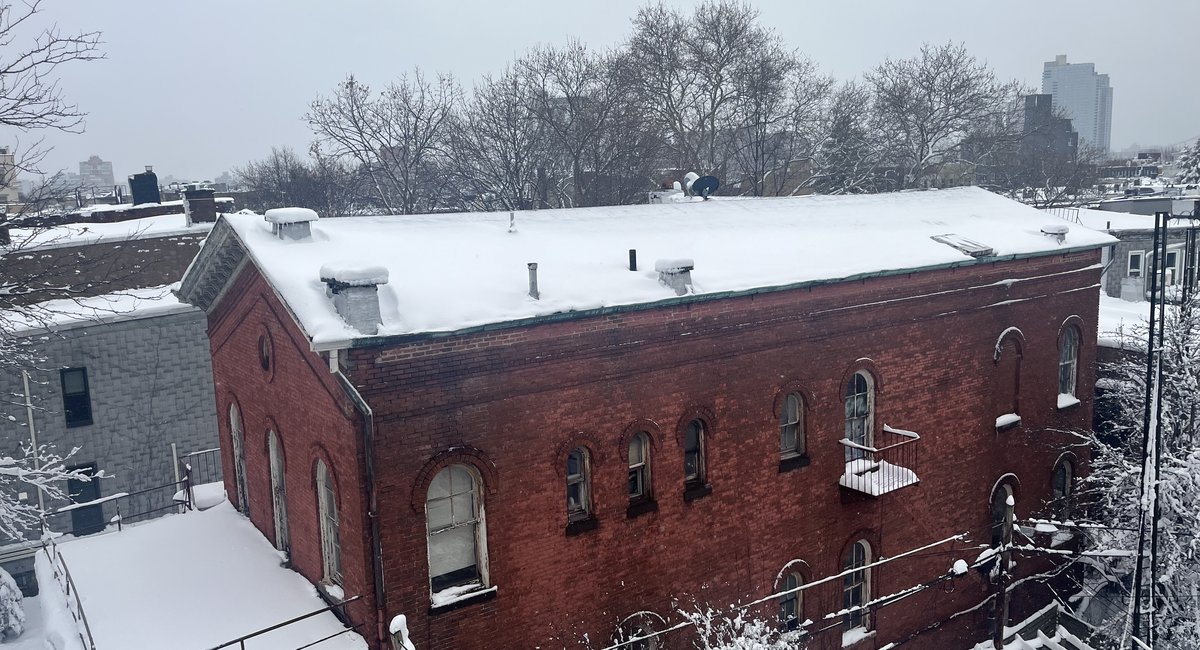
New York City’s 1 million rooftops are going through it.
Just days after a crusty mass of weeks-old snow finally melted, a fresh blizzard has dumped another 15 inches and counting on top of buildings across New York and New Jersey. Roofers and building experts warn that all that weight can lead to leaks and even collapses, with dangerous consequences for homeowners and renters.
But how much snow is too much? That depends on how steeply the roof is pitched, the age, the material and the condition of the roof, but contractors say there are a few clear signs of trouble that signal the need for immediate intervention — like water trickling through the ceiling.
“Once it’s leaking, that’s the dangerous part,” said Shirley Gilyard, a veteran Brooklyn roofer who worked for the New York City Housing Authority. “Act right away because you know the roof is not in a good condition.”
The demand for roof work is going, well, through the roof. Multiple contractors told Gothamist that they have been responding to far more calls than usual in recent weeks, after snow and ice lingered on top of buildings.
“People are calling us and saying, ‘I’ve been in my home for 30 years. It’s never been this bad,’” said Amanda Vienott, who owns Maven Roofing & Exterior in Morris County, New Jersey.
Vienott said her company has received 300 calls for snow removal over the past three weeks and completed 120 jobs — up from about one per winter.
“Usually it’s dead,” she said.
Eden Sultan, a senior project manager with the Brooklyn-based roofing company Royal Renovators, said his company was getting up to 30 calls an hour from home- and building owners in New York City in need of help earlier this month.
“It comes anywhere from shingle roofs to brownstones to multifamily dwellings,” Sultan said. “We’ve been seeing this everywhere.”
Both contractors said the main problem was what roofers call “ice damming,” where melted snow turns to thick ice that seals gutters and drainage areas. Those dams force melted snow to pool on rooftops and refreeze, or stream into attics and ceilings.
“Snow will melt and the water will be trapped and that will cause damage to the roof,” Sultan said.
Department of Buildings spokesperson Andrew Rudansky said most New York City roofs can handle the weight of the recent snow and ice because building codes require owners to account for heavy loads. But, he said, the strength of a roof can deteriorate without regular maintenance.
Rudansky said the agency has not received any reports of roof collapses during the two recent storms. He said the buildings department urges property owners to clear gutters and downspouts to prevent water from pooling on rooftops and to take breaks while shoveling or clearing snow.
The emergency management agency for the state of Maine, no stranger to major snowfall, specifically warns property owners of the risk of heavy ice. A single inch of ice equals a foot of fresh snow, and weighs about 5 pounds per square foot, the agency writes on its website, citing insurance industry data. The Insurance Institute for Business & Home Safety estimates that most roofs can handle 20 pounds per square foot — the equivalent of about four feet of fresh snow or four inches of ice.
Sultan said he expected the current snowfall to cause less damage because temperatures are forecasted to rise in the coming days, likely preventing ice build-up.
But heavy snowfall can still cause major problems for older roofs or shoddy renovations. He specifically described how property owners forgo replacing roofs because of the expense and instead layer new shingles or materials on top of existing ones, straining the structure below.
“All those layers sag the beam,” he said. “You add 2 feet of snow and that can lead to roof collapses.”
But he cautioned homeowners against salting their roofs because the salt can damage the waterproofing material and shingles.
Vienott recommended that building owners call a contractor to clear the snow, or purchase special rakes that can reach a few stories to scrape the snow away from gutters.
Property owners across the city are also opting to shovel the snow themselves.
Ish Bruncaj, who owns and manages three apartment buildings in the Bronx, said he wasn’t taking any chances with snow accumulation since a new roof runs well into the six figures and any damage can injure a tenant.
He said he planned to shovel some of the snow off the roof and make sure the drains were clear at each site.
“I have to ensure the roofs don’t collapse,” Bruncaj said. “The last thing I want is a resident of ours to get hurt. I wouldn’t be able to sleep at night.”
Brunaj spoke with Gothamist while driving from his home in Westchester to one of his buildings. He said he would shovel the snow off the roof himself to lighten the load and prevent the “ice damming.”.
“I’m going to take it slow,” he said. “But something has to be done.”
But roofing industry expert Karen Edwards, who runs the trade group Roofers Coffee Shop, warned it’s best to let a professional handle snow removal.
“The risk of falling is real,” Edwards said.