
 4 min read
The first time I met Queen Elizabeth II—who will always be “the Queen” for me—I was lost for works, as so many people were in those circumstances. She was accustomed to this; indeed, my husband, who had known her since childhood, said that even the most sophisticated individuals often “talked gibberish” when they were introduced to the Queen. As a consequence, she tended to ask simple questions, but on this occasion, her generic opener—“Have you come far?”–would not help give that she already knew the answer. We had been invited to dinner at Balmoral, just a few miles from my husband’s family home in the Scottish Highlands, and when the Queen greeted me, I somehow managed to curtsey without falling over, while feeling utterly awestruck by the power of her presence. Awe is not conducive to conversation; like countless others before me, I became tongue-tied and inept.
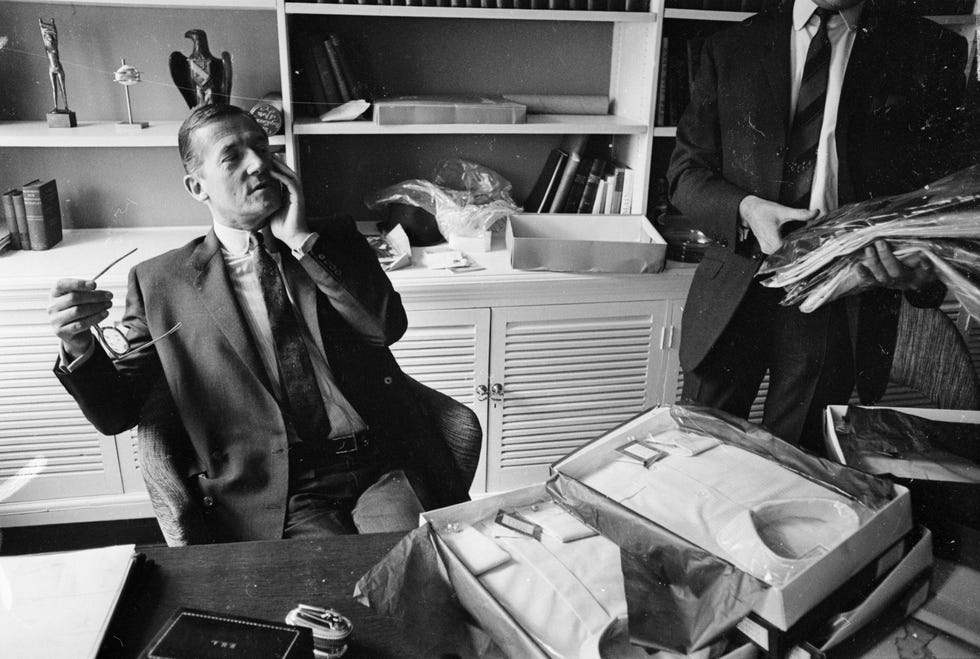 M. McKeown//Getty Images
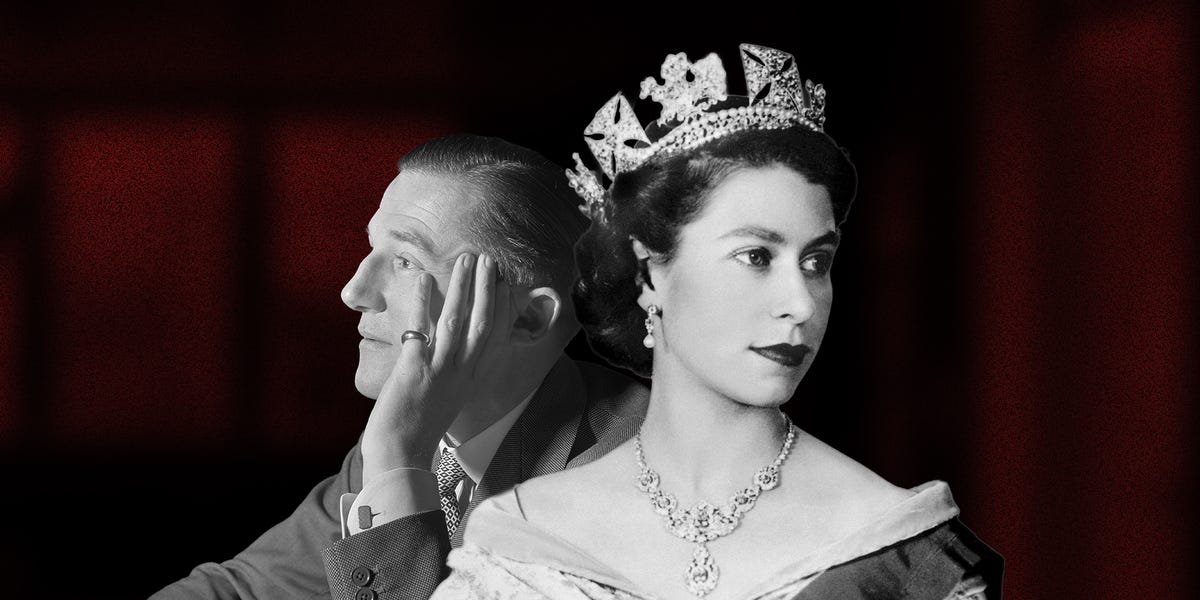
Designer Hardy Amies, who worked with Queen Elizabeth II and had also served as a senior intelligence officer for the Special Operations Executive during World War II.
I had not grown up in a monarchist household—on the contrary, my father espoused Marxism during my 1960s childhood; not had I become an ardent royalist in adulthood. Insofar as I ever thought about the Queen, it was as a reassuringly consistent, grandmotherly figure in the background of our national life, although marginal to my own day-to-day existence. Yet suddenly here she was before me, dazzling in an array of diamond jewelry and an exquisitely embroidered silver evening gown, the magnificent manifestation of her own adage, “I have to be seen to be believed.” The queen was in her early eighties at the time, but her age seemed immaterial. Instead, I was struck by the glamour and grace of her appearance; by her fine, pale skin and the sparkling blue of her eyes that matched her sapphire earrings; and by the way she looked patiently at me while I stumble through an attempt at small talk. At the end of that memorable evening, I felt that the Queen was possessed of her own unique style, embodying majesty, mystery, and myth. If these are the fundamental qualities of a successful monarch, then our limited conversation was almost irrelevant: her sartorial splendor and superb jewels did the talking.
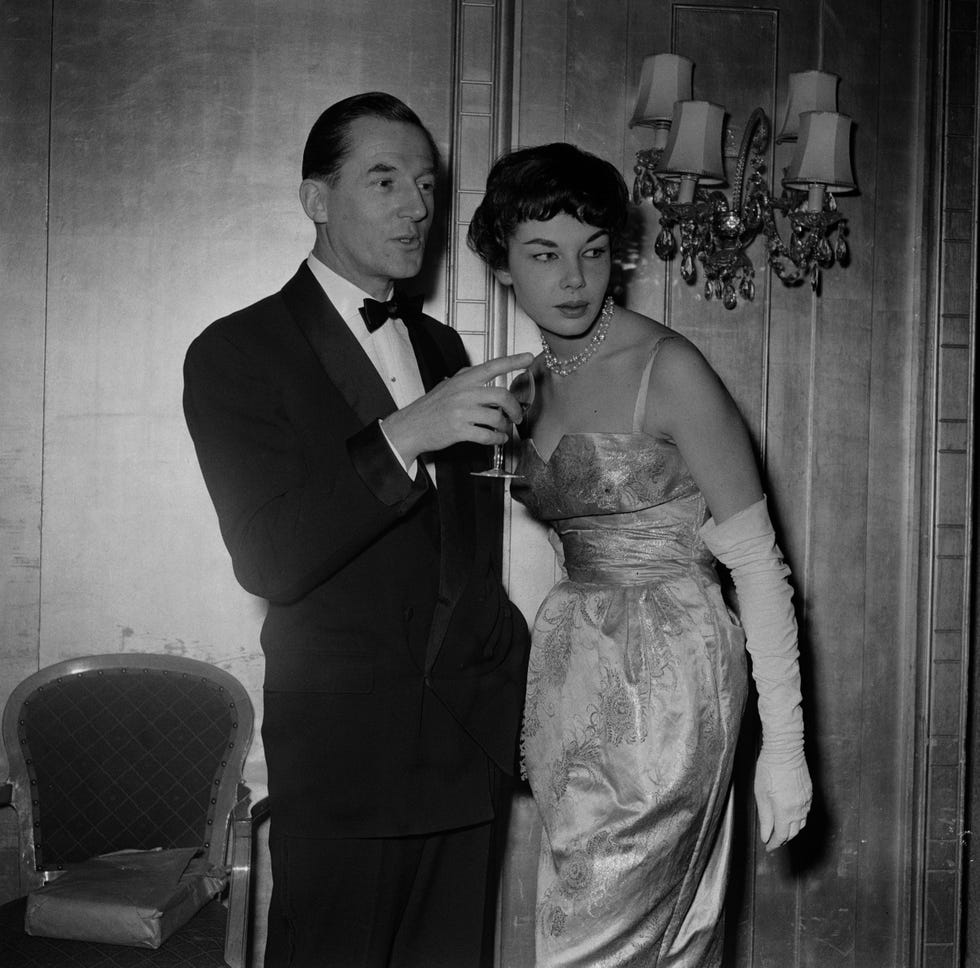 Evening Standard//Getty Images
Hardy Amies with Caroline Ponsonby in 1958. Of Amies, Queen Elizabeth once said, “Of course, it was excellent cover for a spy to be a couturier.”
Our second meeting also took place at Balmoral, this time in a remote mountain bothy on the estate. My husband was shooting with a royal party that day, and the Queen and several others, including me, joined them for lunch. She was surrounded by her favorite corgis; fortunately, I am fond of dogs, and such was their steadying influence that I was able to speak in complete sentences, although still rather stilted by shyness. By this point, I had published a biography of Coco Chanel, and had also being intrigued by the little-known story of Sir Hardy Amies, one of the Queen’s former couturiers, who had risen to the rank of lieutenant colonel during the Second World War. I mentioned to her that my mother had known him, and that I had met him several times before his death in 2003, while I was working at Vogue. And then I pluck up courage to ask her about Amies’ role as a senior intelligence officer for the Special Operations Executive, liaising with the Belgian Resistance as an undercover agent. The Queen looked at me, with the merest hint of a raised eyebrow, and said, “Ah yes, those rumors that he was very good at garroting Nazis.” I had not, in fact, heard any such tales, but tried to mirror her exemplary composure, as a brief silence fell between us. “Of course, it was excellent cover for a spy to be a couturier,” she continued; an observation that implied some knowledge of the ways in which clothes can be used to conceal, rather than reveal, the secrets of those who make and wear them.
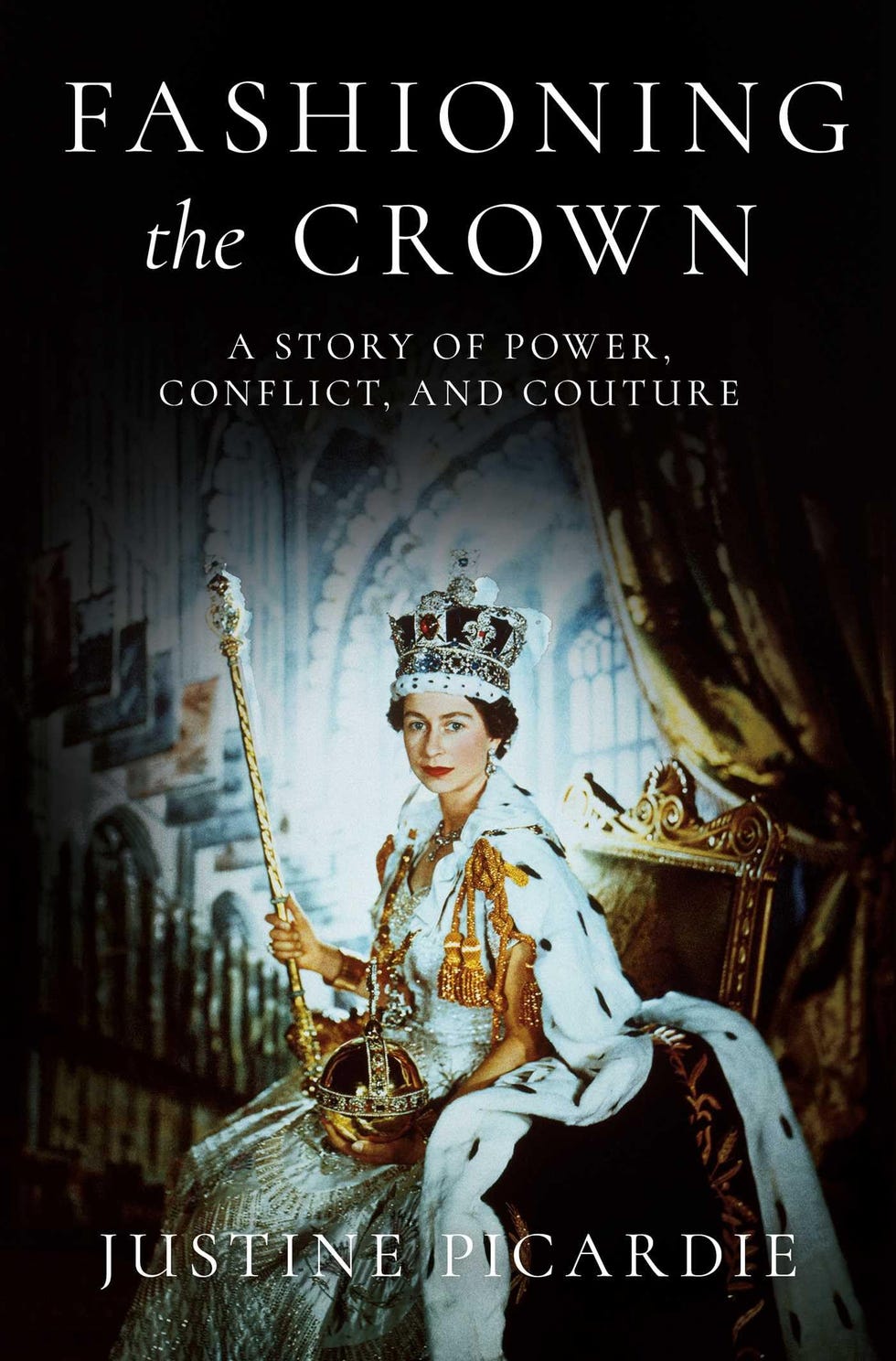
Fashioning the Crown: A Story of Power, Conflict, and Couture
Before I could ask another question, she deftly changed the subject, steering the conversation towards a less startling anecdote, connected to my position as the editor of Harper’s Bazaar. A former wartime editor of the magazine, remarked the Queen, had subsequently married the Scottish laird of a neighboring estate to Balmoral, and had astonished the locals with her flamboyant hats and shocking pink Schiaparelli outfits. “It caused quite a stir at church,” she said, and smile wryly, adding that the editor’s handwriting was utterly illegible. “One simply couldn’t make any sense of it, whichever way one looked at it.” And here the matter ended, as if in tacit acknowledgement that there would be no further discussion of fashion (let alone espionage) or those who engaged in its obscure and arcane practice.
Excerpted from Fashioning the Crown: A Story of Power, Conflict, and Couture by Justine Picardie. Published by Pegasus Books. © Justine Picardie. Reprinted with permission.

Justine Picardie is the author of seven books, including the international bestsellers Coco Chanel and Miss Dior. Previously editor-in-chief of Harper’s Bazaar UK, she was an investigative journalist for The Sunday Times, columnist for The Telegraph, editor of The Observer Magazine, and features director of British Vogue. She lives in England.