
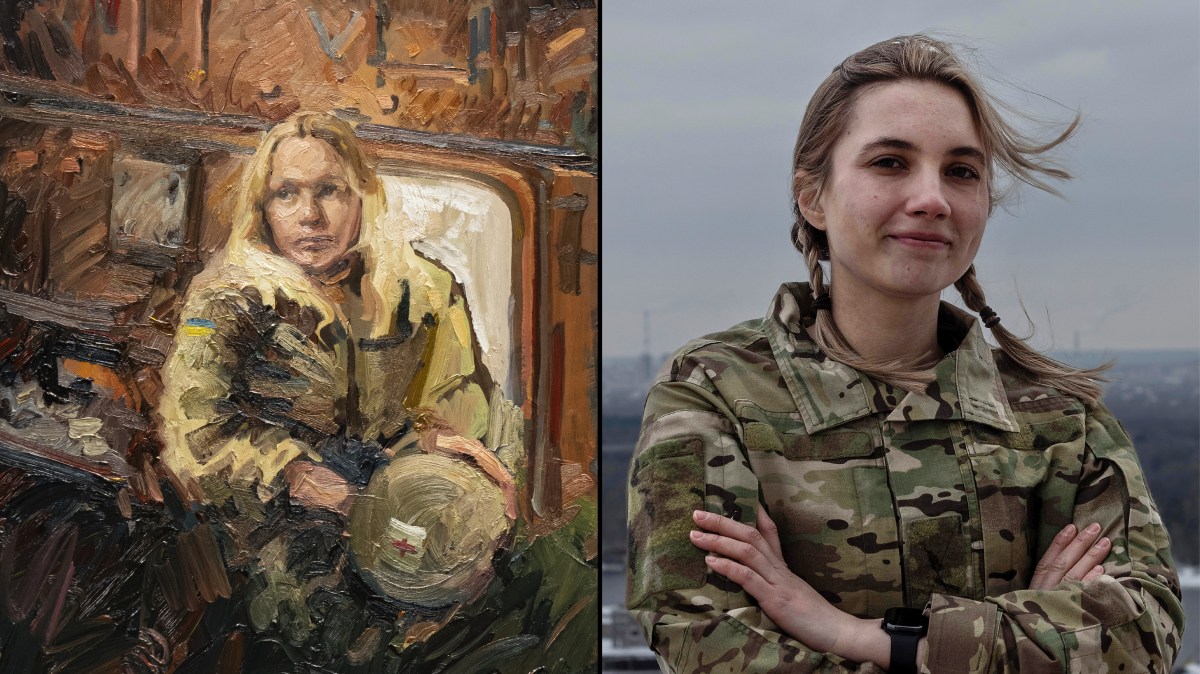
When Viktoriia Honcharuk left behind her dream job on Wall Street, her apartment in Manhattan, and fear of blood for life as a combat medic on the front lines of Ukraine, she had no idea what she was letting herself in for. Not only would the young investment banker end up evacuating hundreds of casualties from the battlefields of Bakhmut and Avdiivka, two of the deadliest fronts in the war with Russia, but she would lose the four close friends she joined up with.
Yet for Tori — the name she goes by on her military call sign — the past year has been the most challenging of all. Russia’s massive use of fibre-optic killer drones, which Ukrainian forces can neither detect nor jam, has created a no-go “kill zone” ten miles around the front, making it too dangerous for medics like her to evacuate the injured.
“Over the last year I went from rescuing 100 wounded soldiers a week to not being able to evacuate at all,” she says. “I’ve gone from staying 800 metres from our frontline positions to being 10-15km away. And when I’m in position and we hear on the radio someone has been injured, we’re literally just listening to them die.”
Tuesday will mark the grim fourth anniversary of the Russian invasion of Ukraine. Tens of thousands of Ukrainians left careers, from concert violinists and lawyers to jewellers and poets, to defend their country. Honcharuk, 25, is initially reluctant to talk about how she abandoned her life as a banker, insisting she is nothing special.
But British soldiers entering the reception of the UK Defence Academy in Shrivenham are greeted by her portrait in oils, showing her sitting inside a ruined tank in the heavily fought-over city of Bakhmut, in 2023, before it was eventually taken by the Russians. Painted by the British war artist Max Denison-Pender, it was installed in a ceremony that December as an inspiration to others to keep supporting Ukraine.
Honcharuk and her elder sister, Maryna, both from the Third Assault Brigade, will be in London this week attending an exhibition of Denison-Pender’s paintings from Ukraine including their portraits, and speaking at the Royal Military Academy Sandhurst.
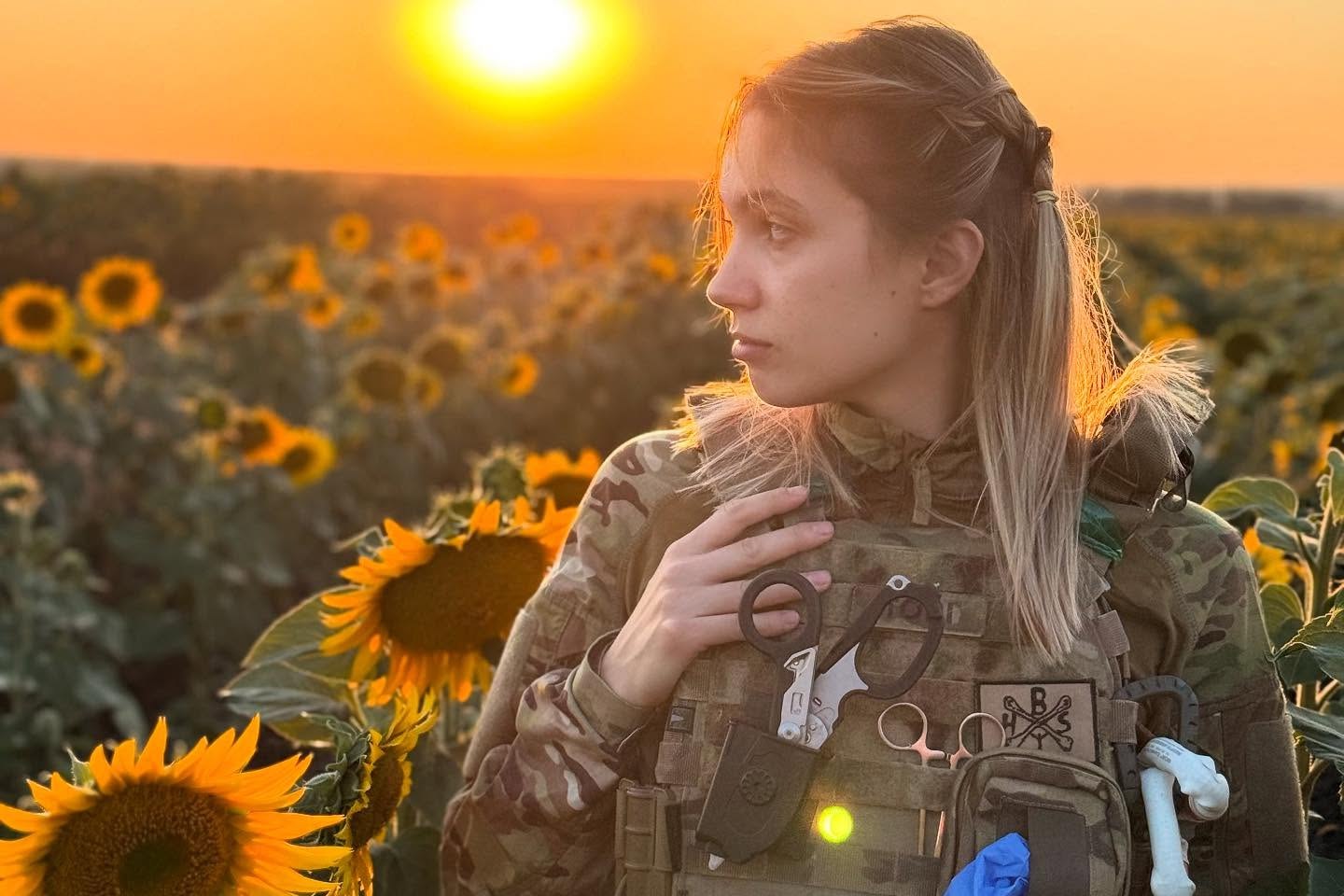
Viktoriia Honcharuk in the sunflower fields of Ukraine
@VICTORIA__HONCHARUK
Earlier this month, Honcharuk led Ukraine’s military delegation to the Munich security conference. There, she used her firsthand experience of how drones have changed this high-tech war to discuss with western partners and defence companies the needs of frontline units, including 3D radars for detecting airborne devices and support developing unmanned ground vehicles (UGVs) — remotely controlled robotic devices that can go where it is too dangerous for humans. They can be used to deliver ammunition and extract the wounded.
Most of all, she pleaded for help in detection of Russia’s fibre-optic drones. “It’s personal,” she says. “Until we fix this, my work as a combat medic is useless.”
Until the Russian invasion in February 2022, Honcharuk had been working in the New York office of Morgan Stanley, one of the world’s biggest investment banks. “Life was good,” she says. “I had a great apartment. I was literally living the dream.”
Born in the small town of Baranivka in a region of northwest Ukraine which borders Belarus, her life changed at 15 when she won a scholarship to high school in America, then to Minerva University in California.
After sending off 80 applications on graduation, she got an internship at Citibank, then a role at Morgan Stanley.

Sisters Viktoriia, left, and Maryna Honcharuk of Ukraine’s Third Assault Brigade
Less than a year into the job, she woke up on February 24, 2022 to hear that the Russians had invaded. “I was very confused, I couldn’t believe it,” she says. “But when I called my parents, they told me ‘it’s happening’ and they had joined the Territorial Army.”
These volunteers were all poorly equipped, needing everything from body armour to camouflage netting, so for the first few months Honcharuk was sending money. “I thought I was helping,” she says. “But after a while I couldn’t look myself in the mirror. There I was, going to fancy parties in New York clubs when my country, my culture, my area … were all threatened. I realised there was more to life than career. I needed to be on the ground.”
In September 2022, she returned and met her sister, who had joined up with a group of four young men calling themselves Brothers in Arms. “I thought these are people I want to walk in life with,” she says.
To start with, Honcharuk did a couple of humanitarian trips to help people in the besieged city of Bakhmut with Eddy Scott, a British volunteer who later lost his arm and leg in a drone attack while evacuating civilians from Pokrovsk.
Then, in December 2022, she left New York for good. “I thought I need to do more,” she says. “They said they needed medics. I was afraid of blood and needles but I thought if that’s what they need, that’s what I’m going to have to do.”

An unmanned ground vehicle (UGV) is used for evacuation in a frontline practice run near Kyiv on Friday
GETTY
She took a week-long course in tactical medicine, learning how to apply tourniquets and drips, and one day later was sent to the Zaporizhzhia front doing medivacs — medical evacuations — to the civilian point. “Fortunately, my first injured were not too bad and I was working for a much more experienced leader.”
The situation quickly escalated, however, and soon she was dealing with much more difficult injuries — gunshot wounds, arms and legs blown off by mines. “When I became leader of a crew in Lyman region we were getting 100 injured a week we needed to evacuate,” she says.
Stationed just a few hundred metres from the front line, she and a driver in a makeshift ambulance would race to retrieve the wounded and transport them to small field hospitals, often underground.
For the first nine months, she was attached to different brigades. “Literally any but that of my sister,” she laughs. “I didn’t want to be a burden.” Maryna Honcharuk, now 30, had become Ukraine’s first female assault trooper in the Third Assault Brigade and now commands its intelligence unit.
“She’s the most badass,” says Viktoriia. “Once she captured someone from the Wagner Group [Russian mercenaries] and he couldn’t believe he had been taken prisoner by a woman.”
• War diary: love and desperation on Ukraine’s front line
In August 2023, she joined Maryna in the Third Assault Brigade and the two remarkable sisters have been together on the front lines of Bakhmut, Avdiivka, Limon and Luhansk.
Honcharuk has treated Russian prisoners of war, as well as Ukrainian casualties, including one commander who, she says, “was so scared he peed in my car”.
“I’ve had to treat multiple POWs and always do it with respect — even though I hate those people, they came to our country to take it, and they killed my friends.” The four young men she and her sister joined up with were killed in Bakhmut and Avdiivka.
Both sisters are still on active service, but last year they also helped set up the Snake Island Institute, a defence think tank named after the island in the Black Sea which became a global symbol of defiance in 2022 when Ukrainian forces there refused to surrender to Russian invaders, famously declaring “Russian warship, Go f*** yourself!”
Setting up the institute was partly a response to the showdown in the Oval Office last year, when President Zelensky received a dressing down in front of the cameras by President Trump. “I felt our military needed to speak more directly to decision-makers,” Honcharuk explains. “We wanted a way of presenting our military story.”

President Zelensky’s Oval Office clash with Trump and JD Vance made Honcharuk determined to change the narrative
EPA
The institute also aims to work with foreign partners and tech companies to identify and fill gaps on the front line in a war that is changing rapidly.
As its director of tech, Honcharuk organises so-called crash tests to check how well devices work in frontline conditions, and the readiness of battalions to use the latest capabilities. Her team recently conducted a test of strike UGVs, robotic devices operated remotely by joysticks, which Ukraine is using more and more.
“I believe 2026 will be the year of strike UGVs,” she says. Her brigade already has a special UGV battalion, NC13, and she plays me videos showing how they used one to deliver a massive aviation bomb and blow up a Russian position, and another to take a POW — both world firsts.
Another UGV managed to rescue a wounded soldier who had spent 33 days behind enemy lines and — after six failed attempts — take him to safety in an armoured capsule.
As they tested the UGVs, navigating through mud and trenches, only four models out of 15 from different manufacturers made it through.
• Putin has the men and the gear — and still believes he can win
These tests are key, given that Ukraine is systematically scaling up the use of ground-based robotic devices at the front. Last month alone, more than 7,000 missions using ground-based drones were carried out, according to Ukraine’s Ministry of Defence. The vast majority were logistical tasks but one held a position for 45 days with no men.
Honcharuk’s team is now focusing on the detection of fibre-optic drones, one area in which Russia is leading the way. Anywhere within ten miles of the front, there are shimmering fibres draped along trees and buildings and across fields like spiderwebs, while in the besieged city of Pokrovsk, streets are tangled with them.

A drone strike leaves behind destruction in Raihorodka, Lyman, in May 2025. One person was killed and another injured
GETTY
“We have no way of tracking these fibre-optic drones, so they turn large areas into no-go zones too dangerous for resupply, troop rotations or medical evacuations,” she explains.
Not being able to do evacuations is a huge problem, given that about 3,000 soldiers a month along the 1,000km front line need evacuating, and the army is suffering a shortage of manpower. Knowing they may well not be rescued if injured is also very damaging to troops’ morale.
Honcharuk has little hope for the ongoing peace talks. “From what I’ve seen, Russia’s not going to stop, so we need to strengthen our forces.” To Europe and Nato, she says: “If they don’t start putting their money where their mouth is, we won’t succeed.”
If there were to be peace, would Honcharuk return to Manhattan? “I miss that life with all my heart,” she smiles.