
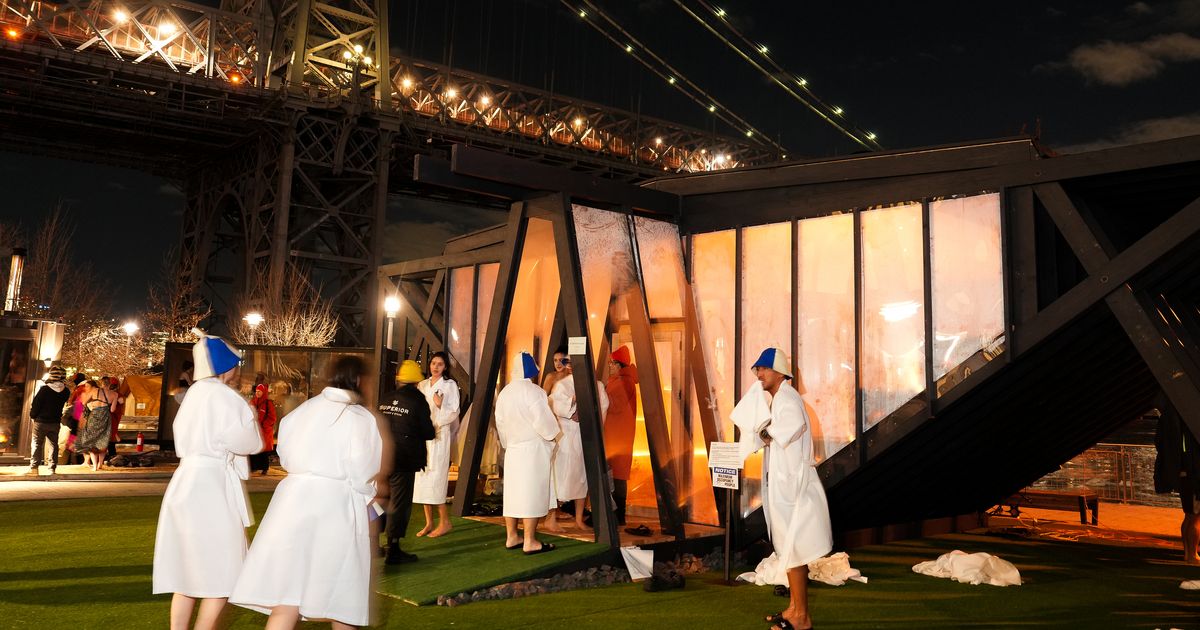
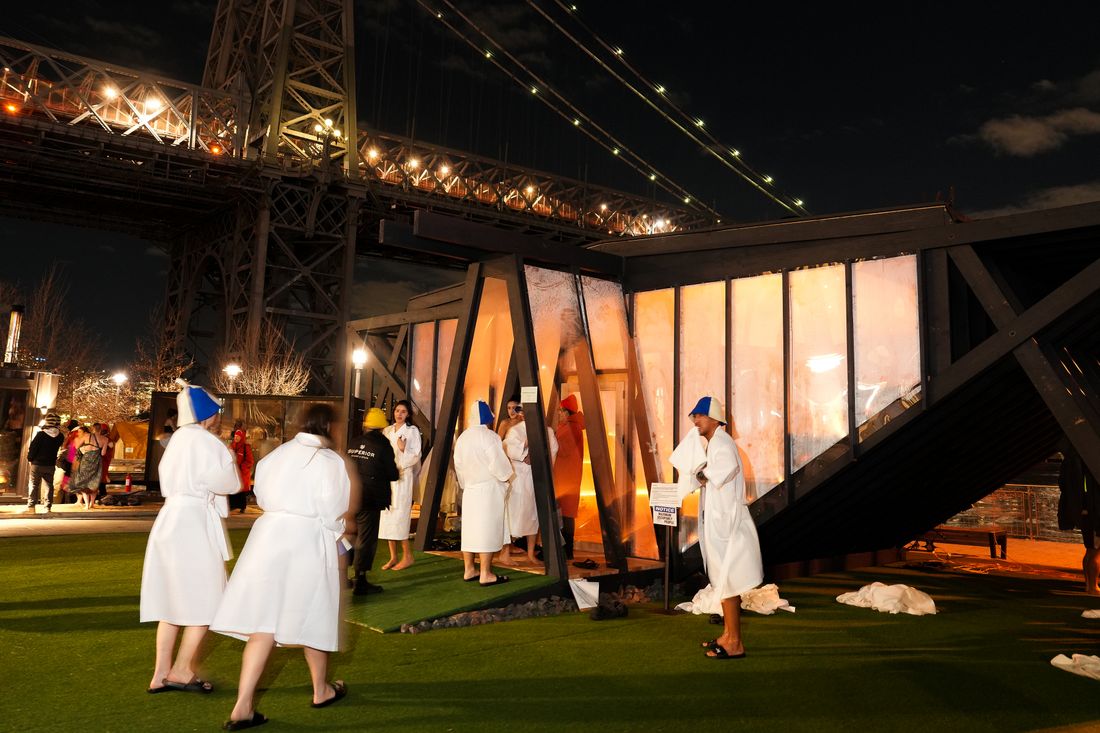
An evening at a sauna festival on the East River.
Photo: Hannah Turner Harts/BFA.com
It’s boom times for bathhouses in New York as glitzed-up shvitzes open in Manhattan and Brooklyn — and unlike the faithful banyas and K-spas that have served the boroughs for decades, these establishments are fluent in the language of productivity. Now, even in the one spot where you could allow yourself some idleness, you can rest assured you are getting shit done. You’re not just sweating — you’re enhancing performance, you’re doing recovery, and you’re building community, as defined by the low bar of looking at other people as opposed to your phone. Some bathhouses, like the Toronto import Othership, are aggressively programmed to be social with its staff leading group stretching, prompting guests to share during ersatz group-therapy sessions, and performing Aufguss, a German sauna ritual that involves ladling scented water or ice over hot sauna stones and circulating the steam by dancing around with a towel. Community-building is also one pitch for the pop-up Culture of Bathe-ing, a cluster of saunas in Domino Park that’s billing itself as New York’s first sauna festival. (The stronger pitch is all the content you could make with that skyline backdrop.) Some bathhouses are for the biohackers: At the Altar, a self-defined “health club” that soft-opens in March, you can follow up your session with an IV drip and an order off a menu of peptides. Local chainlet Bathhouse, which has heated some of its pools with the heat generated by bitcoin mining, calls itself “an oasis to be fundamentally human.” These places are not built for a day of leisure. They’re built for microdosing relaxation, 30 to 75 minutes at a time.
The cold plunge is a major part of that. Adam Elzer and James O’Reilly, the co-founders of Noho’s recently opened Lore Bathing Club, say that scientific research about the benefits of contrast therapy — cycling between hot and cold, sauna and plunge — and its endorsement by Andrew Huberman and Joe Rogan have made more people than ever curious about whether a dunk in cold water could change their lives. The science might be there: Studies suggest that cold showers or plunges could help control inflammation and reduce pain, reduce stress, and increase insulin sensitivity for diabetics. Elzer, who used to fill up his apartment’s bathtub with ice every morning and force himself to get in, says that at Lore, “we wanted the cold pool to be central. We felt that there was a bigger sense of accomplishment if somebody could get into the cold.” “They feel galvanized,” adds O’Reilly. “It creates a tension in the experience. Rather than everything being easy, you’ve actually done something.”
Health and community blah-blah aside, the rush of entrants to the sauna space can mean only one thing: money. One of the real reasons so many bathhouses are able to open now is because the de Blasio administration eliminated a lot of the red tape in an attempt to support gyms and spas in the wake of COVID closures. It’s still very hard to open one — bathhouse founders describe navigating the permitting process as “much, much more complicated than a restaurant,” “took years off our lives,” and “brain damage” — but operators believe it’s worth it. Luke Carstens and Shayna Olsan left jobs in finance and marketing to open Akari, their wood-paneled Williamsburg bathhouse, at the end of 2023. Carstens says their now two Brooklyn locations are profitable even though, out of concern for overcrowding, they operate under a membership model that allows only several hundred people to be members of each location at any one time; when I visit their Greenpoint location on a weeknight, it is pleasantly sleepy, with around a dozen people drifting between the saunas and sipping buckwheat tea. In a few months, they’ll open their third location, on the Lower East Side. “But, you know, we make significantly less than somebody else who allows for onetime visits,” Carstens adds.
That’s the model Robbie Hammond is interested in. Hammond got his platform as the co-founder of Friends of the High Line in the late ’90s and is now the president and chief strategy officer of Therme Group US, the American division of an Austria-based company that operates theme-park-size bathhouses in Romania and Germany. “Part of a bathhouse is being crowded. That’s what makes it good! You have fixed costs, and you get more revenue the more people that can come,” he says. Hammond is what you might call a professional booster, all too happy to promote the general cause of Big Shvitz. That’s why he launched Culture of Bathe-ing, which Therme sponsors, and for which Hammond co-authors a Substack detailing various bathhouse openings and business developments. After he got the job, he says, “I wasn’t an expert, and I started going around meeting everybody in the business, and I was like, ‘I love these people!’” He also loves the possibilities for profit. “I always joke that people lie about their margins!” he says. “They’re deflating them because investors can’t believe you can get anywhere near 50 percent, but I’ve seen them, and we do, too, in Europe.” (A Therme spokesperson later declines to confirm whether this is true.)
Smelling blood in the bathwater, Therme has spent the past several years pushing for development in North American cities, spending massively on hiring and events and wooing community representatives and public officials. In the midst of this PR blitz, last year, the New York Times published an investigation of Therme’s successful bid to win a lucrative government contract and 95-year-lease in Toronto: In order to lock down a large piece of land where it could develop a spa, the Times reported that Therme misrepresented how many bathhouses it operated — claiming that it operated four, including three in Germany, when it only operated one, in Romania. According to the report, the other spas were run by a different, older company with a near-identical name. The Times paraphrased a Therme rep justifying this by saying that “references to its success in Germany were meant to communicate that the concept of Therme had been successful.” A Therme spokesperson tells me that at the time of the bid, it was “integrated with the development and operating teams” of the other facilities. The waters have been muddied even more since then because, in the time since the Toronto deal, Therme has apparently raised enough money — including through a partnership with private equity — to actually buy the German businesses. When I raise the Times’ reporting with Hammond, he waves it away. “I don’t feel like it was misleading anybody,” he says. “There was always a relationship with the others! Sometimes I said we had five, sometimes I said we had one. And now we own five outright.”
Therme’s reps have previously said they want to build in New York too, although Hammond says that might be a decade away; his dream is to open near Penn Station, perhaps sprawling a Therme over the former site of the Hotel Pennsylvania. Last year, Therme staged a free sauna festival in Washington, D.C., where it’s dying to eventually build a large campus on a tranche of public land. And now it’s doing the festival in New York, although, this being New York, guests have to pay. On a recent Wednesday, I found myself struggling into a headwind down a Williamsburg sidewalk wearing only a white waffle robe, a bathing suit, and shower slides, crossing the long block between indoor changing rooms and Culture of Bathe-ing. Hammond is flitting around the festival wearing a button-up shirt embroidered with the word SWEAT. When I speak to him the next day, he’s wearing another that says SOAK. He has another that says CULTURE OF BATHE-ING. He says the festival name is spelled that way to distinguish “the culture of your bathroom” from bathhouse culture and adds, “Well, I’m such a bad speller I didn’t really even get it at first.” There’s no actual “bathe-ing” at the festival, which consists of 15 saunas of varying attitudes — some small and hutlike, others large and vitrine-esque, one inside a rehabbed Airstream trailer. Bathrooms are upscale porta-potties, and there are a few shower trailers nearby. Entrance to the festival for an adult can cost as much as $95 for two hours, which is more than a visit to Lore, Othership, or nearly every other bathhouse I can think of. (The festival is giving away over 1,000 free tickets through a city agency and other partners.) So it’s a developer-sponsored festival with few showers in a private park surrounded by high-end condo buildings in the shadow of the Williamsburg Bridge, our surroundings ringed in a thick crust of weeks-old pissed-on snow. I ask Hammond what makes this experience more appealing than going to an actual bathhouse. “Being outside in nature,” he says.
Hammond is interested in the idea of participating in a “uniquely American bath culture.” It is often bemoaned, in the world of recreational bathing, that the U.S. does not have one — unlike Finland’s saunas, or like Mexico and Central America have the temazcal, or Japan has the hot-spring onsen and public-bath sento. Maybe it doesn’t deserve one. Many indigenous groups on this continent whom settlers swindled, attacked, and displaced have a long history of using sweat lodges both for cleaning the body and in ritual. In New York City, where scores of public baths opened during tenement days, what could’ve been a distinct urban bathing culture was wiped out by sexual panic. In the 1970s, the city placed heavy restrictions around the opening of new bathhouses that it believed were dens of prostitution and sin. Then, in the ’80s, many long-standing businesses were closed, supposedly to prevent the spread of AIDS. (A Times story from 1985 calls them “gathering places for homosexuals.”) That doesn’t mean it was impossible to find a sauna. The stalwart banyas and, later, K-spas made sure New York never lacked completely.
I ask Hammond why an American version is important when we’re able to enjoy the bathhouses brought here by immigrant communities. “That’s a great point!” he says, smile fixed. “I think American bathing will also just be like America is. Some of it gets mixed together and then some of it stays distinct.” Maybe this is the uniquely American bathhouse culture: a steam bath of productivity and profit and a vague sense of origin with the occasional plunge into the murky depths of public-private partnerships. At Culture of Bathe-ing, I endeavor to clear my mind. I step into one of the saunas, lay my towel on the bench, and let the good, dry heat penetrate. After a few minutes, a person working with the festival pops his head in to check the temperature. “If it passes 194 degrees, my ass is grass with the Health Department!” he says. He works for a company that manufactures saunas and begins to relate his experiences of last year’s festival in D.C. “There were people who had never, ever, experienced sauna before,” he says, giving the example of a woman who fell asleep in one of the units; it turned out that she was unhoused and had been staying in her car. “She said it was the first time she’d been able to sleep in six weeks,” he says. To me, this sounded like a tragedy; a two-day pop-up was no replacement for a social safety net. To him, it was a beautiful moment. “That’s the power of sauna,” he says. “It really brings people together.”
Thank you for subscribing and supporting our journalism.
If you prefer to read in print, you can also find this article in the February 23, 2026, issue of
New York Magazine.
Want more stories like this one? Subscribe now
to support our journalism and get unlimited access to our coverage.
If you prefer to read in print, you can also find this article in the February 23, 2026, issue of
New York Magazine.