
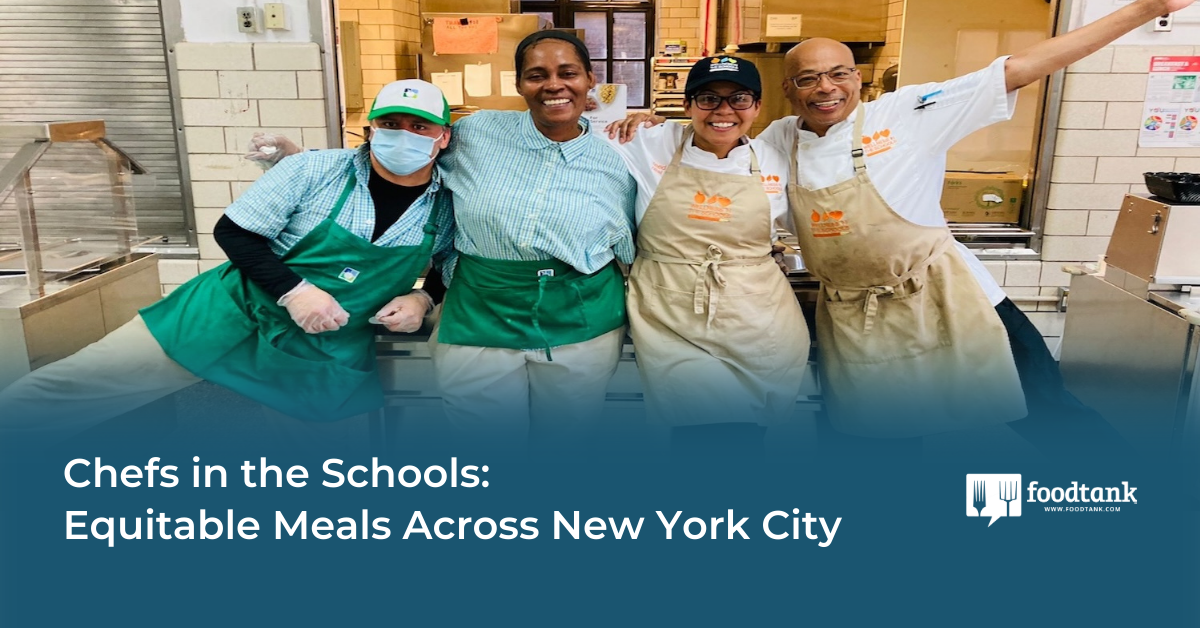
Chefs in the Schools (CITS) recently released a new report on its three-year program bringing sustainable nutrition to New York City Public Schools, during which they fed nearly 1 million children daily. They hope their takeaways can serve as a blueprint to scale sustainable school meals nationally.
Wellness in the Schools (WITS), a national nonprofit educating children on healthy habits, launched CITS in partnership with the Mayor’s Office of Food Policy, the New York City Department of Education, and the Office of Food and Nutrition Services. The program aims to increase the quantity of plant-based, scratch-made, and culturally inclusive meals served in NYC schools, while decreasing the amount of processed food. They did this through developing menus, training school cooks on best practices for healthful meals, and providing nutrition and culinary education to children.
The new report shows that CITS established 44 recipes fitting their desired criteria. Food education and side-by-side training reached 1,035 public schools, hundreds of school cooks, and more than 850,000 students. Multiple training methods including side-by-side training and an off-site CookCamp training, teaching staff new skills and providing a higher level of support, collaboration with the city of New York, and student engagement, all contributed to the program’s success.
Alexina Cather, Director of Policy and Special Projects for WITS, tells Food Tank, “Our findings make clear that transforming school food requires more than swapping ingredients. It requires investing in people, training, and systems. Through Chefs in the Schools, we’ve demonstrated that when schools are supported with culinary expertise and professional development, scratch cooking becomes scalable and sustainable.”
The pilot also faced challenges. Both the high cost of fresh produce and assumptions that produce will be expensive even when it’s not created difficulties. Additionally, school cafeteria staff shortages and inadequate kitchen equipment were setbacks the program faced. Difficulty measuring and quantifying outcomes was another factor CITS needed to contend with
According to the report, these issues are not unique to New York City. The U.S. Centers for Disease Control and Prevention (CDC) reports that most of the calories consumed by youth nationwide are from ultra-processed foods (UPFs). These products, prevalent in both school and packaged meals, are associated with health concerns including obesity, type 2 diabetes, and heart disease. The CDC also reports that children who eat nutrient-poor diets are at increased risk of hindered cognitive development, more school days missed, academic delays, and behavioral and emotional challenges.
Food insecurity is also a justice issue. Black, Latinx, and Indigenous communities are more impacted by the health concerns caused by lack of access to sufficient nutrition, experiencing diabetes at a 1.5 times greater rate than white populations.
But WITS sees schools as uniquely situated to transform the systemic challenges facing food and agriculture systems into an opportunity for societal change. Their report provides a series of policy recommendations with the aim of scaling nutritious, culturally-relevant, and sustainable school meals.
One recommendation is to eliminate ultra-processed food from school menus. California, for example, made progress towards this through its passing of Assembly Bill 1264, known as the Real Food, Healthy Kids Act. This law will phase-out ultra-processed food from school meals, eliminating them entirely by 2035.
WITS also advocates for the alignment of federal policy with public health goals. They argue that subsidies for fruits and vegetables would create greater incentive for schools to use them in their meals.
Additionally, the report advocates for reform in school food procurement, encouraging schools to invest in local supply chains that can provide healthy and whole ingredients. They also stress the importance of kitchen infrastructure that is well-suited to scratch-cooking, and the importance of opportunities for professional development for school food workers.
True-cost accounting, healthy school meals for all legislation, and higher federal reimbursement rates for school lunches are amongst the other policy avenues the report recommends.
Cather tells Food Tank, “This report is both a celebration of what’s possible and a call to policymakers and funders to prioritize school food as a cornerstone of health equity.”
Articles like the one you just read are made possible through the generosity of Food Tank members. Can we please count on you to be part of our growing movement? Become a member today by clicking here.
Photo courtesy of Wellness in the Schools