
New York City’s complex property tax system affects everyone in the city, not just people who own property. The cost of those taxes affects retail space, how much you pay for rent and how (and where) things get built.
In the five boroughs, there’s been longstanding and widespread agreement that the system is convoluted and its outcomes unjust.
How so? Currently, the system favors small homes and lavish condos over apartment buildings. And owners of similar homes in different neighborhoods face drastic differences in the taxes they pay. For instance, tony brownstones in Brooklyn and fancy condos in Manhattan frequently have lower effective tax rates compared to similar homes in Queens or The Bronx.
Mayor Zohran Mamdani came into office promising to fix the system. But, like many mayors before him found out, doing so is not easy.
But before his administration makes moves to fix the system, Mamdani said he is weighing a 9.5% across-the-board increase on property taxes to make up a $5.4 billion city budget gap — unless Gov. Kathy Hochul agrees to raise taxes on the wealthy.
Property taxes are the engine of New York City’s budget. They are the city’s largest revenue source, amounting to about $33 billion of the $112.4 billion budget for fiscal year 2025.
How can lawmakers reform that key driver of revenue, how does the system work and why should you care? Read on:
How does New York City’s property tax system work?
We can thank state law from 1981 for the basic structure of the property tax system today.
A property’s tax bill depends largely on what kind of property it is. There are four categories, known as classes, for taxes purposes:
Class 1: One-, two- and three-family houses
Class 2: Residential buildings with four or more apartments, including cooperatives and condos
Class 3: Utility company equipment
Class 4: Commercial property like offices, stores, hotels and factories
Each of these categories has its own tax rate, which the City Council sets. The rates are based on the share of total property taxes paid to the city. Think of the property taxes the city collects as a pie, and each class is assigned a differently sized slice of the pie.
There are other important factors that go into determining a property’s specific tax rate — the “market” and “assessed” value, more on these later — but its class category underpins it all.
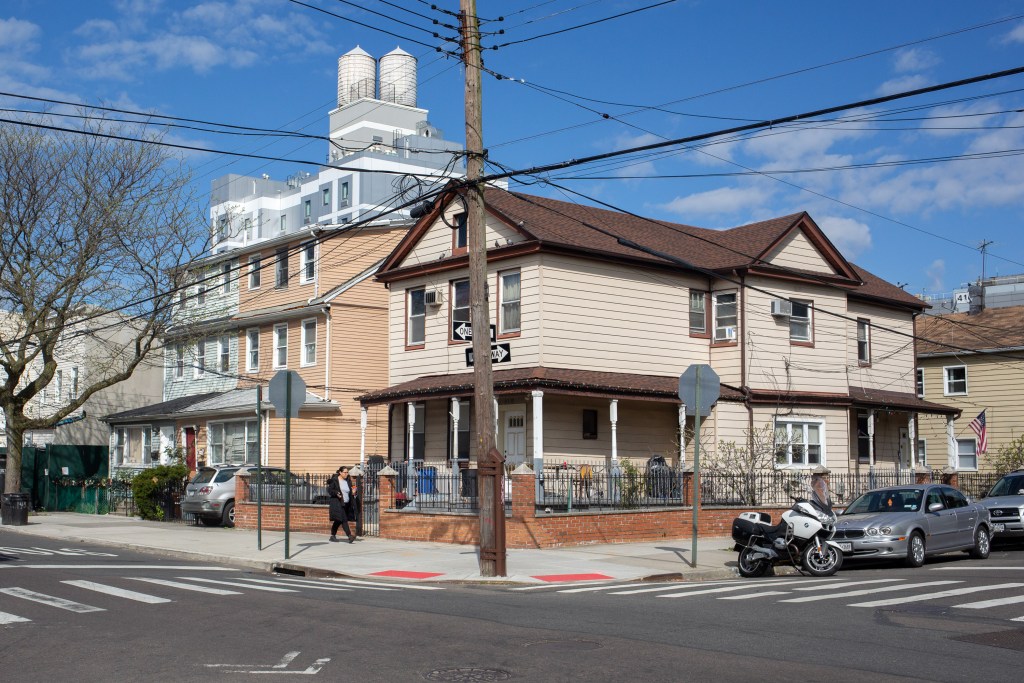 Single-family homes line a residential block in Jamaica, Queens, April 25, 2024. Credit: Ben Fractenberg/THE CITY
What’s the issue with how the system works?
Primarily, there are huge differences in how much is paid by owners of the same types of buildings in different neighborhoods — and between different types of buildings, even if they’re located in the same area — multiple studies have shown.
Areas with more Black homeowners pay property tax rates that are twice those of primarily white neighborhoods, according to a 2025 report by the Community Service Society and Progress and Poverty Institute.
In some cases, two types of the same property in different locations would pay very different effective property tax rates.
That report highlighted a two-family building in the East Village with an annual property tax bill of just over $13,000 in 2022, compared to a two-family home in Canarsie that paid $5,600 in property taxes that year. The East Village building had a market value of over $5.5 million, meaning its effective tax rate is just 0.2%. Compare this to the Canarsie home, valued at $550,000 — putting its tax effective rate at 1%.
Plus, there are rules around how assessed values are calculated and caps imposed on those values for different property types that lead to vast inequities in the system. More on that below.
I don’t own property in New York. Why does this matter to me?
Property taxes hit your wallet, even if you don’t own an apartment or a building. Landlords often factor property taxes into rent they charge, whether for renters or commercial tenants.
So, if a tax rate is high for your apartment building, or the building of your favorite shop or bar, that can affect the rent. Businesses can pass along some of those costs to you, affecting how much you might pay at a restaurant, or for anything else.
Utility companies also pass along property taxes in the electric and gas bills you pay. Higher property taxes were a key driver of Con Ed’s latest rate hike, THE CITY previously reported.
The cost of property taxes can also stymie housing development — much of which only happens with tax incentives that lower what developers pay. And because rental housing is taxed at a higher rate than condominiums, developers may be incentivized to build condos instead of rentals (more on this later).
“The property tax touches everyone, it absolutely does,” said former city finance commissioner Martha Stark. She is also the policy director for the coalition Tax Equity Now New York, which filed a lawsuit in 2017 aiming to get the courts to force property tax reform.
“It pays for things we care about,” she added. “Whether you’re poor or rich, you are availing yourself of things that are paid for by this tax.”
How is my building’s real tax rate calculated?
The tax rates based on building class discussed earlier are not always the rate that appears on a bill.
That’s because the city Department of Finance figures out property taxes using a complicated formula based on the class of the property, market value for the property and the “assessed value.” (To figure out a property’s final bill, the agency multiplies the assessed value by the tax rate.)
Confusingly, the market value — in the context of the property tax system — does not typically indicate how much the property would sell for on the market if the owner were to put it up for sale.
So, what sets the market value for tax purposes? For small homes (Class 1) the finance department determines the home’s value based on sales data for comparable properties. For commercial and residential buildings (Class 2 and 4) the DOF determines the value based on net income — even if the building doesn’t actually have rentals.
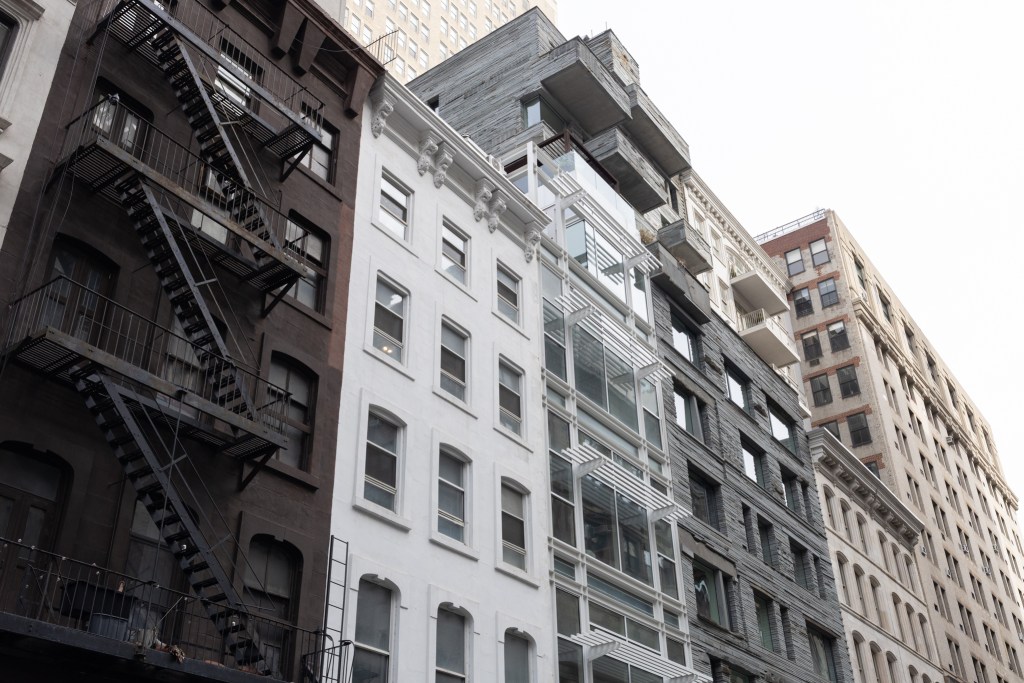 New and pre-war buildings sit next to each other in TriBeCa, Feb. 19, 2026. Credit: Ben Fractenberg/THE CITY
For co-ops and condos, where residents own their apartments, state law requires DOF to determine market value based on how much rental income they would generate if those buildings were rentals.
Stark said that approach means DOF significantly undervalues many expensive co-ops and condos — and there’s a consequence.
Remember that each class of property is required to pay a different slice of the pie, which is all the property taxes paid to the city. So within each slice, if a set of buildings pays less, others will pay relatively more to make up for it.
“Because all apartment buildings are in the same tax class, if some buildings are [valued] very low, other buildings in that tax class are picking up extra burden as a result of it,” Stark said. “That kind of policy results in people paying more who own more modestly priced co-ops and condos and rental buildings.”
Is your head spinning yet? Stick with us, because that last piece is a major reason why some co-op and condos pay wildly different property taxes than others.
Why do ordinary co-ops pay relatively more in taxes than luxury condos??
To get an answer, we have to look at the landscape of New York City’s buildings before the city’s current tax system was put into place — in the 1980s.
Back then, New York’s ownership rate was quite low, and condos were exceedingly rare. There were many conversions from rental buildings to co-ops, but with a mix of rent-regulated tenants and owners. This history shows the roots of why the DOF considers theoretical, would-be rental income for many buildings that have few or zero rental apartments.
Stark said back then, state lawmakers didn’t want to discourage homeownership by valuing the co-ops higher.
The result? A kind of distortion of the value within co-ops and condos, said Ana Champeny, vice president at the Citizens Budget Commission.
“The value of an apartment unit like a co-op unit or a condo unit, based on its rental potential, is much, much lower than its actual sales price,” Champeny said.
Nowadays, of course, the city is filled with condos and the number of renters in co-ops has shrunk. And the city’s process of determining the value of a condo or co-op — again, that is much lower than its actual market value — means luxury condos have a lower effective tax rate than more modest co-ops or condos. The luxury condos pay less in taxes relative to what they’re worth.
A notable example of this is the $238 million penthouse condo located on Central Park South that billionaire hedge fund founder Ken Griffin purchased in 2019. The DOF valued the apartment at $9.4 million, and the effective tax rate was just 0.22%, City and State reported at the time.
Why are similar properties in different neighborhoods taxed so differently? And why are smaller homes taxed less than larger buildings?
The main culprit here is a property’s assessed value. (Remember, to determine your tax final bill, the DOF multiplies your property’s assessed value by your tax rate.)
“The assessed values are a percent, a fraction of the market value,” said Mark Willis, senior policy fellow at the New York University Furman Center.
State law sets the official percentages, which vary based on the type of property — 6% for small homes in Class 1 and 45% for properties in the other classes. This is part of the reason smaller homes are taxed less than larger buildings.
The way the state determines assessed value is also one of the reasons there are tax burden inequities among different property types and between similar homes in different neighborhoods.
That’s because state law limits the extent to which the assessed value of small homes and smaller apartment buildings can grow each year. So, in neighborhoods that have seen property values climb rapidly — as many areas of New York have in recent decades — the effective tax rate gets out of whack.
Take a brownstone in neighborhoods like Park Slope or the Upper West Side, which have seen property values rise a ton in the span of a generation.
In places like that, the market value will exceed the cap on the assessed value, limiting what the owner would pay in taxes relative to what the house is worth. As time passes, the assessed value of that brownstone becomes an increasingly smaller share of the market value of the home.
“Rapidly appreciating neighborhoods have lower tax burdens than more stable, slowly appreciating neighborhoods,” Champeny said.
The bottom line: There’s a good chance that a coveted three-story townhouse in Fort Greene, Brooklyn has a much lower tax rate than a same-sized, same-era townhome in Richmond Hill, Queens.
Larger apartment buildings, commercial property and utility property do not have caps on assessed values, so taxes can rise at a higher rate than for smaller homes and apartment buildings.
OK, but can we actually fix this system?
This has been the hope for years and years, starting as far back as during the administration of Mayor David Dinkins. Under Mayor Bill de Blasio, a commission looking at tax reform released a report with recommendations to reform the property tax system, but those didn’t go far. Mayor Eric Adams also promised to fix the system, but didn’t.
Mamdani indicated the administration would deliver a bill to state lawmakers to reform the system within weeks.
It’s not hard to imagine why real reform has been slow; changing the tax code is a fraught political hot potato. While some property owners would see their taxes decrease, some will certainly end up paying more.
This is particularly complicated when thinking about one-, two- and three-family homes in neighborhoods that have become more expensive quickly, like Harlem and Bedford-Stuyvesant.
Some property owners have higher incomes and bought their homes recently in a more expensive market, but others are long-term owners, perhaps with lower or fixed incomes. A change to the way the city would tax class one properties would hit both types of owners, regardless of ability to afford the taxes.
To Champeny, those neighborhoods create “a self-perpetuating loop,” where “rapidly appreciating neighborhoods have lower taxes, and they appreciate even more because the taxes are low and it keeps escalating.”
Changes could also impact the housing market, since higher property values can be tied to lower taxes — and higher taxes reduce the amount of mortgage a buyer could take out.
What are the chances that Mamdani will actually raise property taxes?
Mamdani would need the City Council to support raising the tax to his proposed 9.5% level, a prospect Council Speaker Julie Menin dismissed in a statement saying increases “should not be on the table whatsoever.”
Other lawmakers and officials swiftly criticized the proposal, highlighting how higher property taxes would disproportionately squeeze renters, as well as lower- and middle-class homeowners in majority neighborhoods of color.
Related