
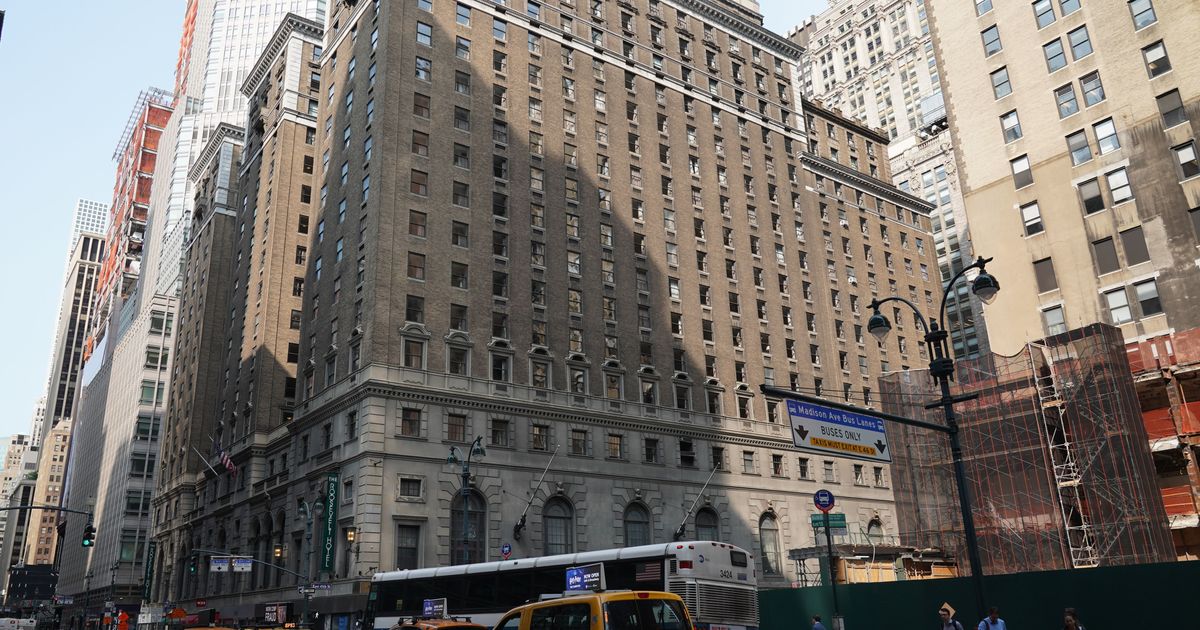
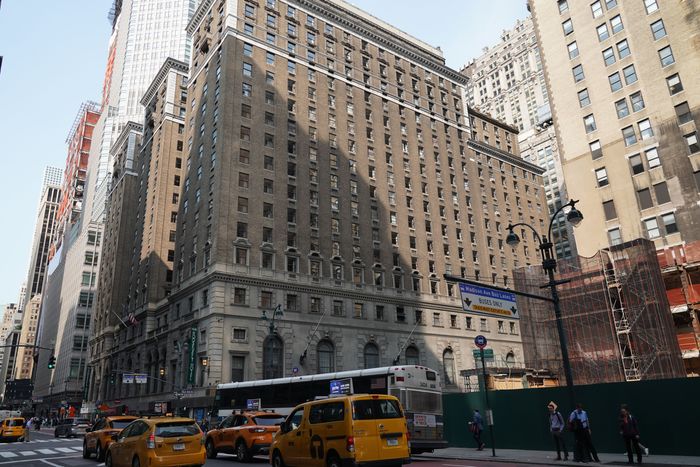
Photo: Leonard Zhukovsky/Shutterstock
Barring a really surprising turn, the Roosevelt Hotel is headed for demolition. It shouldn’t be, because we’re short on nice hotels and it’s a 1,000-room building with a lot to recommend it. If it were in London, it would be renovated and rise again. But at 45th Street and Madison Avenue, it’s got no chance. Last week, a joint deal between the overseas owners and, weirdly, the federal government all but sealed its fate. It’s almost sure to come down.
The hotel is on a prime cut of the Midtown East business district near Grand Central that the Bloomberg and de Blasio administrations upzoned in the 2010s. That change was meant to spur projects like this one, replacing older mid-rise buildings with newer taller ones, and we’re seeing the results now. Two blocks to the north, Chase’s 800-foot behemoth has been demolished for its even behemoth-ier 1,500-foot replacement. Just to the south, the old Equitable Trust building (20 stories) is gone, and another thousand-footer is going up. The Roosevelt, a stolid 19 masonry floors, can’t compete in this new game. It’s a good building but also kind of frumpy, and it spent a few years as a migrant shelter during the pandemic, so if it were to be returned to use as an upscale hotel, it’d need rehabbing. A supertall on the site seems inevitable.
Until recently, it was owned by the nation of Pakistan, which transferred it to a holding company that also controls PIA, the newly privatized Pakistani national airline. (For what it’s worth, Pakistan’s X post about the deal hints at renovation rather than demolition, but that may be a case of covering all options.) The government still seems to be in charge, though, judging by the fact that (per Reuters) this redevelopment deal was signed by Pakistan’s Ministry of Defense and the United States government’s General Services Administration. (The GSA is the federal agency that handles building operations and property management, buying everything from office chairs to roofing.) Pakistan is recovering from a severe economic crisis and needs money, and the hotel is a big overseas asset, so profitable redevelopment of the site would be a significant part of its recovery. Reports suggest that it’s worth about $1 billion.
The GSA’s involvement is … strange. Why is a federal-government agency involved with this entirely private development? The answer may be Steve Witkoff, the Trump administration’s special envoy to the Middle East, who brokered the deal — and, like the president, is a longtime New York real-estate guy. One can’t help jumping to the conclusion that he and Trump made an offer to the Pakistanis: “We’ll help you address your debts if you cut us in on the redevelopment.” That would be a perfectly reasonable offer from a for-profit real-estate company; a local operator would likely be helpful as a foreign entity attempts to deal with the eccentricities of the New York regulatory environment. But turning the GSA into a Manhattan real-estate company is a highly atypical use of federal power.
Which, of course, is a Trump thing. He does not differentiate between government action, corporate action, and his own desires; the operation of the government, in this administration, is an extension of himself. Trump is a New York real-estate developer and a dealmaker and therefore the United States is. He also has begun to recede, as his poll numbers continue to drop, into doing things he knows how to do from his previous career: the East Wing demolition and ballroom project, the Kennedy Center renovation, that ridiculous golf-course upscaling, now this. The one thing he was ever okay at was building stuff and then fluffing it in the press, and as his tariff plan implodes and his deportation plan continues to meet mass resistance, he’s gone back to his comfort zone. He has minimal interest in the details of immigration law or enforcing accountability for ICE agents, but he knows how to choose a marble sample and order an architect around. Doing so, he can feel like a winner once again.
His Republican lackeys, the same ones who natter on about limited government and deregulation and staying out of businesses’ way, will presumably get onboard with this. In doing so, they’re embracing a scenario whereby the federal government dives into the realm occupied by the private sector, using its size and scale to outcompete those entities. Were this done by anyone else besides Trump, and especially if that someone else were a Democrat, state management of a major private project would go by another name: communism.
Sign Up for the Curbed Newsletter
A daily mix of stories about cities, city life, and our always evolving neighborhoods and skylines.
Vox Media, LLC Terms and Privacy Notice
Related