
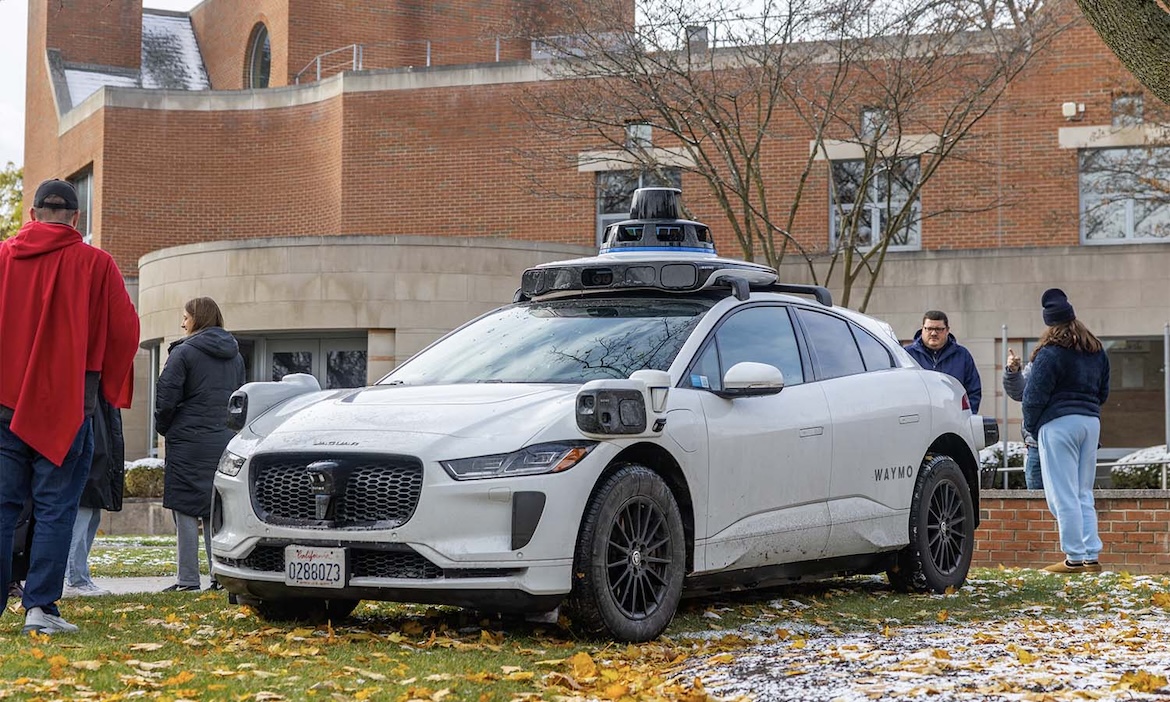
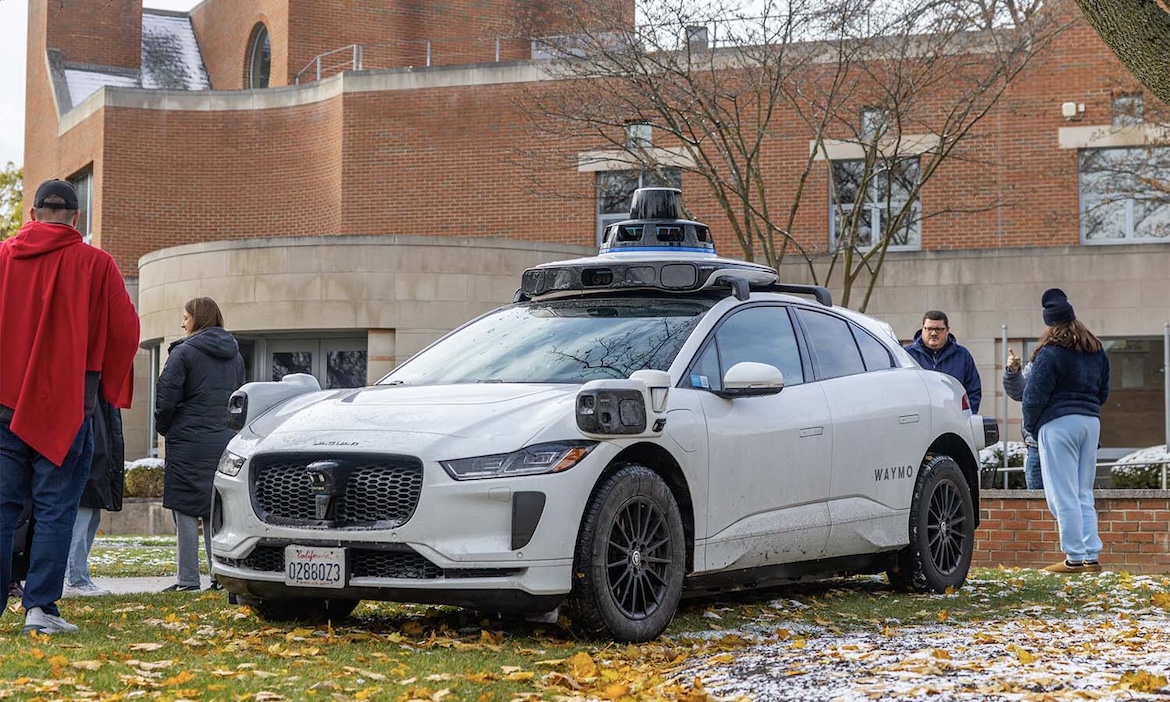
 A Waymo static showcase at Hobart and William Smith Colleges | Photo: HWS
Once poised for deployment, robotaxi programs in New York have hit the brakes.
Gov. Kathy Hochul changed course on autonomous vehicles last week, withdrawing a proposal from her budget that would have allowed robotaxi pilot programs in areas outside New York City. This reverses AV-friendly language in Hochul’s State of the State book, where she praised their safety and accessibility.
For proponents of the technology, including state Sen. Jeremy Cooney, who chairs the Transportation Committee, it represents a setback. In November, he made a supportive appearance at a Waymo static showcase at Hobart and William Smith Colleges.
“I’m disappointed in Governor Hochul’s decision to remove her support for expanded use of autonomous vehicles in New York,” Cooney said in a statement. “As New York’s champion for this technology since 2022, I will continue to work with the Governor and my state legislative colleagues to address concerns and work towards a solution that allows all New Yorkers to benefit from this technology, which many large states and cities have already embraced.
“This is not science fiction, rather a real opportunity to increase driver and pedestrian safety across our state,” he continued. “I remain committed to working on a standalone bill on autonomous vehicles outside of the budget process, especially with partners in organized labor to address their concerns. As Chairman of the Senate Transportation Committee, I will prioritize my legislation during the remainder of this legislative session so all New Yorkers can benefit.”
Cooney still believes in the future of self-driving commercial passenger vehicles and has confidence in his own bill, introduced last year and currently in committee. The legislation would allow a person to operate a fully autonomous vehicle on public roads without a driver, provided the system is engaged, and the vehicle meets certain conditions.
While Cooney hopes areas outside New York City can benefit from this technology, not everyone is as upbeat about the potential. News reports of accidents in cities that widely use AVs have raised questions.
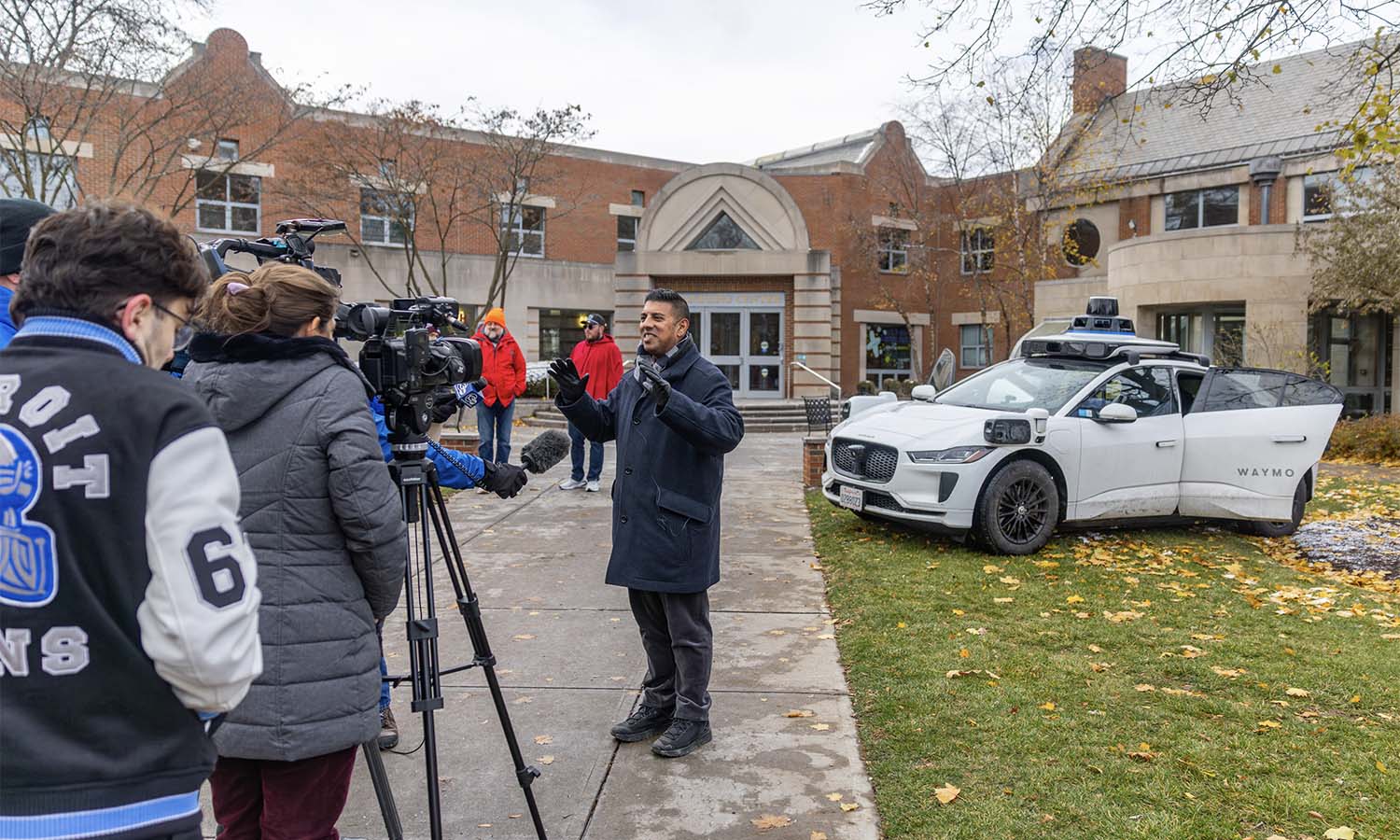 State Sen. Jeremy Cooney stopped by a Waymo showcase event in November. | Photo: HWS
Cooney’s drive for AV adoption is also born out of FOMO (fear of missing out), which he says occurred about a decade ago with ridesharing apps like Uber and Lyft. The statewide rollout for those services was slow, spread over several years.
David Bastian, legislative chair of the Limousine Bus Taxi Operators of Upstate New York, also recalls the time when ridesharing came to New York, but as a cautionary tale of out-of-state corporations crushing their competition. LBTUNY is a self-described “citizen lobbyist” organization representing over 30 transportation services and livery providers in Buffalo, Rochester, Syracuse, Albany, and Niagara Falls.
“It felt like the cards were stacked against us and there was no way we could win,” Bastian recalls. “We’re kind of seeing (AVs) as the same thing.”
“Why is Upstate New York going to be the experiment for this, when places like California are having such a hard time struggling with all these issues?” adds Dave Brown, LBTUNY vice president and an operator of a transportation service. “I praise the governor for realizing, we need to take a step back right now and say, ‘Hey, if California’s having all these problems with these driverless vehicles, shouldn’t we learn from that?’”
Brown says that, even while they would be competing for riders, he does not have a problem with AVs. In fact, he believes self-driving technology is inevitable and could see a future in which he purchases some for his livery fleet.
However, LBTUNY is concerned that both safety and liability standards are currently weak or nonexistent for AVs, and the playing field would not be level compared to traditional legal driving services. Therefore, it applauds Hochul’s decision to withdraw her proposal.
Local street-safety and public transit advocacy group Reconnect Rochester sees both benefits and concerns with AVs, but, above all, is calling for a measured approach to their implementation. Before Hochul spiked the proposal, Reconnect Rochester co-signed a letter along with 18 other community organizations across New York calling for increased oversight and transparency.
“We understand these are probably going to be rolled out by the state. It’s the trend,” says Cody Donahue, co-executive director of Reconnect Rochester. “So if it is to be rolled out, we want to make sure that there’s public process, that municipalities get to opt into it, that they give residents the opportunity to have a public hearing on the issue, that there’s data transparency and reporting, and that there’s some kind of evaluations process by the DMV to make sure that the companies are following all the rules that they’re supposed to.
“And when the vehicle inevitably goes haywire or has a glitch, that company is able to be held accountable, whether that’s for blowing a traffic light or hitting somebody or passing a stopped school bus,” he adds.
“We’re asking for transparency,” says Henry Litsky, policy and advocacy coordinator for Reconnect Rochester. “Transparency in data, transparency in how these decisions are being made. We want the public to be involved in shaping the future of our transportation system, especially when AVs could be very disruptive in a very positive way, or it could be in a negative way.”
California’s experience
Cooney believes that the AV market has made some strides. He points to more than 25 states that have some kind of program—either a testing phase or full use.
“As of this year, in January 2026, there’s been over 20 million rides in a fully autonomous Waymo car in the United States,” he says. “What’s going to happen is New Yorkers are going to get on planes and go to Los Angeles, go to Vegas or wherever, have an experience and say, ‘Why don’t we have this in New York?’
“There’s going to be that pressure for us to engage as the rest of the country is engaging with this type of technology,” he adds. “For New York State to stick its head in the sand and say, ‘We’re not going to allow this type of technology in the state’ is really irresponsible and just not productive.”
Driverless passenger taxis have been operating since 2020 in cities like Phoenix, Atlanta, Miami, Las Vegas, and Austin. California, however, is perhaps the most AV-forward area in the nation, with Silicon Valley-based Google beginning to develop the technology in 2009 before spinning off the effort seven years later into Waymo, a subsidiary of Google parent Alphabet.
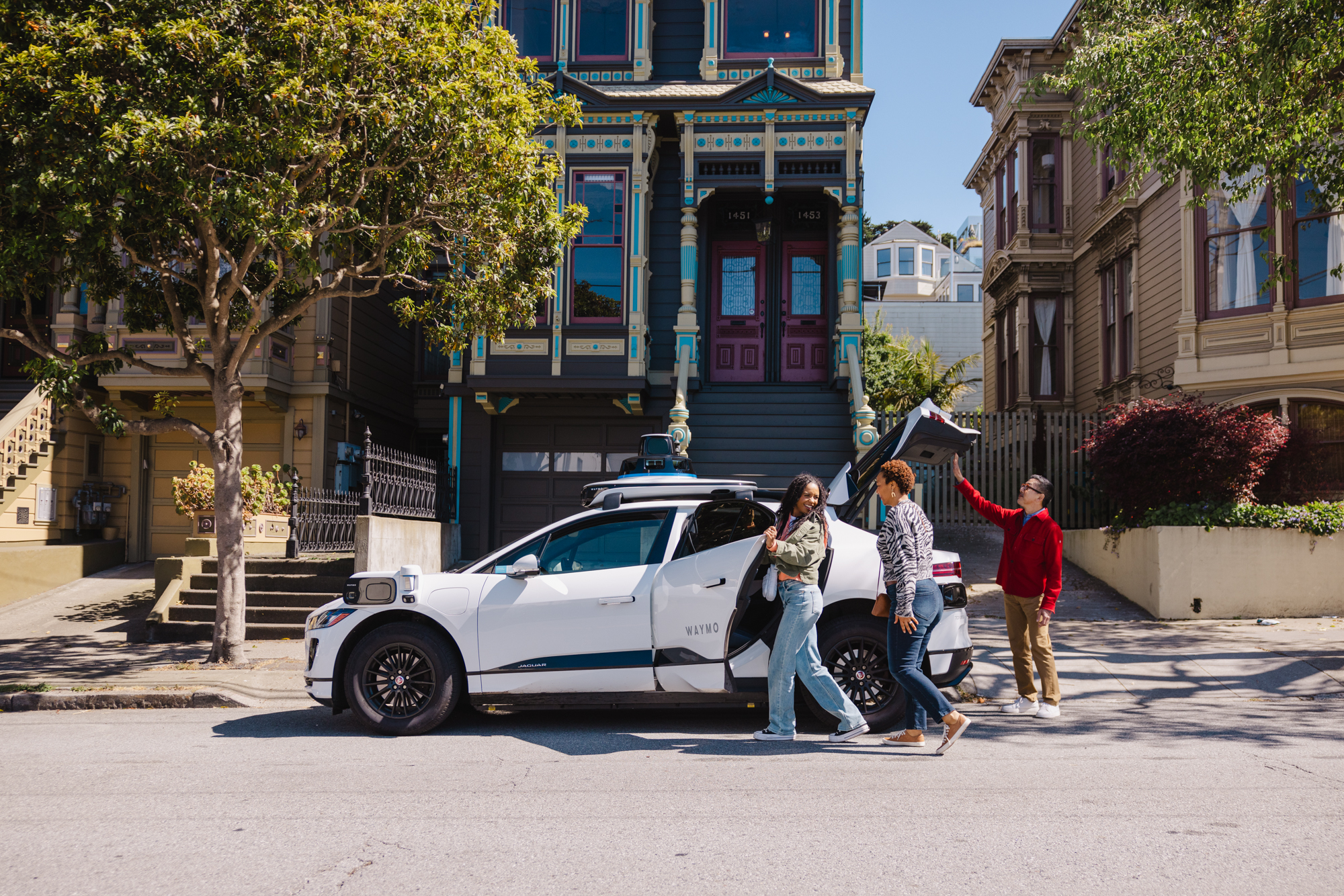 A Waymo in San Francisco | Photo: Waymo
Data from the California Department of Motor Vehicles offer a sense of this scale and expansion. In 2018, 651 AVs were registered in the state. By 2024, there were 2,819.
In 2024, 1,119 (40 percent) of those were owned by Cruise, the General Motors-backed AV company that suspended driverless operations in 2023. Waymo was second with 1,035 vehicles (37 percent), and Amazon-owned Zoox followed in distant third with 380 (13 percent).
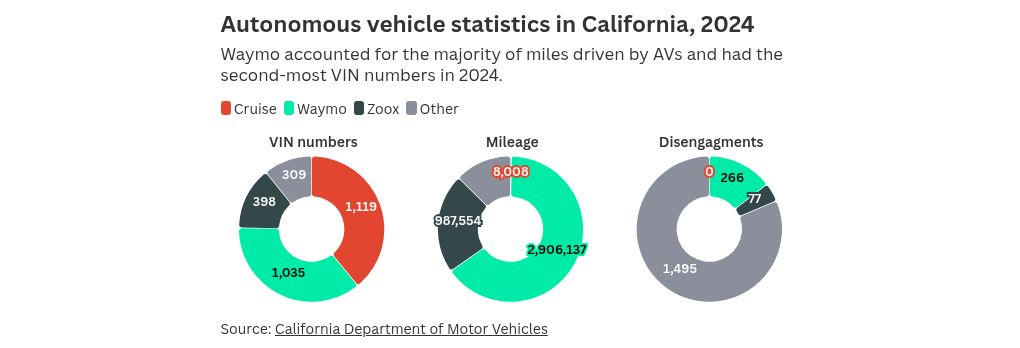
The listed vehicles differ in their level of self-driving automation, from level 3 or conditional driving automation—which means drivers may have to intervene if systems reach their limits— to level 5 (full driving automation). Currently, only six of 30 manufacturers are permitted to test fully driverless vehicles in the state.
Tesla, a big name in the AV space, has rider assistance technology in its owner-driven vehicles and launched a ride-sharing program in the Bay area. However, Tesla does not currently have the proper permits to operate without a safety driver in California and was recently hit with a false advertising ruling in the “Autopilot” and “Full Self-Driving” feature.
Combined, California AVs recorded 3.9 million miles of driving in 2024, with 552,000 of those miles driven in fully driverless mode. Waymo vehicles accounted for 2.9 million (65 percent) of that total mileage and 516,572 (93 percent) of the driverless mileage.
Over those millions of miles, there were 1,795 AV disengagements, meaning vehicles disengaged from autonomous mode due to technical failures or other situations. Most disengagements involved manufacturers other than Waymo or Zoox, suggesting that those larger companies’ cars experienced fewer issues than others’.
The safety picture
Waymo has sought to position itself as the responsible AV company in the industry. It has made its research into AV technology public, most recently publishing a peer-reviewed study into crashes last year.
That study counted 56.7 million miles of rider-only rides with level 4 automation, just a step below fully driverless. It found that the automated driving system had much lower crash rates compared to human benchmarks. The biggest difference they found was in vehicle-to-vehicle intersection crash events, where AVs had 96 percent fewer reported injuries and 91 percent fewer airbag deployments compared to the human benchmarks.
“Since the pandemic, the data on driver safety is very clear,” says Cooney. “We have seen increased pedestrian and cycling accidents. We’ve seen worker aggression or driver aggression towards transit workers. We have seen distracted driving rates go through the roof with all the new technology we have on our phones and in our cars.
“In a country where we have nearly 40,000 automobile fatalities every year, we should be looking at every form of technology to help save lives,” he adds. “I believe that AV technology is one of those tools in the toolbox to help reduce accidents and fatalities.”
While Waymo has made efforts toward safety, Donahue notes that these studies are self-reported and made public only because of the company’s prerogative, rather than as a regulatory measure.
“I think the issue is we don’t know what we don’t know,” he says. “They are disclosing it based on their own criteria. So they might have more crash data, they might even have incidents that they’re not reporting, but that’s speculation because it’s self-disclosed.”
“There’s a lot of scholarship and a lot of folks in academia going back and forth on whether (AVs) are extremely safe or they’re actually more dangerous than human drivers,” adds Litsky. “Having abundant transparent data will allow that discourse to continue and really be able to figure out what’s working and what isn’t working so that we can help to move forward in a way that really is prioritizing safety.”
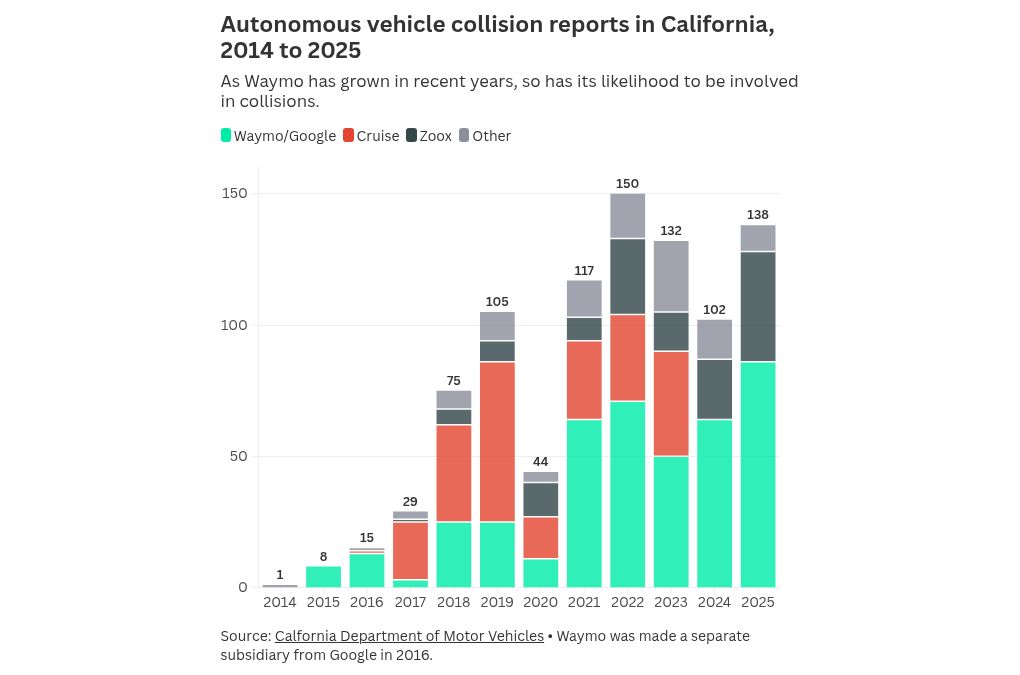
Reports from the California DMV show that Waymo had the most collisions of any AV operator. Of the 925 collisions involving AVs since 2014, Waymo accounted for 46 percent, followed by Cruise (26 percent) and Zoox (16 percent). The remainder involved other companies developing AVs, including Apple, Pony.ai, WeRide, Mercedes-Benz, and others.
Absent from those collision figures is the context for a series of disastrous events for Cruise AVs. In 2023, a Cruise vehicle struck a fire truck. In a different incident, the car dragged a pedestrian, who had been hit by a different vehicle, for 20 feet. A report showed Cruise knew its AVs had difficulty recognizing children. This scrutiny led the company to suspend all driverless operations in October of that year.
Even for Waymo, operational issues persist, with some recent high-profile incidents with school buses.
The company is facing a federal investigation after one of its vehicles struck a child last month during an elementary school drop-off. In December 2025, the Austin Independent School District released an eight-minute video showing multiple Waymo AVs illegally passing school buses with flashing red lights and stop signs. While the company issued a voluntary recall to resolve the issue, it seems yet to be fixed.
Rochester’s system of fines for school bus stop violators recently went into effect, with Mayor Malik Evans saying there had already been “hundreds of violations per day” at a recent public safety press conference.
“We shouldn’t push this forward that fast. We need to make sure everything’s right before, God forbid, somebody gets in an accident or a kid gets run over by one of these vehicles passing a school bus,” Brown says.
“Let’s learn from those mistakes. Let’s ensure that the legal framework for operation takes into account those issues,” Donahue adds.
Litsky also notes that changes at the federal level have left this area in some uncertainty. While the Biden administration instituted more detailed reporting and investigation measures, the Trump administration has limited the scope of AV crash reporting, indicating that it is allowing for more experimentation with AVs.
Uber memories
As the story of AVs has developed, members of the LBTUNY are reminded of when ridesharing apps first came to Upstate New York.
While Uber launched in New York City in 2011, Bastian says, Lyft attempted to operate in Buffalo in 2014, beginning its operations in a legal grey area. The company argued that it had private drivers rather than “for hire” car services, thereby allowing it to bypass certain regulations. Although LBTUNY saw some initial success pushing back against this claim, ridesharing expanded to the rest of the state in 2017.
“What I’m fearful of is that if we do not engage with it, then there will be disruptive players like what we’re seeing with Tesla. They’ve gone into parts of Texas and just started putting their fully autonomous vehicles on the streets of Austin and Dallas. And they’re not getting permits, they’re just operating,” Cooney says. “We don’t want to become the wild, wild west here. We want to make sure that we have some bright light rules of safety and transparency.”
In LBTUNY’s view, the expansion in 2017 was the result of ridesharing apps mounting a full-court lobbying press. A report by government accountability research nonprofit LittleSis found that Uber and Lyft spent more than $1.7 million on lobbying state and local governments in Western New York in the last six months of 2016.
“(Uber and Lyft) lobbied every chamber, the restaurant association, the hotel association, the Buffalo Sabres and the Bills; they got every organization you could think of to get on their side,” Bastian notes. “And they crushed us.”
Politico reported earlier this year that Waymo has spent $1.8 million lobbying Hochul and other state officials since 2019.
The Cooney-sponsored bill has already received its share of attention from lobbyists. According to publicly available records, the senator was lobbied 69 times on this proposed legislation, with 50 of those entries on behalf of Waymo.
The CenterState Corporation for Economic Opportunity, a Syracuse-based economic development organization, spoke four times on this bill when the senator was listed as present. CenterState CEO has been a booster of AV development in the state, with Waymo as a sponsor of its INSPYRE Innovation Hub.
On the opposing side, Open Plans, a “people-first street culture” group and Reconnect Rochester letter co-signer, has been heavily critical of plans for AV expansion into New York. The group has expressed doubt about the accuracy of safety test data from AV companies and wants enforcement mechanisms to hold companies accountable in New York. Open Plans had two meetings listed with Cooney as present.
Other parties that spoke with Cooney on the bill included the Amalgamated Transit Union of New York, the New York State AFL-CIO, and American Federation of State, County and Municipal Employees.
“Senator Cooney has met with advocates on both sides of this debate,” a statement from Cooney’s office reads. “His support for this bill is rooted in his work as Transportation Chair of the Senate and his goal to enhance access to transportation services for New Yorkers statewide.”
Calls for a measured approach
Aside from the potential to make streets safer, Cooney is also a proponent of AVs because they increase accessibility for the differently-abled. For example, the American Council of the Blind of New York supported Hochul’s initial proposal for AVs.
The organization emphasizes that transportation is a major challenge for people who are blind or have low vision, as public or paratransit services are not offered in certain locations or at certain times. AVs could be a “game changer” allowing these people to lead more independent lives.
“We strongly encourage the safe commercial use of autonomous vehicles throughout the state as soon as possible,” Rodney Stanford, president of ACBNY, said last month. “There is still much work to be done to turn the promise of autonomous vehicle technology into a tangible reality. ACBNY stands ready to continue advocating for this technology and supporting those who are doing the work to make this happen.”
Cooney also sees use cases for Rochester’s young college students and for people who need transport at odd times.
“(College students) don’t necessarily want to get into a car with a human being behind the wheel who could take advantage of them or could harass them in some way in a late-night hour situation,” he says. “A Waymo or another provider could ameliorate that, right? They get the safety of their own vehicle, the security of their own vehicle without any sort of tracking or interaction with someone while they’re in a vulnerable state.
“When I fly, I’m usually getting up at the crack of dawn,” Cooney adds, using a personal example. “It is very hard to find a taxi driver or Uber and Lyft driver at 4 o’clock in the morning because people don’t want to get up that early. But an autonomous vehicle doesn’t care what time of day it is. We also know that when it’s raining or when it’s snowing, there are less Uber and Lyft drivers and taxi drivers on the road, and surge pricing goes into effect, because the demand is higher. That doesn’t happen with an autonomous vehicle.”
LBTUNY still questions whether AVs are up to the task of upstate weather. Brown predicts the model of car used by Waymo, Jaguar I-PACE, will quickly require maintenance in this region. He also notes that AVs are currently being sold at relatively low prices.
“You figure, why are they so inexpensive right now? It’s because they’re trying to flood the market with these vehicles,” says Brown. “But sooner or later, if this company wants to make a profit, they’re going to have to pay the piper.
“Uber did the same thing, they got into the market very inexpensively, and they learned their lesson. In fact, you see surge pricing. So if you’re in an Uber now, you’ll pay more than a taxi cab for the same trip.”
Brown also wonders about licensing and insurance, asking who will pay if AVs are involved in accidents. He says he has “more questions than answers,” and needs to see more development before feeling confident about the rollout.
Similarly, Reconnect Rochester raises additional questions, noting difficulties ticketing AVs that are not following the rules of the road, AVs shutting down during blackouts, and the potential for external AV operators to create cybersecurity vulnerabilities. (A Waymo executive recently told a Senate committee that the company has 35 remote workers in the Philippines who assist its vehicles.)
While Reconnect Rochester is open to self-driving technology, ultimately, it wants any rollout to consider various issues. It believes the letter sent to Hochul is a good outline of what to work toward.
The letter advocates for:
■ local support to be determined by a municipal resolution, which can create incentive or exclusion zones and other resolutions to best serve their community;
■ transparent collection and public release of data, including disengagements, traffic violations, mileage, and more;
■ the ability for law enforcement to ticket AVs that violate vehicle and traffic laws, and a framework to incentivize safe operation; and
■ oversight of remote operators, including requiring those to have a valid New York State license.
“We already know that we have the toolkit today in terms of what we can do to eliminate fatalities and serious injuries on our transportation system. That’s something that we advocate on a daily basis,” Litsky says. “If we look to many European and Asian cities, they are on the road to achieving Vision Zero or significantly lowering traffic fatalities and injuries through other measures, such as traffic calming, lowering speed limits, doing automated enforcement, and changing driver behavior.
“I think there are a lot of folks who will say that we have a traffic violence crisis in America, and we have thousands of people dying on our streets every year, which is true. And they’ll say that AVs are the solution, but they’re definitely not the only solution,” he adds. “But if there are a bunch more vehicles out there that are following speed limits, that are really obeying traffic laws and yielding to pedestrians, that is a great thing to have on our roadways as well.”
Henry Litsky is a Rochester Beacon contributing photographer.
Jacob Schermerhorn is a Rochester Beacon contributing writer and data journalist.
The Beacon welcomes comments and letters from readers who adhere to our comment policy including use of their full, real name. See “Leave a Reply” below to discuss on this post. Comments of a general nature may be submitted to the Letters page by emailing [email protected].
Related