
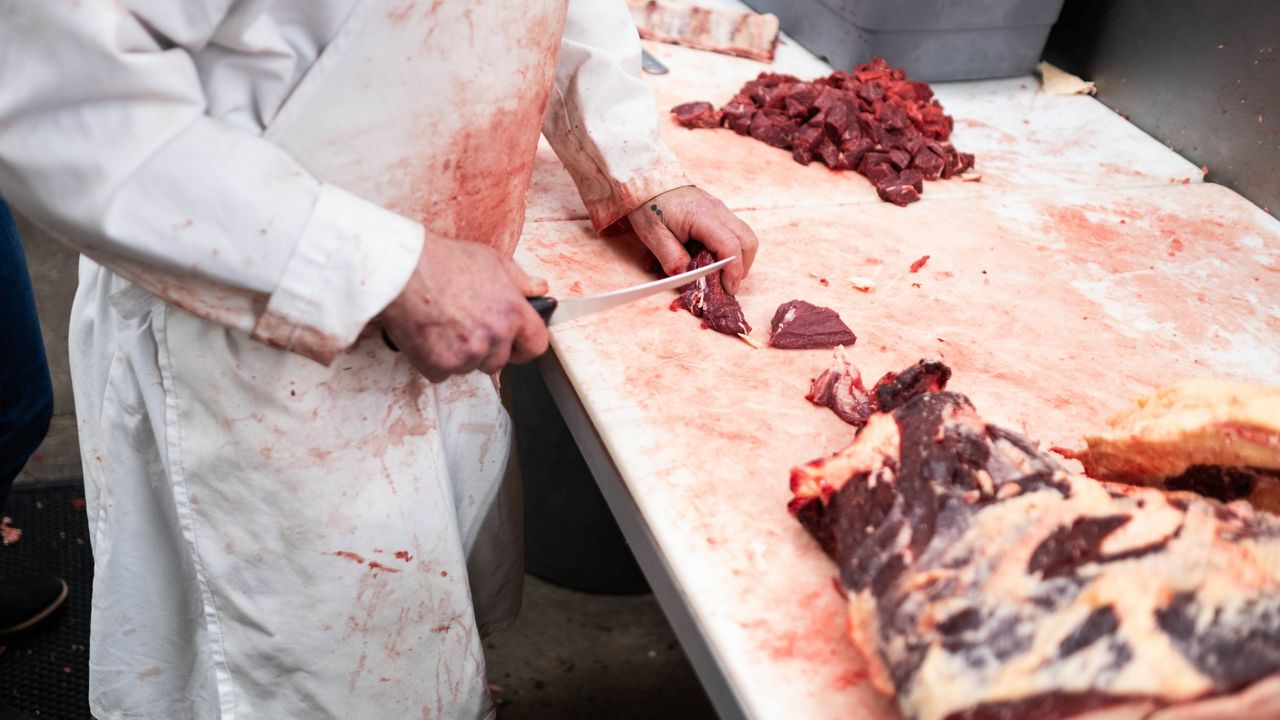
Finding employees to fill positions in the meat industry can be a challenge, a new apprenticeship program through the New York state Department of Labor is opening the door for businesses to teach more people about the practice.
Amy Barkley, a livestock specialist with Cornell Cooperative Extension, spearheaded getting this program off the ground.
“This idea was part of a long-time conversation that’s been going on for many, many years and that conversation was really, ‘we don’t have enough butcher shops to process our livestock for small-scale farmers,’” Barkley said.
After the COVID-19 pandemic, Barkley said the program was seeing more of a personnel shortage rather than a facility shortage. While there have been investments to build new facilities and purchase equipment, there hasn’t been investment in the workforce, she said.
“We’ve been talking to several processors, and they are moving either to only slaughtering their own animals and not taking in external and even decreasing the amount of animals they take overall in part because they don’t have qualified people to take over that role,” Barkley said.
Some people have the skills to cut meat that has already been slaughtered and broken into parts, but there is a lack of people who can do the whole process from beginning to end, Barkley said.
“When you take it all the way back to handling the animals as they’re coming off the truck, holding those animals in pens, moving them through the process, slaughtering them, gutting them, dehiding them and then processing them out, there’s a huge gap in education there,” she said.
The 36-month program is broken out into nine coverage areas including sanitation and safety, the pre-slaughter process, slaughter and butcher process, and preservation. In total, apprentices complete approximately 6,000 hours of education, plus 144 credit hours per year of classes.
“In addition to cutting down meat, we have further processing information in there so making sausages, making jerky, making bologna, making European style meats, all the way through sales and marketing, food safety and quality, and animal welfare and handling,” Barkley said.
Thomas Moriarty owns Moriarty Meats in Buffalo with his wife Caitlin. They focus on using all parts of the animal, averaging at about 95% of every animal including bones and fat, where the industry standard is about 65%. Moriarty worked with the Department of Labor to help develop the requirements for the apprenticeship program.
“There is definitely a need for it. There’s just not a lot of slaughterhouses left. Nobody seems to want to take up the torch,” Moriarty said.
There are culinary programs that include certain butchering skills, but Moriarty said there are no trade schools that offer the experience he had while studying in France.
“The last program here in New York state was in 1981, as far as I know. Every time I lose a guy, or we need to add somebody to the workforce, it’s really hard because myself and the other guys who have trained over the years have to take on the new worker and really teach them from the ground up,” Moriarty said. “It would be great after a few years of running this program, we can build a base of workers who are able to come in and hit the ground running right off the bat.”
Moriarty said it is difficult to find people who have experience outside of cutting steaks and grinding meat in a grocery store.
“Within the industry, usually next to impossible to find somebody who has not just meat-cutting experience but breaking down whole animals, knowing how to make sausage, and other value-added products,” he said. “We usually end up getting people from the culinary industry who are interested in butchery and training them, because they at least have a base in food preparation.”
Moriarty hopes the apprenticeship program begins to build the industry in New York.
“It’s really tough to find people that are willing to do this work. Some people say they want to learn butchery, and they kind of expect that they are going to pick it up in a week, a month, a year, but it takes more than that so this apprenticeship program, I feel like, is a starting point to building a foundation for small businesses like myself and slaughterhouses,” he said.