
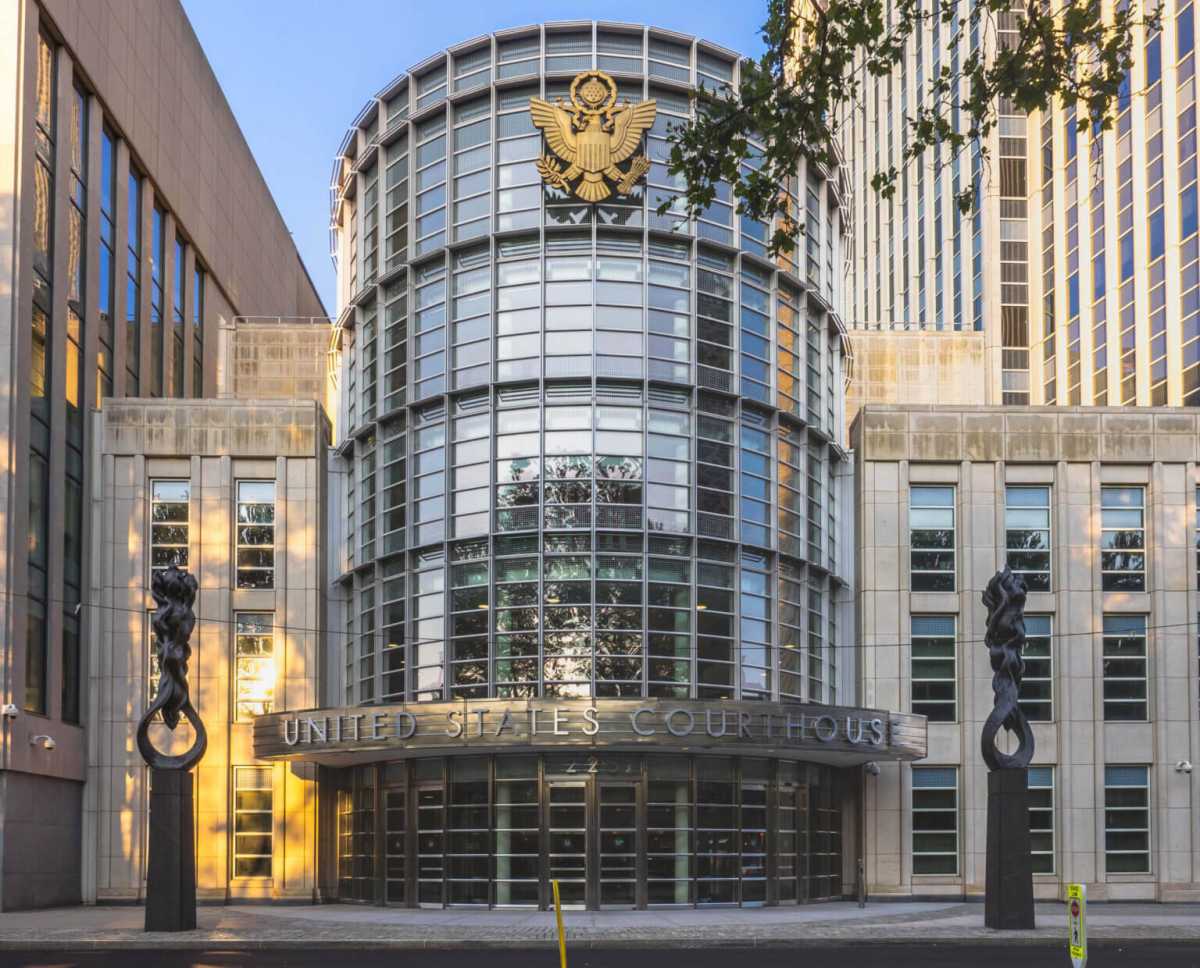
The federal courthouse in Downtown Brooklyn.
Ajay Suresh via Flickr
At a trial in Brooklyn federal court, prosecutors are unpacking their case against Asif Merchant, a Pakistani man with ties to Iran who is accused of taking part in a 2024 terrorism attempt and plot to kill Donald Trump.
Merchant, who faces a life sentence if convicted in the Eastern District of New York, allegedly asked a New York City contact, Naseem Ali, to connect him with two hit men. Unbeknownst to Merchant, Ali, a former translator for the U.S. military who served in Afghanistan, had already informed the FBI about Merchant’s suspicious requests — and those hit men were in face undercover agents.
Ali, who’s testifying under a pseudonym, took the stand Wednesday and Thursday as the first government witness. He said he met Merchant back in 2017, and the two stayed in touch but weren’t close friends. They discussed possibly going into business together, with Merchant working abroad and Ali based in New York.
It was in May 2024 that Ali contacted the FBI, he said, after he noticed he was being followed by as many as eight or nine cars whenever he was driving around with Merchant. He became an informant.
Assistant U.S. Attorney Sara Winik asked Ali why he offered to help the feds.
“I serve this country before and I will serve it again. If you need it, I will serve it again and again and always,” Ali said. He also testified that the FBI paid him $20,000 for his time and services.
In June 2024, the two men met at Merchant’s hotel room in Queens, where Merchant told him he wanted to hire people to steal documents or a USB from a house; stage a protest at a political event; and kill a high-up U.S. political official.
Video footage of that meeting shown to the jury — Ali, who’d booked the room, gave the FBI access before the rendezvous — shows Merchant unfolding a napkin on a table and placing on it what appears to be a disposable vape, standing upright. “This is the target,” he says in the tape.
“I was shocked,” Ali told the jury, which is being kept anonymous. But he insisted to Merchant that he could help him with his plot.
“The FBI told me, ‘Play along with him … just keep going with it,” said Ali, who is originally from Karachi, Pakistan, and moved to the U.S. when he was 18 years old.
The two men then discuss hiring people to commit the slate of crimes including the “big job” of assassinating a political figure. While trial attorneys so far haven’t referred to Trump by name, defense attorneys confirmed in a pre-trial document that the case involves “charges that the defendant was acting as an agent of a foreign government and was plotting to assassinate high-ranking government officials, including President Trump.”
Merchant is charged with one count each of attempting to commit an act of terrorism transcending national boundaries and murder for hire.
According to prosecutors, Merchant ultimately paid the FBI agents posing as hit men a $5,000 cash deposit to fund the assassination, making the payment on June 21, 2024. The defendant then made plans to leave the U.S. on July 12, but was arrested before he could fly out. He has been in U.S. custody awaiting trial.
During a brief, 10-minute opening statement Wednesday Assistant U.S. Attorney Nina Gupta laid out the government’s case and hinted as to Merchant’s perceived motive. “He said that the target would not be a normal person, but someone who was hurting Pakistan and the Muslim world,” Gupta said.
Defense attorney Christopher Neff reminded jurors in his own 15-minute opening that even as a non-U.S. citizen, Merchant is entitled to the presumption of innocence and to a fair jury. He described Merchant as a well-educated, “self-made man” who worked as a banker and who loves his family — before revealing a surprising detail about Merchant’s personal life.
“In fact, you’ll learn that he has two families,” Neff said: a wife and children in both Iran and Pakistan.
“To be clear, having two wives is perfectly legal in both of the countries Mr. Merchant calls home,” he said.
Neff also told jurors to think about why government witnesses might not be telling them the truth. “Public officials lie to our faces, and they expect to get away with it — and they often do,” he said.
The two undercover agents are expected to testify at trial under pseudonyms.