
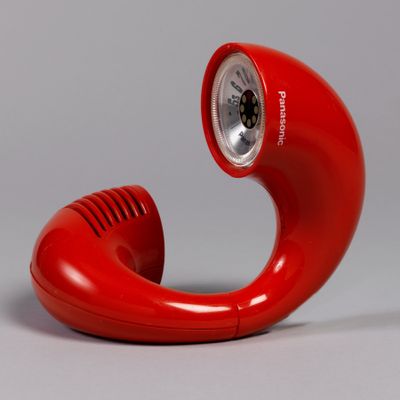
R-72 Toot-a-Loop Portable Radio from 1971, designed by Daisuke Kajiwara and manufactured by Panasonic.
Photo: Matt Flynn
For those of us who grew up analog, a visit to the Cooper Hewitt’s survey Art of Noise turns into a nostalgic romp through the technologies of yesterday. My Proustian trigger was a portable gramophone designed by Mario Bellini for the Italian company Minerva. As a child, I spent hours in the backseat of the family station wagon entertaining myself with a similar gizmo, shaped like a bright plastic club sandwich. The mangiadischi, or “record-eater,” would swallow a 45; spin it for four minutes of crackly, tinny song; and then spit it out again with a click and a whimper. It must have driven my parents crazy.
The exhibition covers more than a century’s worth of music and design — or rather, design for music — and along the way it prompts a whole series of such full-body memories. I can recall a roll call of music machines, each with its own hazards and revelations, each tied to a moment in my evolving taste. It’s no accident that my mind goes back to a pocket music maker, because the story that the Cooper Hewitt tells is largely a chronicle of portability.
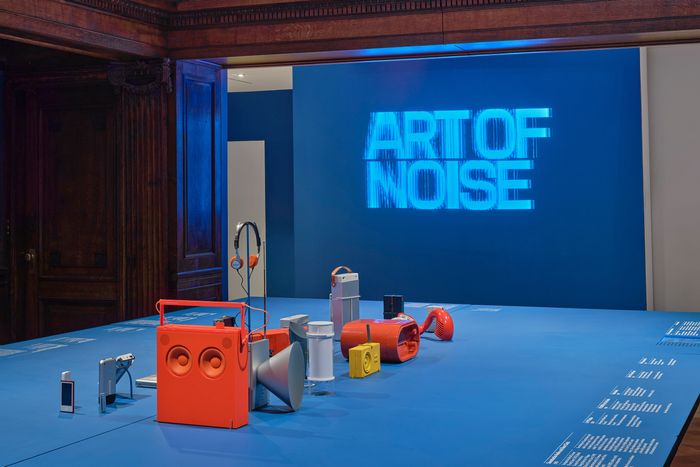
Installation view of “Art of Noise.”
Photo: Thomas Barratt/
We never had a living-room record player, so I didn’t buy LPs. Instead, as a teenager I learned from my father to record music from the radio onto cassettes, which I stashed in shoeboxes and popped into players that were rarely larger than a paperback. At one time or another, I wore out a portable radio that was fickle about staying tuned to my favorite station, a top-loading cassette deck (I always kept an ear out for the wet warble of tape getting caught in the spools), a compact boom box that eventually quacked more than it boomed, a Sony Walkman that should really have been called Dropman, given all the concussions it survived. These advances were all miraculous in their day. I remember the first time someone popped a set of high-end Braun headphones over my ears and suddenly, I had Mick Jagger drawling in my brain.
Later, I was working for a record company when the compact disc arrived, igniting a renaissance in sales as consumers replaced their collections with the new technology, orchestras rerecorded the entire repertoire in digital format, and engineers remastered the whole history of pop music. But the CD wasn’t really compatible with portability. The Discman, as Sony illogically called the descendant of the Walkman, was a backward step, since it barely fit in a coat pocket and the disc skipped if your gait was any more irregular than a glide. (Later versions got more rugged, but they still protested if you ran for a bus.) As car stereos transitioned into and then out of CDs, we drove thousands of western miles with a cassette player propped on my wife’s lap so that we could keep our son mesmerized by Harry Potter books on tape.
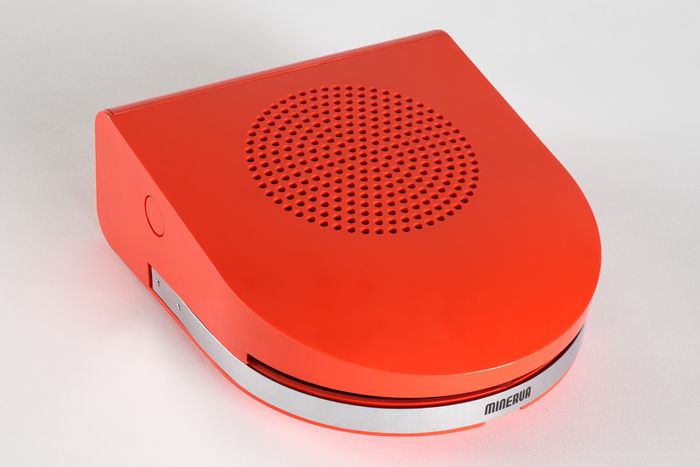
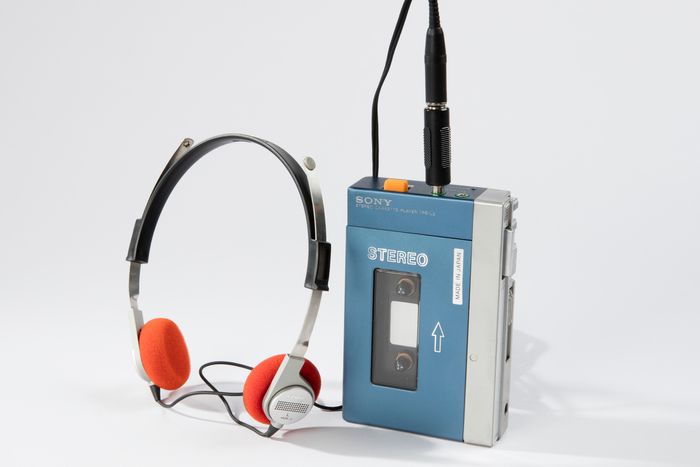
From left: Mario Bellini’s Pop Automatic Record Player from 1968. Photo: Katherine Du TielWalkman cassette player and headphones from 1979, designed by Akio Morita and Kozo Ohsone, manufactured by Sony. Photo: Matt Flynn
From top: Mario Bellini’s Pop Automatic Record Player from 1968. Photo: Katherine Du TielWalkman cassette player and headphones from 1979, designed by… more
From top: Mario Bellini’s Pop Automatic Record Player from 1968. Photo: Katherine Du TielWalkman cassette player and headphones from 1979, designed by Akio Morita and Kozo Ohsone, manufactured by Sony. Photo: Matt Flynn
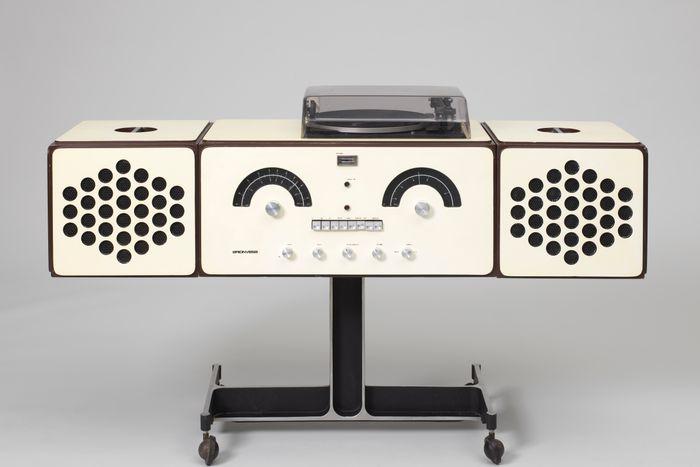
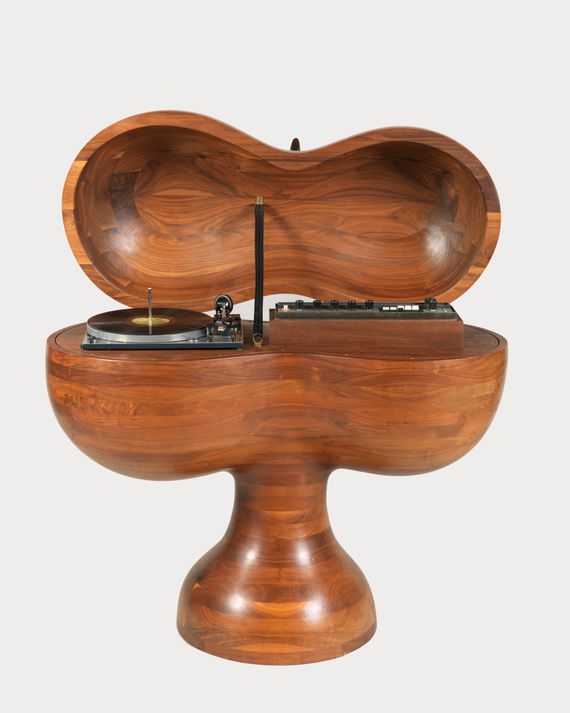
From left: RR-126 Radio-Phonograph from 1965, designed by Achille Castiglioni and Pier Giacomo Castiglioni for Brionvega, S.p.A. Photo: Matt FlynnStereo Chest from 1973, designed and made by Wendell Castle. Photo: Ellen McDermott
From top: RR-126 Radio-Phonograph from 1965, designed by Achille Castiglioni and Pier Giacomo Castiglioni for Brionvega, S.p.A. Photo: Matt FlynnStere… more
From top: RR-126 Radio-Phonograph from 1965, designed by Achille Castiglioni and Pier Giacomo Castiglioni for Brionvega, S.p.A. Photo: Matt FlynnStereo Chest from 1973, designed and made by Wendell Castle. Photo: Ellen McDermott
Through all those years, technology was making a slow U-turn. For decades, classical music gave engineers a clear mission: reproduce the effect of an unamplified piano, a voice, or an orchestra, as accurately as possible, to create the illusion that the performers are there in the room with the listener. Machines were functional furniture. By the end of the 20th century, the assignments bifurcated. Some products were aimed at exacting audiophiles; the vast majority squeezed the range of timbres and volumes enough so that listeners could carry a virtually infinite music library in their pockets and pipe it directly to their ears, and never mind if they were floored by the jump from a solo lute, say, to an electronic cannonade of bass and brass. For the first time, technological progress produced lower-quality sound.
Miniaturizing the stereo so much that it weighed nothing and took up no space also made listening to recorded music a largely solo activity. The elders among us remember hanging out in a haze of pot smoke, letting a band’s latest album roll over three or four bodies draped around a teenager’s bedroom. Some blasted tunes from a pair of speakers hoisted on their shoulders as they strode down the street or gathered around parked cars for outdoor listening parties. These activities still exist (or have been commodified into high-end listening bars), but they seem as specialized and precious as a ren faire or a Civil War reenactment. Sure, music lays down a foundation of loudness in bars and DJs mix tracks in dance clubs, but most of us, most of the time, do our listening in solitude.
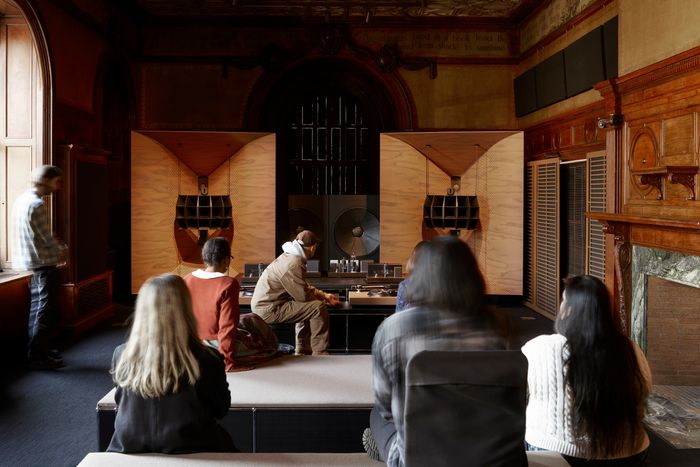
Listeners in Devon Turnbull’s HiFi Pursuit Listening Room Dream No. 3 at the Cooper Hewitt.
Photo: Mark Waldhauser
To highlight the exoticism of sharing recorded music and letting it roll around a room, the Cooper Hewitt has turned over Andrew Carnegie’s ground-floor library to the engineer and artist Devon Turnbull’s HiFi Pursuit Listening Room Dream No. 3. Turnbull has filled one end with handmade audio equipment, installed as a reverent artwork — a “shrine to music,” he calls it — and like a reconstructed chapel or Japanese tea house it’s rendered somewhat sterile by being transplanted to a museum. While I was there, a facilitator put on Nils Frahm’s “Human Range,” in which a muted trumpet meanders through a humid landscape of electronic shivers, chirps, and drips. The sound was plush, the sense of space immense, the details glistening — and half a dozen visitors sat listening in rigid discomfort.
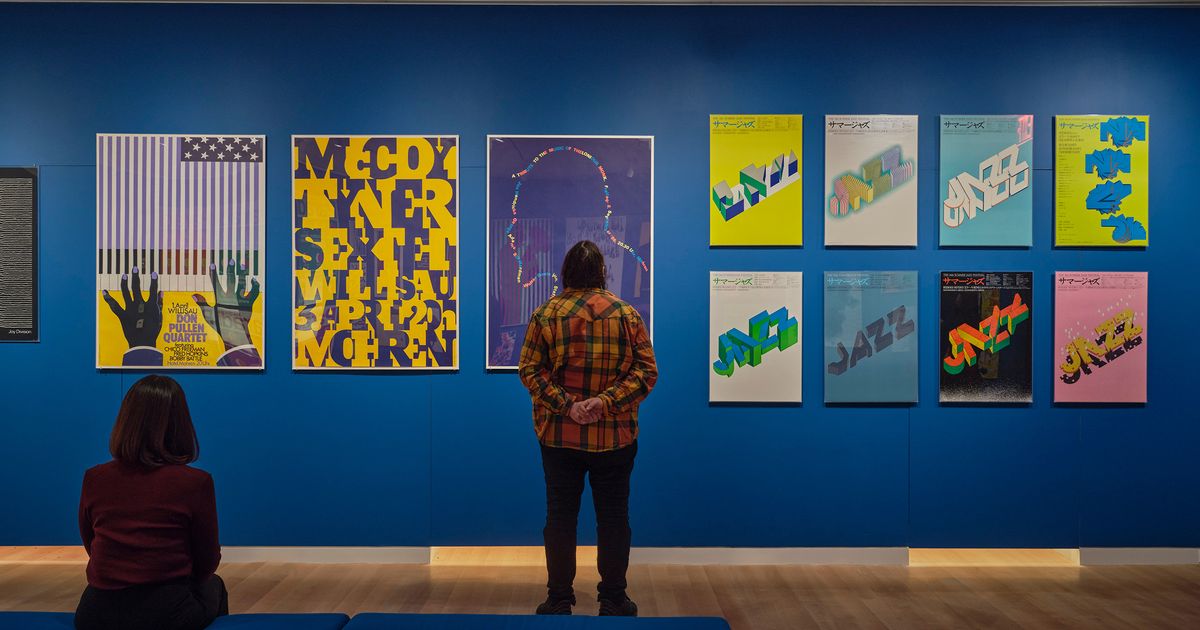
This exhibition, which was adapted from the original at SFMOMA, made me crave a genuine blockbuster. But even in its compact form, the Cooper Hewitt version takes a stab at a broader theme: It isn’t only about how we listen to music, but also how we see it. Artists translate a concoction of sound waves, overtones, and rhythms into an image that seems right, for reasons we can’t always articulate. It’s hard to pin down what the bleakly insistent, post-punk drive of Joy Division has to do with radio waves from a pulsar, as visualized by an astronomy graduate student, but the music and the diagram somehow married in the mind of the artist Peter Saville, and the cover of Unknown Pleasures became a classic. What made Martin Sharp think of Dürer’s intricate knot patterns when he heard Bob Dylan, or render all those Jewfro ringlets as so many Jasper Johns targets in a 1968 poster? It’s hardly news that rock posters and album covers, together with costume and concert lighting, gave each subgenre a distinctive visual style. But even with hundreds of objects, the show barely floats the question of how that chemistry operated, let alone explore it. It does divide up the artifacts by genre: a vitrine of hand-scrawled fliers for punk shows, another of colorful summons to salsa parties, a wall of Reid Miles’s Blue Note covers. The groupings showcase the disparate visual styles, but they do little to analyze how they relate to their separate musical idioms.
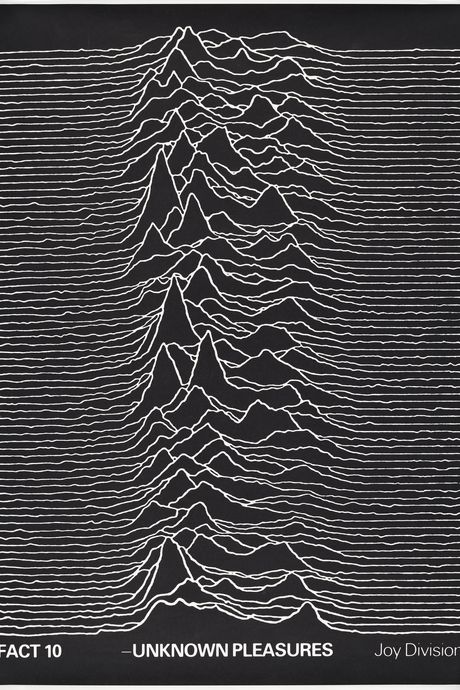
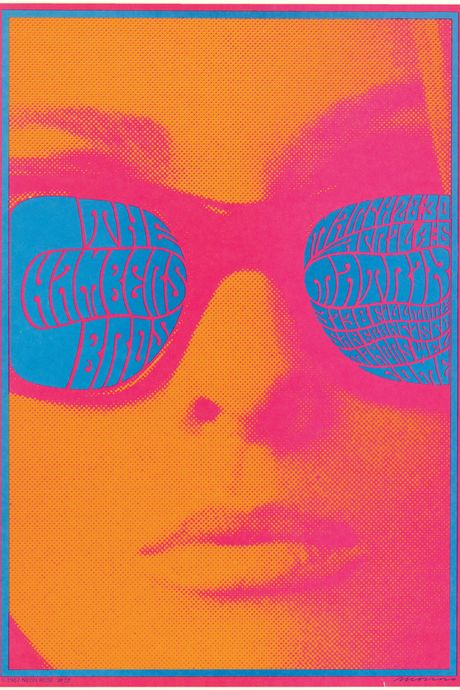
From left: Joy Division’s Unknown Pleasures Poster, 1979. Designed by Factory Records after Peter Saville. Photo: Tenari TuatagaloaChambers Brothers Band, Neon Rose #12, by Victor Moscoso. Photo: Matt Flynn
From top: Joy Division’s Unknown Pleasures Poster, 1979. Designed by Factory Records after Peter Saville. Photo: Tenari TuatagaloaChambers Brothers Ba… more
From top: Joy Division’s Unknown Pleasures Poster, 1979. Designed by Factory Records after Peter Saville. Photo: Tenari TuatagaloaChambers Brothers Band, Neon Rose #12, by Victor Moscoso. Photo: Matt Flynn
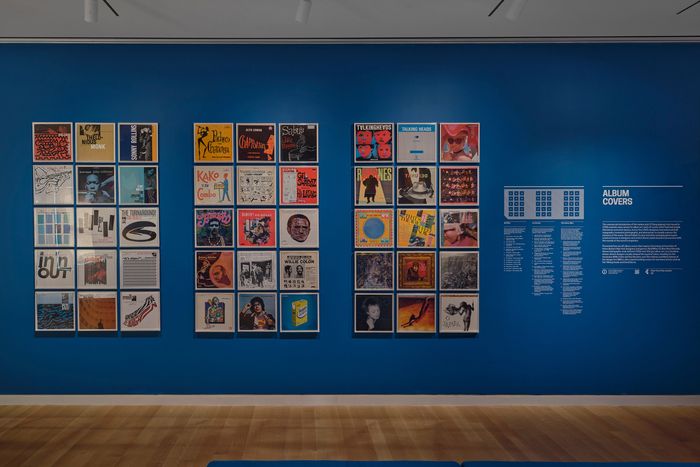
A wall of 3 distinct NYC designers and the genres they helped to define. On the left, 15 of Reid Miles’s Blue Note covers, exemplars of 1950s and 1960s’ jazz cover art; in the middle, Izzy Sanabria’s designs for salsa musicians such as Willie Colón and Ray Barretto, and on the right, Tibor Kalman and Maira Kalman of the firm M&Co, who created art for new wave and experimental artists such as the Talking Heads and Laurie Anderson.
Photo: Thomas Barratt/
We get a grid of Miles’s album covers from the 1950s and ’60s, for instance, with no elaboration on the kinship he created between musical and visual aesthetics. And so you have to supply your own connections: Miles took simple elements — a black-and-white candid photo, a sans-serif typeface, a thick black line — and recombined them into jumpy, jagged, in-your-face, and exuberantly modern designs. There’s Joe Henderson’s in n’ out, with the letters growing thick black tails that swoop and slide into one another like the riffs from his alto sax; and Jackie McClean’s It’s Time!, a long parade of exclamation marks trailing the title like so many staccato syncopations. In his famous cover for Blue Train, Miles focused on the relationship between the virtuoso and his instrument, cropping a portrait photo of John Coltrane so tightly that it’s all mouthpiece and pensiveness. The look is cool, but since there’s nothing to listen or connect it to, its significance is left to conjecture.
As with so many museum shows about music, this one mostly leaves out the music. That’s frustrating enough to make the whole experience almost pointless. A few brief, inaudible videos play in a loop, but as I bent in close to listen to the R-72 Toot-a-Loop Portable Radio play the Who’s “Baba O’Riley” on camera, I wound up having to take the explanatory text on faith: “Crunchy, hard plastic taps and low heavy-tuning feedback are heard throughout the interaction. The object emits a muffled, staticky sound.” And here I thought all that noise was just the dusty patina of memory.
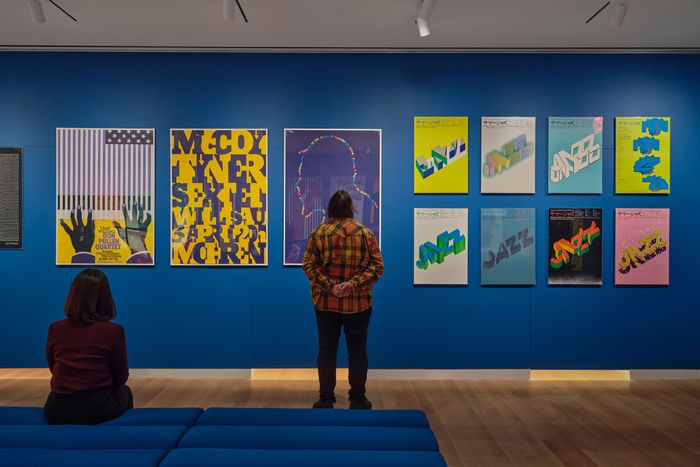
Photo: Thomas Barratt/
Sign Up for the Curbed Newsletter
A daily mix of stories about cities, city life, and our always evolving neighborhoods and skylines.
Vox Media, LLC Terms and Privacy Notice
Related