
For months, Marc Perez lived a double life.
By day, the Bayside, Queens resident worked as an IT account executive. Then he would make the short drive to a nearby hospital for hours of kidney dialysis — a routine that consumed more than 12 hours a week, not including commuting time.
Perez had been diagnosed with Advanced IgA Nephropathy, a rare kidney disease. More than a year ago, doctors told him that without a transplant, he would die.
So he began sharing his story online and reached out to NY1 last summer, hoping someone might see it.
Someone did.
What You Need To Know
Marc Perez, a Queens resident diagnosed with advanced IgA Nephropathy, told NY1 over the summer his kidney function was down to 10%
After seeing his profile on NY1, another Queens resident reached out to help him find a donor
Months later, a Brooklyn teacher agreed to be tested and was found to be a match
The successful transplant gave Perez a second chance at life and led to an emotional first meeting in January
“I didn’t realize it literally is right here. Like we’re 8/10 of a mile,” said Erica Rose Siegel, a realtor and nonprofit founder in the neighborhood.
Siegel saw the NY1 story and commented on it. That led to direct messages, then a phone call and lunch.
“I then ended up learning, really, that he was a good person,” she recalled thinking.
Siegel gifted Perez a membership to her nonprofit, Best of Bayside, which supports local businesses.
“I took business owners of my community to help meet other neighbors and grow their business, and we’ve helped them grow significantly,” said Siegel. “But then I said, hey, we could do the same thing with you, which is we wouldn’t be selling your business. We would be telling your story.”
The two spent hours walking through the neighborhood, speaking with shop owners and posting flyers about Perez’s need for a kidney donor.
“Twelve plus hours a week that he’s on dialysis plus commuting there back,” she said of Perez’s life. “He’s super positive. We need more people like him. He needs to live.”
Inspired, Siegel began the process to see if she could donate her own kidney to Perez — a man who had been a stranger just months earlier. While she waited to learn whether she was a match, she continued spreading his story, including at a business retreat for female entrepreneurs.
That’s when one of the event’s co-founders approached her.
“I know this person wanting to donate a kidney,” Siegel recalled being told.
Siegel asked to connect Perez with the co-founder’s friend. Soon, Perez sent a text message to Aline Linden, a teacher at Mazel Day School in Sheepshead Bay, Brooklyn.
Linden had long considered kidney donation, inspired by a friend who had donated years earlier. For a while, she said, the timing wasn’t right. But last year, she believed it was.
“I just kind of wanted to pay it forward or outward somehow,” she said. “And I was like, ‘What can I do to help somebody?’”
Kidney donation is not simple. Blood and tissue types must be compatible with one of the nearly 90,000 people nationwide waiting for a transplant.
After speaking by phone, Linden agreed to be tested to see if she was a match for Perez, whose kidney function had dropped to 6%.
“Mentally I kind of prepared myself for the end at one point,” Perez recalled.
Doctors determined they were compatible. Within weeks of connecting, they were preparing for surgery.
This fall, the transplant went as well as possible.
“That in and of itself felt like a gift, to be able to share my good health with someone else,” said Linden.
Linden was exercising just a week after the procedure. Perez now has two working kidneys and, he says, a new beginning.
“Second half of my life begins now,” he said.
Because his immune system was still recovering, Perez could not immediately meet the woman who donated her kidney.
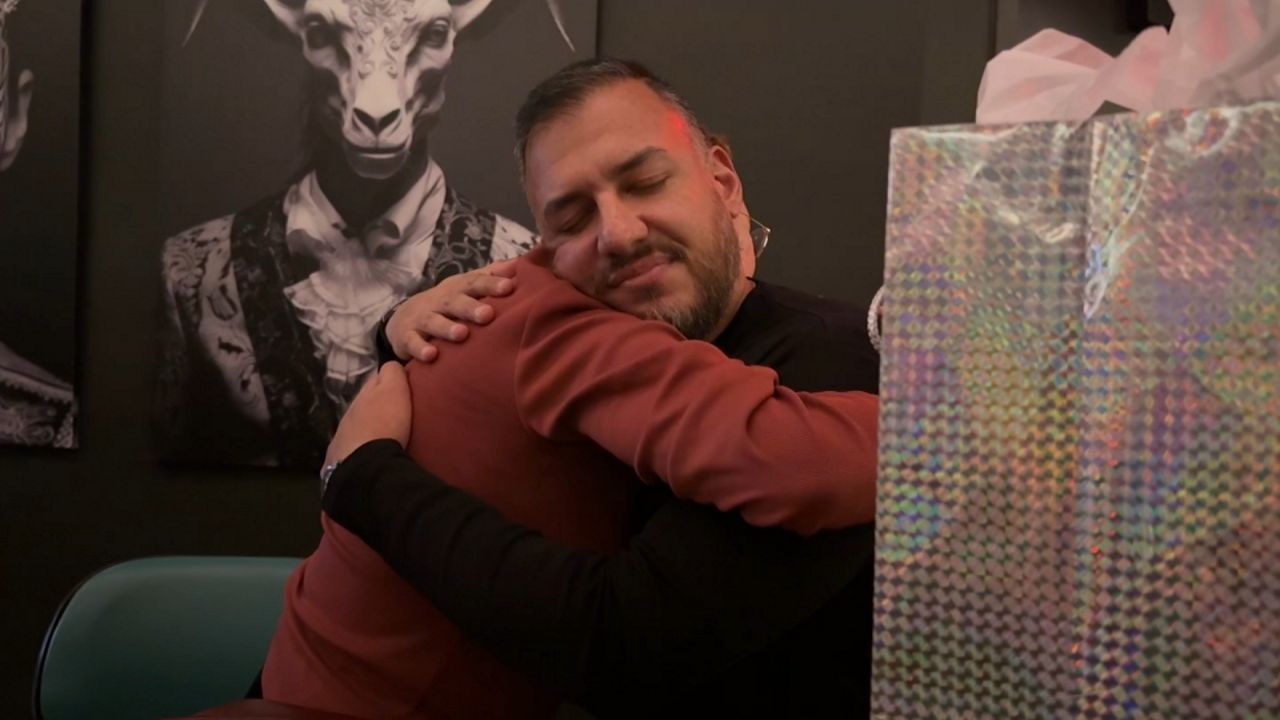
That changed in January, when they met for dinner at a restaurant in Manhattan. Friends, including Siegel, joined them.
“It was just incredible,” said Linden, “to meet him face to face, give him a hug and a sit and have a meal.”
Strangers just months earlier, they are now forever connected by a decision that saved a life.
“This is the best meal that I’ve ever had,” said Perez.