
2. The menu spans Southwestern India, but especially Kerala.
While the overall region shares a few signature dishes, such as the famous ghee podi dosa at the Tamil-inspired Semma Keralan cooking is milder than the arguably more fiery and tart flavors of Tamil, relying on coconut in all its forms — including coconut oil, freshly grated, dried, and fried coconut, and coconut milk. Fittingly, coconuts are also the jumping off point for many dishes at Kidilum.
Raveendran explained that while other Kerala-focused restaurants like the Chatti by Regi Mathew evoke the state’s toddy shop culture, Kidilum draws from summers Raveendran spent at his cousin’s tea shop in Kerala. “Every Malayali feels proud of what [Mathew] is doing at Chatti,” Raveendran notes, explaining that while toddy shops typically serve small plates to go with palm wine, tea shops also allow for larger-format dishes.
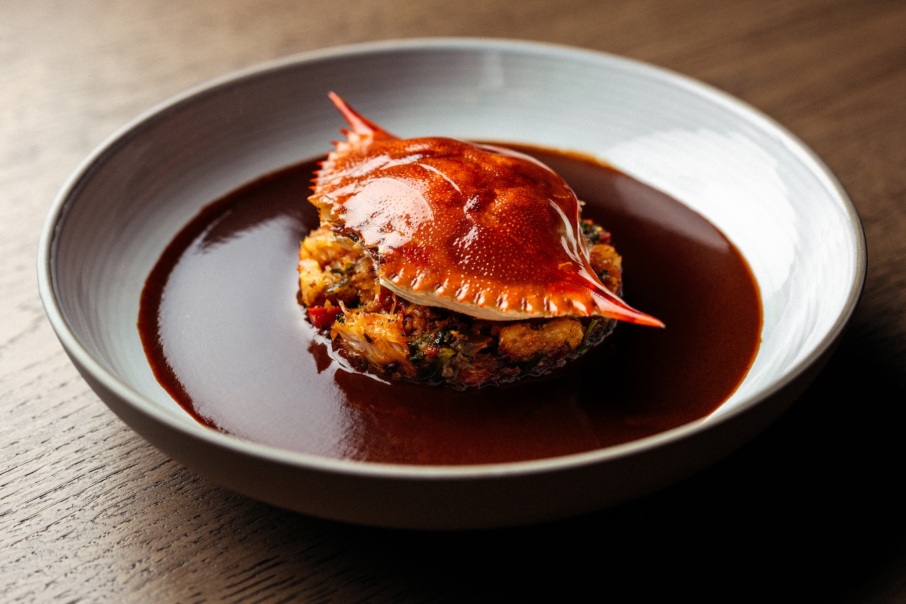
Raveendran suggests starting your meal with an amuse bouche of a mini steamed idli, or fermented rice cake, dusted with podi, a roasted lentil and spice powder, and served tableside with fresh coconut chutney — the first presentation of its kind. “It’s not a very hot [spicy] dish, but it is warm,” he says. “It helps open up your palate for heavier, bolder flavors.” Said flavors include those of the nandu crab curry featuring roasted coconut, fragrant thalasherry biriyani with goat, and vella korma, a white lamb shank korma with burnt garlic oil. A tart-hot pork vindaloo is a reminder of the history of Portuguese trade in the region. Raveendren is also working on a paper podi dosa that could very well join the ranks of those you’ll find at Semma and Kanyakumari when it comes onto the ever-evolving menu.
Desserts at Kidilum are contemporary interpretations of traditional desserts like pradhaman, which is made with lentils, jaggery, salted cashews, and lemon pickle jam, while the Calicut halwa arrives with Malabar vanilla ice cream and praline.