
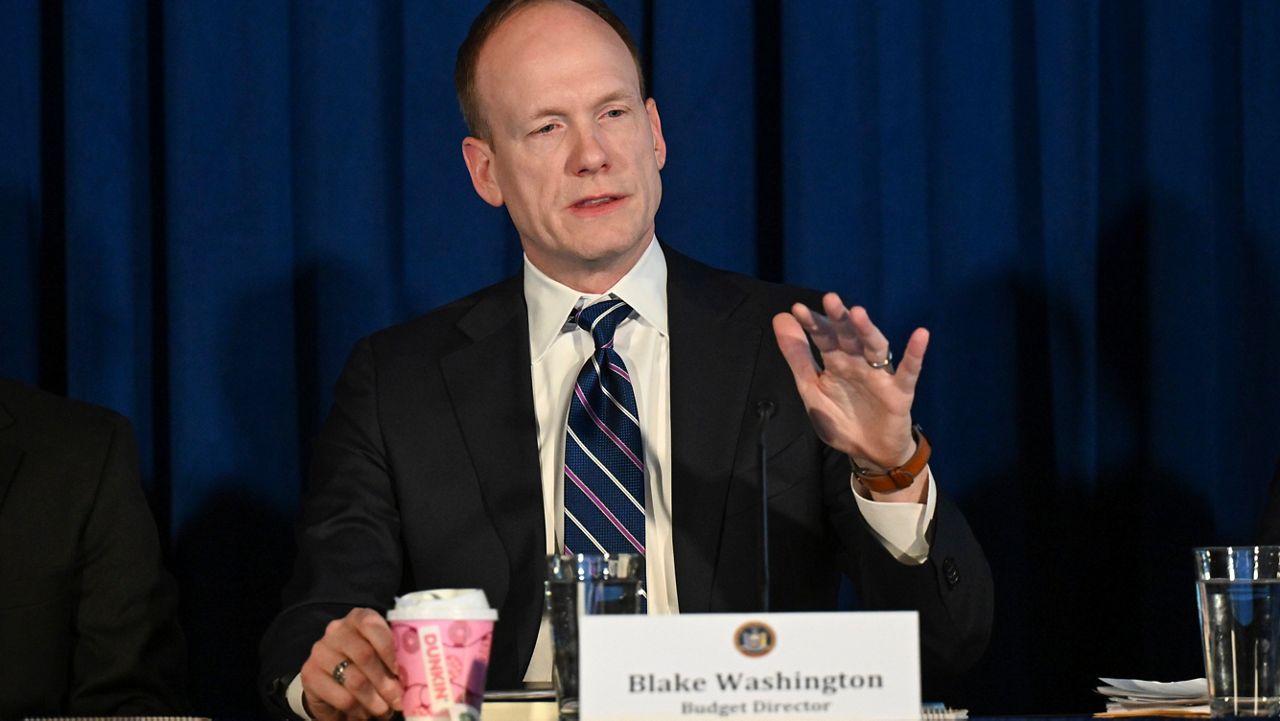
One day after the release of a memo from the New York State Energy Research and Development Authority Thursday detailing what the Hochul administration characterized as significant cost burdens on ratepayers if changes aren’t made to the state’s landmark 2019 climate law, the governor’s budget director, Blake Washington, told reporters that Hochul’s team is ready to have the tough conversation around making changes with the state Legislature.
“We’ll get there. It will be a negotiation,” Washington said. “It’s something that we’re willing to have that conversation about.”
The Climate Leadership and Community Protection Act, or CLCPA is the blueprint for the state’s goals to drastically reduce greenhouse gas emissions in the coming decades. Hochul has expressed support for those goals overall, but stressed the changing economic and political tides in the time since its passage.
Washington made the comments following the state’s annual Consensus Economic and Revenue Forecasting Conference. He said that cost projections and ongoing litigation are creating a level of urgency around the issue, and implied that if not for legislative opposition — “in a perfect world, we would gladly do it before the budget.”
“It’s best to address these issues in a collegial way, in a way that embraces all of the parties’ needs in this, but also in a way that reflects the needs of New Yorkers,” he said.
When asked what Hochul could potentially offer the reluctant Democratic-led Legislature in return for changes to the law, and exactly what would change remains unclear, Washington questioned the premise.
“This budget is already $263 billion. There are lots of somethings in there for everyone already,” he said, pointing to legislative support for the governor’s existing proposals. “They matter to their constituents as much as avoiding new costs that matter to their constituents.”
The memo states that without changes to the law, for upstate households, oil and natural gas costs could rise in excess of $4,000 per year, with costs hitting $2,300 a year in the city.
At the pump, it says the impact of the law on the price of gasoline could exceed $2.23 per gallon on top of the price at the time.
A core argument of the Climate Leadership and Community Protection Act has always been that the costs of inaction on reducing fossil fuel emissions exceed the cost of action— Washington said that post-pandemic and in the Trump era, times have changed.
“The founding principle was in 2019, when we had a different economy, a federal government that was a partner,” he said.
Environmental advocates have railed against the memo, and Robert Howarth, a professor at Cornell University and one of the 22 members of the New York State Climate Action Council, told Capital Tonight’s Susan Arbetter that the NYSERDA memo only considers one side of the cap-and-invest “ledger,” and therefore its calculations are skewed.
“The way they’re estimating the costs is to look at the cap-and-invest fee that the Climate Action Council recommended as a funding mechanism, but those funds are supposed to be spent to deal with our energy situation and lower costs,” Howarth told Capital Tonight.
With lawmakers not set to return to Albany until Wednesday, by the time they get back to the capital city the calendar will read March 4, less than one month from the budget deadline.
All the talk of climate rollbacks has them gearing up for another late budget, though there is optimism in the Capitol halls that it will be a less angsty spectacle than last year’s finish date of May 9.
Hochul last attempted to alter the climate law in 2023, when she was in a considerably weaker political position, and her previous strategy of pushing for a change to the way the state tallies emissions could repeat itself this year.
Multiple legislative sources familiar with ongoing discussions said Friday that in general, many Democratic lawmakers who have steadfastly resisted making changes to the climate law are resigned to the fact that this is going to be a long, tough battle with an uncertain outcome, but they are especially frustrated with Hochul for a familiar reason:
That she is poised to pick yet another fight later in the budget process rather than proposing it at the outset or formally through the 30-day amendments.
This week, state Senate Majority Leader Andrea Stewart-Cousins told reporters that the Senate remains opposed.
“We have demonstrated our commitment to trying to make things more affordable, and we understand people are struggling with their utility bills,” she said Tuesday. “I think our conference has been really deliberative in how to make sure we protect our climate and make things more affordable. We are constantly moving toward a direction that will alleviate the pain and save the planet. We’re not closed to anybody’s suggestions. I think we look at whatever is out there.”
Republicans who have consistently beaten the drum of rolling back the state’s climate law over affordability concerns are basking in the moment as Hochul charts her course.
“I hate to say I told you so — my mother used to say that all the time,” he said. “But in this case, I told you so, Gov. Hochul.”
To many in the GOP, Hochul has long been the antagonist when it comes to their frustrations with the state’s climate policy. Mattera acknowledges that at this point, that frustration is aimed at his own fellow lawmakers in the Democratic majority.
“All this doing to go all electric is hurting everything and she realizes it, but her colleagues don’t— my colleagues on the other side all they keep on saying is ‘it’s saving money’ that is a farce,” he said.