
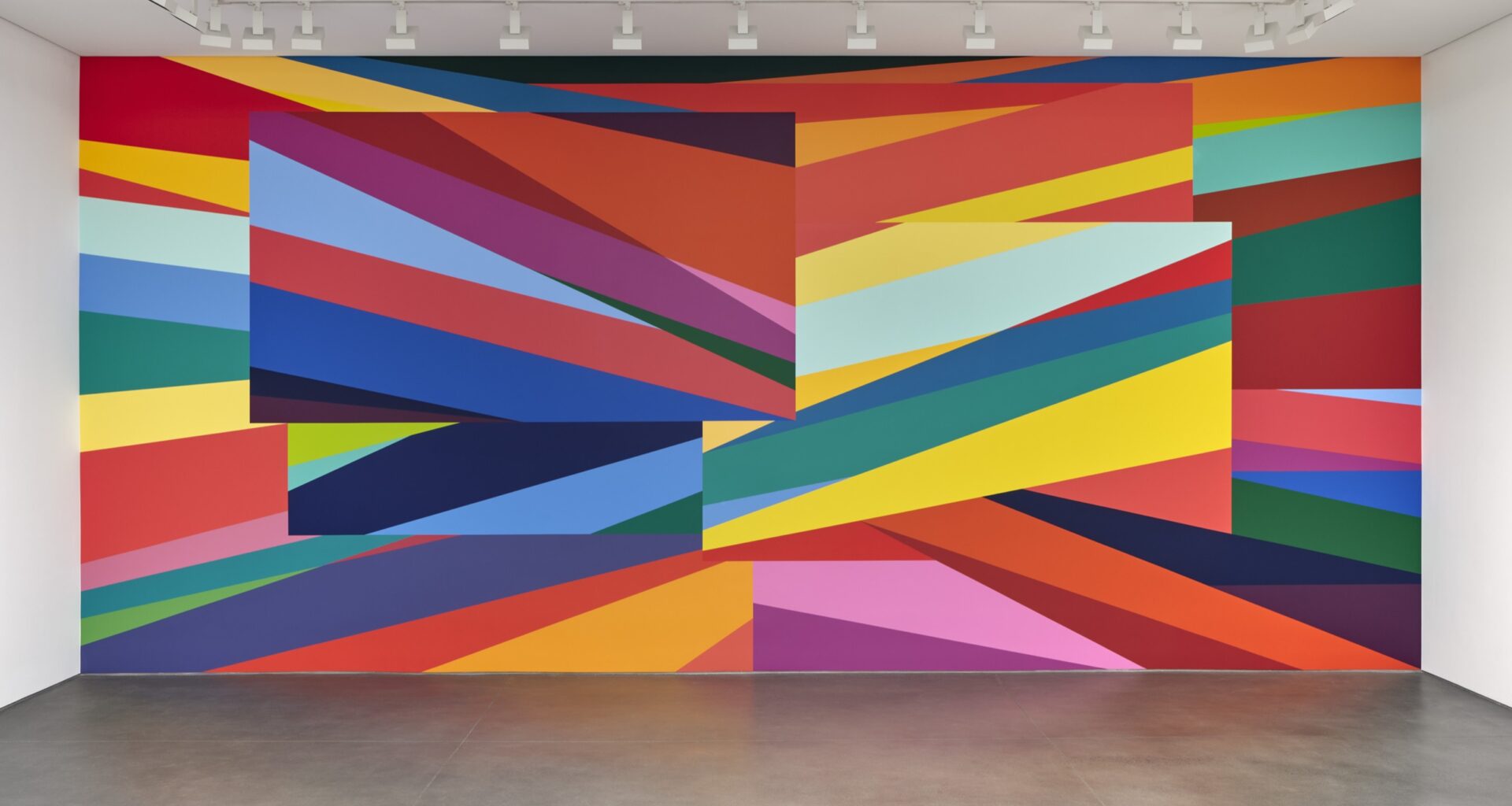
Odili Donald Odita: Shadowland
David Kordansky Gallery
January 15–February 28, 2026
New York
The spectacled face of a young boy smiles out from a duotone photograph over which the word “cancelled” has been stamped. In Passport (2000), a large manipulated photograph, Nigerian American artist Odili Donald Odita repurposes an expired document issued to him long ago by the Federal Republic of Nigeria to consider origins, identity, the way we carry the past, and the way the past carries us. Hanging in the vestibule of David Kordansky Gallery, Passport neatly sets up Odili Donald Odita: Shadowland, an exhibition that brings together the artist’s recent and older works with those of his father, the late Nigerian artist and academic Dr. Okechukwu Emmanuel Odita. The result is a powerful immersion in color and form enriched with considerations of time, legacy, and art making’s endless potential to foster both personal connection and political disruption.
In his current practice, Odita creates large, abstract paintings in which repeating geometric shapes emerge and expand from a central seam or point. He paints in bold and deeply saturated acrylics, and his patterns recall both M. C. Escher’s intricacy and the energy of Keith Haring while evoking traditions of Mbuti textile design. In Peonies and Pansies (2025), square tessellations pinwheel out from a central point. Odili’s strategic use of navy, teal, and red allows his painted forms to coalesce into an X that seems to float above a ground of pink, yellow, and mauve squares. Sanctuary (2025), meanwhile, features two vertical panels striped with triangular fractals. On the left, Odita employs sunny yellows, pale blues, lavender, and aqua to form shapes that merge and collide, creating the illusion of three-dimensionality. Shifting his palette to darker shades of purple and red on the left, the artist plays with the perception of darkness and light as positive and negative spaces appear in his careful juxtapositions of color. For Odita, the idea of a shadowland, a place cast in darkness, offers privacy and protection. It is in the endless combinations his geometric renderings create that nascent modes of resistance and creative expression can be nurtured.
The presence of the artist’s father—whose work was at the avant-garde of Nigerian modernism—and his impact on Odita’s work is made clear by the inclusion of two of his works: Njikoka: Nigerian Unity, Yoruba and Igbo, Panel 2 (1976) and Njikoka: Nigerian Unity, Yoruba and Hausa, Panel 3 (1977–1978). These two figurative paintings, made in the years following Nigeria’s civil war, celebrate the delicate unity of Nigerian ethnic groups who worked together in the struggle for freedom from British colonial rule. In Panel 2, a faceless woman dressed in flowing textiles rendered as color blocks stands against a background of geometric shapes that prefigure Odita’s paintings. In Panel 3, a similar figure in multicolored robes stands anchored against of field of earthy colors. Hanging adjacent to the younger Odita’s work, these paintings show us a generational line of artmaking that provides context for the more recent work on view here. I can imagine the child in the passport photo playing in the shadows of the senior Odita’s studio, observing and absorbing everything in anticipation of his own future practice.