
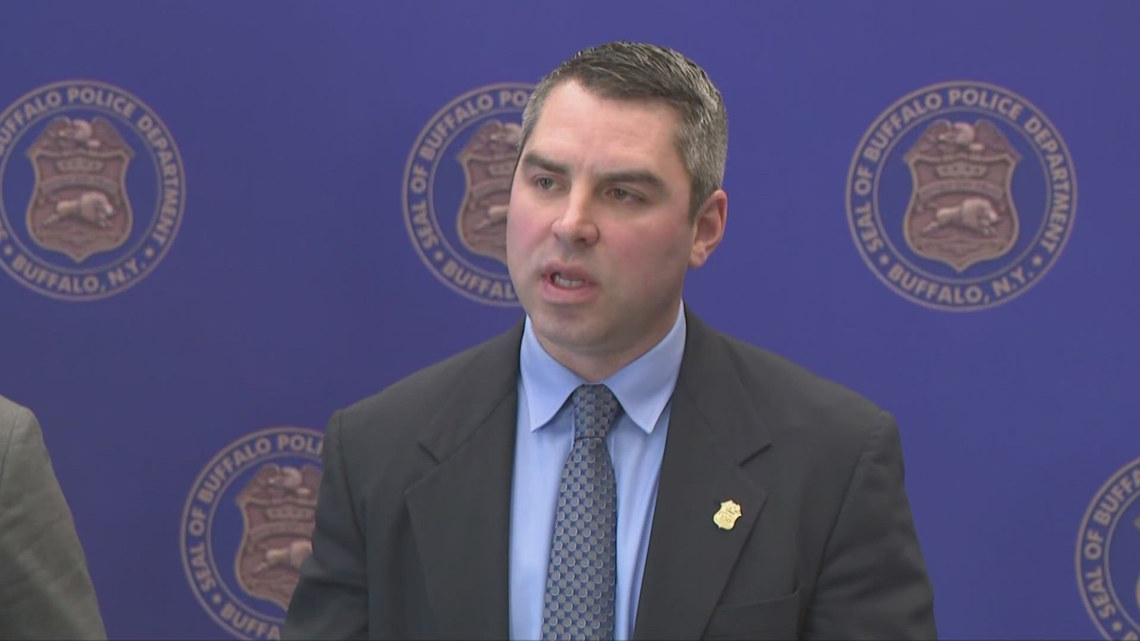
The biggest revelation in the release of the Granville Internal Affairs files, is that then Chief of Detectives Craig Macy was contacted the night of the crash.
BUFFALO, N.Y. — One of the biggest revelations, so far, in a review of the Buffalo Police Internal Affairs files related to the crash involving Erie County Narcotics Chief DJ Granville is that a member of the BPD chain of command was contacted shortly after the crash.
According to the Internal Affairs records first obtained by 2 On Your Side, Lt. Lucia Esquilin contacted then Chief of Detectives Craig Macy.
WGRZ highlighted this in our report earlier this week.
2 On Your Side sat down with now acting Commissioner Macy to discuss the night of the crash and the role he played, and didn’t play.
Nate Benson: “I’ve read through your statement to IA, kind of walk me through though that phone call with Lieutenant Esquilin that night.”
Macy: “I did receive a phone call the night of the accident, right? I was sleeping. I was woken up by it, and I was asked procedurally, what to do with a sheriff’s vehicle that’s an unmarked vehicle that was involved in a accident.”
According to phone records in the Internal Affairs files, Lt. Esquilin called Macy at 12:01am on April 12, 2024. They spoke for more than 6 minutes. Macy called Lt. Esquilin back at 12:11am and they spoke for another six minutes.
Benson: “Is that normal? You were Chief of Detectives at the time. It’s my understanding, based on some conversations I had a lot of people look to you for advice throughout your career. Was this something that normally would happen?”
Macy: “So it still does the phone in some of these jobs that we take rings all the time, right? Whether you’re home sleeping, or you’re at your kids events, or you’re working, it doesn’t matter if the phone rings when people need something, when you’re answering the call, you obviously don’t know what it’s about, and you answer the call.”
Benson: “What details did Lieutenant Esquilin share with you about this?”
Macy: “Well, that there was an accident, and I asked to the extent of it, was there anybody injured? Because procedurally, if there’s somebody that’s injured, then that is a triggers in the AI, you call out the accident investigation, which then has a whole different path to follow up and investigation. It was conveyed to me that it was, it was not, it was a property damage accident only, which can be handled at the district level.”
Benson: “Did Lieutenant Esquilin tell you it was narcotics chief Granville involved in the crash?”
Benson: “Upon learning that, did that change your advice at all to Lieutenant Esquilin?”
Benson: “Did you ask Lieutenant Esquilin about a DUI test, or field sobriety test?”
Macy: “I mean, the City of Buffalo answers 1,000s of accidents the police department specifically, I can tell you, we typically crash about 100 cars a year that are involved in accidents, you know, and in the very small level of those, or number of those are involving, or where are, where the officers are at fault. We’ve had high ranking members of the department get into accidents. I wouldn’t jump to that conclusion that there is something nefarious right off the top.”
Benson: “For the public, though, you know the details are that he crashed into seven different vehicles across three areas of Jersey and prospect.”
Benson: “It’s a widespread crash. It wasn’t a fender bender. It wasn’t ‘I hit someone and turning a corner’ right?”
Benson: “That didn’t trigger for you, from an advice standpoint, to say ‘hey, we need to escalate this a little bit, maybe give him a DUI test or something?'”
Macy: “When you phrase it like that, I would say, yeah. I would say ‘hey, you should probably call the watch commander’ right? When it is conveyed that there is a property damage accident only, and he crashed a car and the car is not operable, that’s a different scenario, right? So with the information that was presented to me, right? Is, the advice that I gave, and the directive was to just issue the appropriate citations, issue the tickets, and move on.”
During her sworn statement to the Internal Affairs investigator, Lt. Esquillin, who was eventually demoted to Detective Sergeant after a disciplinary action stemming from this incident, said that after speaking to Chief Macy she didn’t feel the need to notify the 911 Lieutenant or Duty Officer working that night, mainly because of the guidance provided by Chief Macy.
During his interview with Internal Affairs in 2025, Chief Macy, who retired from Buffalo Police in August 2025, stated that he’s known Granville for six or seven years and considered him a friend.
Benson: “Did you think to escalate it? Did you think to call 911 Lieutenant or your supervisors, or any other chiefs that might have been on duty?”
Macy: “That’s a fair question. No, because, again, this is the information I have, and what I believe happened at the time of the phone call in the middle of the night was that there is a property damage accident only right to the extent of it. I learned much later, like after stuff started coming out on the news, and I absolutely did not tell anybody else. And it’s when you phrase it like that that would be a point to where you could say, Well, why didn’t you? But when you look at it from being woke up in the middle of night, not asking too many other questions, there’s nobody injured. Typically, the phone calls in the middle of the night could range from detective related calls to serious homicide stuff, right? And there’s right, wrong or indifferent, there’s a little bit of a dismissive like, it’s a car accident, right? Like I understand the reasoning for trying to safeguard another agency’s unmarked vehicle, so that’s why it doesn’t raise a lot of red flags, but in the big scheme of things, this is like a blip on the radar for calls and seriousness of calls at that time.”
Benson: “As Chief of Detectives at the time, you’re considered Buffalo Police leadership, do you think you had a responsibility to ask more questions? Maybe go to the scene and investigate more?”
Macy: “So the Chief of Detectives is responsible for all the detectives. AIU does not fall under the Chief of Detectives. That would not be why we do not investigate accidents. We do not investigate fatal accidents that falls under AIU with respect to the the obligation, again, if we’re an informal conversation, which happens pretty much on a daily basis, and I am not concerned with the information that I have that there’s a bigger problem, then I wouldn’t call. That’s part of the point of being a leader, mid-level, higher level leadership, you address those problems as they come up to you. I don’t think it would be fair to the commissioner that I call him and ask advice on a car accident, right? Or the multitude of other calls, that’s the whole point. To be available, right? You can address issues as best you see fit.
You know, looking back and seeing the magnitude of all of this, yeah, it would have been super reasonable to be able to say, ‘hey, we need to be able to present that everything is what it is you need to call the watch commander.’ ‘Hey, you should call AIU. Hey, you should call the sheriff’s AIU to come out’ or their watch commander. That’s all reasonable questions.
And again, hindsight, being 20-20, with all of the information that is here today, and there’s still stuff I don’t know. I have not reviewed that internal affairs case as commissioner. I obviously can, but I’ve stayed very far away from that because there’s an investigation that I was not in charge of, I was not involved in, and it’s just best that I, in my opinion, I stay outside of looking through that so I can answer all my questions honestly as I remember them versus other people’s testimony to influence what I have to say absolutely.”
Benson: “Looking back, do you think you should have advised her to talk to her watch commander or her supervisors?”
Macy: “Yes, you know, with all the information that I have now, I absolutely would have done that, right? I would have said, Hey, have the watch commander come over and if for nothing else, it does give her a cover, because the watch commander is there and it’s another person, right? And I don’t mean cover for wrongdoing, I mean cover for ‘Hey, I notified the next person in my chain of command.’
As Chief of Detectives. I am not in charge of any patrol officers. I’m not in charge of districts. I’m not in charge of patrol supervisors, but if you want to be available and answer the phones, and ultimately, there are so many things that do touch the Detective Division being available to maybe answer the phone and be inconvenienced throughout the night pretty regularly, ends up avoiding problems nine times out of 10 later on, right? Sometimes you need approval for detectives to be able to come in. Sometimes there’s call out scenarios of special operations teams, that stuff happens, right?”
Benson: “You also testified and shared with IA that you consider DJ Granville a friend. Did that at all, do you think, play into a role that that’s why Lieutenant Esquilin called you? She knew you’re a friend of his?”
Macy: “So I can’t, I can’t speculate on why she called me. I can tell you that the vast majority of supervisors in the city have my number. The vast majority of supervisors call at all times, right? Like last night, for instance, there was a guy that was going to jump off a building, and I got a phone call asking if there’s anything else that should be done. I’m still available in this position. With respect to DJ, right, I’ve had a lot of interactions with him in previous jobs, right?
There is professional friendships, I guess you could say, and again, looking back, I’m well aware of the appearance. Part of the point of even sitting down with you is to just lay this out. Because, in my opinion, when you don’t address things, it allows for speculation, and then further speculation in people to insinuate things, right? So I have, again, a professional friendship with him, and I don’t know, I don’t know if that was part of it or just the fact that a lot of people call me.”
Benson: “I think when you couple all this together, and the big narrative with this story, as it’s kind of trickled out over the last year, since we broke the story has been ‘who knew what and when’ and ‘why weren’t certain things done?’ ‘Why wasn’t the book followed?’ I think a lot of people, at least the ones I’ve spoken to in the public [think], ‘if Joe Smith crashed his car in Niagara square, hit seven vehicles, would he be treated the same way?’ ‘Would he avoid a DUI test? Would he avoid heavy penalties?’
I mean, if I crashed my work vehicle, I’d probably be financially ruined by it, right? How do you assure the public as all this information now comes out and the files being released, you know that there wasn’t an organized cover up?”
Macy: “Well, I think part of it starts with me sitting down with you and talking about this, and talking about the interim Commissioner, his interaction with somebody on scene, right? That’s the first thing, second, I don’t know I was not at the scene. If there was anything to indicate those steps be taken. I don’t know what was said. I did not ask those details.
I understand how it looks right? And it’s reasonable to think that, right? But you know, the supervisor on scene, there was an investigation that was very, very lengthy, right? If you’ve seen the files, you see that there’s 1,000s of documents in there. There’s a lot of people that are interviewed. Officers were interviewed on scene. There was a great length that was taken to find out exactly what happened. Ultimately, there was a supervisor that got demoted, right? Which is a very, very significant thing. Maybe some people in the public don’t think that’s significant, but I think the last supervisor that was demoted was something from like 24 years ago, right? It’s a very significant penalty that she paid for that.
The unfortunate thing is, there was a lot of stuff that was being done and it was not commented on, right? There’s a lot of stuff that was not truthful that was talked about in the last year because it was not commented on by people that could have commented on it and and tampered some of this narrative, right? That is factual, and I’m sure, once you start seeing that, or if you, if you talk about the process, you know there was officers, they gave statements, they did cooperate, right under, under guidance of counsel, they were told not to come in without a subpoena, and they were not given subpoenas, right? But they did give statements, right? So they were cooperating. There’s considerations that lawyers provide and Garrity that comes into play with this.
There is more to a lot of this stuff. And as an agency, I think we’ve learned from that, right? I you can tell again, I got to reiterate, that’s why I’m sitting here, right? Because we could push all this stuff out. The mayor wants transparency. These files were turned over immediately, right to to the corporation counsel. They’re in the process of doing all the redaction, right? I’m sitting here. I could say, you know, that’s, here’s the files, you guys read through it. You can make your own determinations, right? You’re hearing it from my mouth, that this is what happened. This is why some of these things happen.
I understand the appearances, but I think we’re moving in the right direction. There was, there was clearly some things that were lacking, right? And those policies were changed.
Benson: “If I’m reading between the lines of what you said a moment ago, are you suggesting former Commissioner Wright should have spoken more about the way things were handled, and then try to get in front of that public trust side of things?”
Macy: “What I will say is that there was a lot of opportunities that some of these narratives could have been addressed. And when you have something [like]you have now, it’s three police commissioners that are still talking about an event that was two years ago, and it was arguably, probably the biggest news story in 2025 for the City of Buffalo.
There is opportunities, right? One of the things that I hope everybody learns, is that when, especially when elected officials or the media is talking about stuff and maybe there’s incorrect narratives, I understand when there’s an open investigation, you can’t lay it out right?
My previous job, I lived that multiple times. There was information that we had I really would have loved to share with the media. I would have loved to share with the public, but you can’t to jeopardize the investigation, right? The fact that when people are under the belief that the Buffalo Police Department, we’re not investigating, and the investigators had all of these videos, had all of these interviews conducted, sometimes months before it even broke the news, and then there is no rebuttal for, yeah, we’re tracking this even, even there’s multiple ways to do that, right? Even if it’s off camera and unofficial, right? You can say ‘hey, listen, I understand your story, this is where we’re at, I can’t comment because of this.’
And in my experience with the media here, if you give them a reason and you give them a timeline on when you’re going to release something, things end up working out, maybe not in your favor, but reasonably.
Benson: “Speaking of multiple commissioners, Commissioner Gramaglia was in charge at the time. Upon learning after the phone call in the subsequent days, did you ever talk to Commissioner Gramaglia about this? Did it ever escalate to him about what happened?”
Macy: “No, I didn’t. And again, when you look back at things in hindsight, but when I’m dealing with the level of stuff that you deal with on a daily basis, and he has six chiefs, seven chiefs, right? I think that’s part of my point, to be able to address problems, not bring them up for what I believed at the time to be a minor accident, right? Like, that’s that’s just not something that I would have done.”
Benson: “In your role as Acting Commissioner, you know, what can you assure the public you know, if this was to happen this weekend, somebody crashes a vehicle, can we expect the situation to be handled the same? Or have you implemented changes, or have there been changes in the department to make sure if something like this happens again, it’s handled a little differently?”
Macy: “So we’ll start with now, working backwards. There’s been a couple different policies that you know from from my experience, and has triggered me to have policies made as soon as I got in office.
And again, this isn’t because I’m expecting to stay here, it’s because there is an issue. I don’t want the next person they have to deal with this, and it’s a problem, right? So the first thing is the conflict of interest policy. If there is even a perception of a conflict of interest, family, friends, relationships, whatever it is, you need to pass that off. You need to call the watch commander, and we can provide that for you. That was, that was done in early January.
Then, if there’s another situation with a another law enforcement agency for their vehicle being crashed in the city of Buffalo, at least, at the very least, their watch commander, their on duty watch commander, or equivalent, of whether it’s a captain or or whatever, needs to be notified of this accident, right?
So again, we’re talking about perception, right? I don’t know I was not at the scene. If there is a million things done wrong, or everything is done right, with this accident that we’re talking about two years ago, there is the perception that nobody can deny that it was not handled as good as it could have been, right?
So those two things are done. There was an issue with body cam retention time, right? So those were all six months, and that’s, that’s how it was from from contract, when the contract started with body cam in January of 25 there is an assessment that was done by Corporation Counsel. ‘Hey, you need to keep body cam for three years and three months for civil litigation.’ From what I’m told, an IAD investigation on this matter started like end of January, beginning of February timeframe, and that was already implemented right now, timing. If it was months earlier, then we would have been able to have those body cams, right? And I think that, again, as a management level, problems don’t get better with age, right? If, if there is an issue, you lay it out, you give as much media or as much information to either media, through media, the general public, elected officials as you possibly can.
And if you can’t, you articulate why. If there is narratives, it doesn’t have to be done in a combative way. But like, you can say offline, like this is not true. Like this is what’s going on. It doesn’t do good for anybody to not say something. [It] ultimately undermines the trust anyways, right? If it’s something bad, so be it, right? You get more credibility by laying something bad out.
So those are the things like looking back that we have changed, and we’ve modified from from this experience.”