
by Michelle Mullen
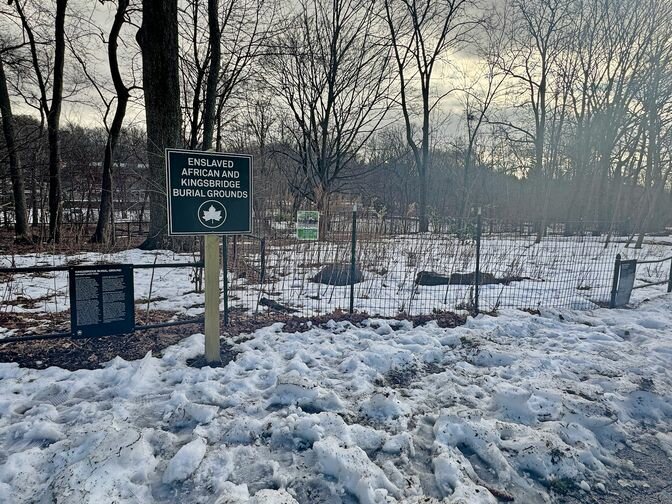
On a brisk February afternoon, the Van Cortlandt Park Alliance invited visitors to tour Van Cortlandt Park’s Enslaved African Burial Ground, drawing renewed attention to a wooded site marked only by a modest green sign. The program is part of a broader effort to retell the park’s storied history as a sprawling plantation through the lives of the enslaved Africans who sustained the land rather from the vantage point of the family that owned it.
The event was among an expanded slate of Black History Month programs centered on the legacy of those who once labored on the land. For generations, the written record of the Van Cortlandt estate has focused on its wealthy merchants and slave traders. Enslaved Africans, who worked the plantation until 1821, appear largely as property — listed in wills, inventoried among assets or described in runaway advertisements.
Ashley Hart Adams, the Alliance’s arts integration strategist, said the Alliances’ Reimagining the Enslaved African Burial Ground initiative seeks to shift that frame.
“We want, for people who hear about this history, to see the enslaved people for the historical figures that they were,” she said. “The landscape of this park does not exist without that labor. [The Van Cortlandt House] doesn’t exist without that labor.”
The two-hour program paired a walking tour of the grounds with a visit inside the home. Nick Dembowski, president of the Kingsbridge Historical Society, said the collaboration underscores how inseparable the house and surrounding land are.
“The history of the house really can’t be understood without thinking about the history of the park and the land around it, because it was all very much connected,” he said.
For many visitors, he added, the information comes as a surprise.
“Most people come to the place and really don’t realize that it has any history whatsoever.”
The tour traced that storied past across the landscape. Hester and Piero’s Mill Pond — renamed from Van Cortlandt Lake in 2021 — once powered a grist mill that ground wheat into flour for export to the Caribbean, linking the plantation to the broader Atlantic slave economy. The athletic fields were once grain fields. The wooded path known as Colonial Road was cleared and expanded through enslaved labor.
From sparse archival references, a handful of names emerge. Piero, later identified in a will as the plantation’s miller. Hester, named as his wife. Little Peter, listed as their son. In earlier estate documents, they appear simply as “my negro man slave” or “my negro woman slave,” before gradually being described with occupations and family ties.
In Piero’s case, that distinction matters. Operating a water-powered grist mill in the 18th century required technical expertise — managing heavy millstones, calibrating the grind so wheat became flour rather than dust, preventing injury and likely overseeing exchanges with neighboring farmers. Hart Adams described the mill as a feat of “engineering innovation” for its time, work that demanded both physical endurance and mechanical knowledge.
“We’re really careful with the language we utilize,” she said. “We don’t like to use words like voiceless, because they did have a voice. It’s just been erased.”
“When we look, most of the information that we learn about the enslaved people who inhabited Van Cortlandt Park, we learn about it through newspaper clippings, journal entries from people who visited the home, or wills,” Hart Adams said. “Sadly, during this time, you could leave an enslaved person in your will because they were seen as property.”
Dembowski noted that even in local histories, African presence was often barely acknowledged.
“It was very seldom that any kind of African presence was ever mentioned,” he said, adding that deeper archival research revealed records of enslavement in the area dating back to the 17th century.
The tour attempts to read against that archive, piecing together skill and humanity from fragments. It highlights figures like Andrew Saxton, an enslaved cooper who escaped the plantation. A newspaper advertisement described his clothing and injuries in detail in an effort to secure his return — evidence of both the violence he endured and the value of his skilled labor. There is no surviving record confirming he was ever captured.
The program concluded at the burial ground, where ground-penetrating radar has identified features consistent with coffins several feet below the surface. Though the site is currently marked by a small sign, the Alliance is working toward something more enduring.
Launched publicly on Juneteenth in 2021 and supported by the Mellon Foundation in partnership with the Design Trust for Public Space and Liminal sp, the Reimagining the Enslaved African Burial Ground project is unfolding in phases. The first phase focused on community engagement and education, including public programs, surveys and tours designed to raise awareness and gather input.
“We did a number of public programs over the last seven months,” Hart Adams said, explaining that the goals were to keep the community informed, expand awareness and build momentum for a permanent memorial.
The initiative has since moved into its next stage. A design ideas competition attracted dozens of proposals envisioning how the burial ground could become a lasting commemorative space. Three teams will be selected to develop entrance concepts, with renderings expected to be unveiled on Juneteenth.
Keywords
Van Cortlandt Park,
Enslaved African Burial Ground,
Black History Month,
Ashley Hart Adams,