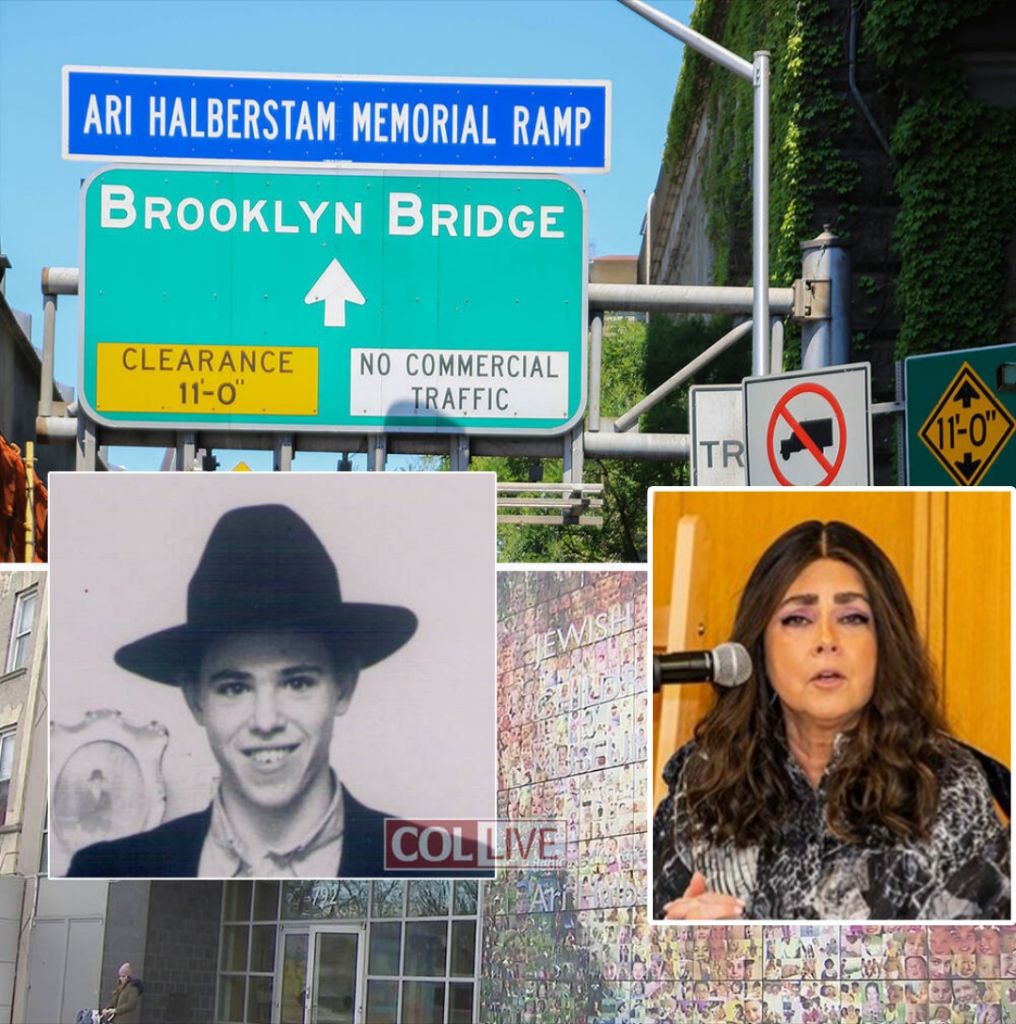
32 years ago, March 1, 18 Adar 1994 at 10:21 AM, Lebanese terrorist Rashid Baz shot at a van of 15 Chabad Yeshiva students traveling on the Brooklyn Bridge, murdering Ari Halberstam HY”D. His mother Devorah Halberstam asks to do a Mitzvah in his memory. Full Story, Video
By COLlive and Mishpacha Magazine
32 years ago on March 1, 18 Adar 1994 at 10:21 AM, Lebanese terrorist Rashid Baz shot at a van of 15 Chabad Yeshiva students traveling on the Brooklyn Bridge, murdering Ari Halberstam HY”D. His mother Devorah Halberstam asks to do a Mitzvah in his memory.
The Attack
On March 1, 1994, a gunman in a car opened fire on a van carrying more than a dozen Hasidic students as it began to cross the Brooklyn Bridge from Manhattan, critically wounding two young men and injuring two others.
The lone gunman, driving a blue Chevrolet Caprice equipped with a submachine gun, two 9mm guns, and a “street sweeper” shotgun, pursued the van full of terrified students across the bridge.
He fired in three separate bursts, spraying both sides of the van. He then disappeared into traffic as the van came to a stop at the Brooklyn end of the bridge.
The injured Yeshiva students were among dozens who were returning from a Manhattan hospital where the spiritual leader of the Lubavitch movement, Rabbi Menachem M. Schneerson, had undergone minor surgery.
The attack occurred less than a week after the massacre of Muslims by a Brooklyn-born Jewish settler in the West Bank. The shooting began at 10:24 A.M. on the ramp that leads from the Franklin D. Roosevelt Drive to the Brooklyn Bridge.
The van that was fired on, a white Dodge Ram 350 carrying 15 students, was one of perhaps 20 vehicles en route back to Crown Heights from Manhattan Eye, Ear, and Throat Hospital, where Rabbi Schneerson was being treated.
Initially, the gunman followed the Rebbe’s entourage to the Brooklyn Battery Tunnel. When he found that it was closed to other vehicular traffic, he reversed his course and traveled north to the Brooklyn Bridge.
When the gunman saw the students garbed in their Hasidic dress, he immediately opened fire. In the first burst of gunfire, the gunman strafed the passenger side of the van, striking three of the students and blowing out the rear windows.
The van came to a stop, and two of the students stumbled out as the driver and the others attempted to see if anyone had been hit. Gunfire then erupted again from the blue four-door Chevrolet, this time raking the driver’s side.
The driver of the van then sped off toward Brooklyn, leaving the two students on the bridge. They were later picked up by an emergency medical technician. The gunman followed the fleeing van with shouts of “Kill the Jews,” hailed in Arabic.
He once more fired shots at the passenger side of the vehicle before it swerved off the bridge at the Cadman Plaza exit. The van, with at least six bullet holes in its body and windows destroyed, finally came to a halt at the Brooklyn entrance to the bridge.
The Wounded
All the shooting victims were immediately rushed to St. Vincent’s Hospital. The most severe of the wounded was 16-year-old Ari Halberstam obm who was shot in the head. He suffered from profound brain injuries and died five days later.
In those days, says Ari’s mother, Mrs. Devorah Halberstam, terrorism was not a concept New Yorkers were familiar with. “Being a fourth-generation American, I didn’t even appreciate anti-Semitism,” she says. “That’s why the horrific Crown Heights riots three years earlier were so shocking.”
Devorah remembers watching the mayhem from her window. “I saw with my own eyes how the police stood and did nothing,” she recounts. “I heard with my own ears how the mobs screamed ‘Hitler didn’t finish his job!’ It shook me to the core.”
But there’s anti-Semitism and there’s terrorism. So while Ari’s murderer was convicted of second-degree murder and 14 additional counts of attempted murder and sentenced to 141 years to life in prison, the crime was first classified as an act of road rage. Devorah tirelessly fought the Department of Justice for seven long years to get it reclassified as terrorism.
In the beginning of September 2001, in an unprecedented move, the Justice Department finally labeled the shooting a terrorist act; Devorah’s efforts had succeeded. The next thing she knew, politicians had dubbed her “the prophet,” because uncannily, just three days after the reclassification, two jetliners slammed into the Twin Towers, turning terrorism into a household word.
“You were right,” admitted law enforcement personnel who showed up unexpectedly at her front door after 9/11. “Now tell us everything you know.”
Before Ari’s murder, Devorah knew nothing about the criminal justice system, let alone about guns. But by 9/11, she was an expert in the field. She authored the first New York state laws on terrorism together with Governor George Pataki. Today she trains law enforcements around the world and has been appointed as New York’s honorary commissioner for the police department for community safety.
Twenty-six years later, Devorah is only too happy to reminisce about her beloved firstborn. “He was six feet tall, handsome, with eyes that were blue like marbles. He was beloved by everyone and a great all-arounder. He loved basketball, yet he was also very ruchniyusdig and chassidish. He would daven b’arichus, and even we knew not to enter the room he locked himself into when he davened. It’s interesting that his final mitzvah was his favorite one, that of putting on tefillin. And because he spent so much time over it, he had to run and catch the van, tefillin still unraveled. That’s the way we received his tefillin, which have since been divided among two of his brothers, one the Rashi and one the Rabbeinu Tam.”
At a farbrengen at one point during the Rebbe’s illness, Ari announced in front of his friends, “I’d give up my life for the Rebbe.” And two weeks before his murder, he was in the kitchen with his mother when he casually remarked, “‘Ma, you don’t know who I am.”
“I still remember looking up at him, somewhat mystified,” his mother recounts, “and saying, ‘What do you mean? Nobody knows you better than your own mother.’ ”
“You’ll see,” he answered.
And two weeks later the neshamah that uttered those cryptic words left This World. Indeed, he gave his life for the Rebbe.
WHAT’S IN A NAME?
The Ari Halberstam Memorial Ramp is a 180-degree ramp leading up to the Brooklyn Bridge; it’s traversed by millions of cars every year. The bridge is a main thoroughfare with several merging points.
Devorah had originally hoped to rename the Brooklyn Bridge for her son, but since it’s a landmark that falls under federal jurisdiction, the bridge itself could not be renamed. So instead she lobbied to memorialize Ari on the ramp leading up to it. The ramp was as yet unnamed and was where the shooting actually unfolded.
“I didn’t care how quickly it happened,” says Devorah. “I was thinking about the future. I wanted it for posterity so that Ari should be remembered every single minute and every single day.”
Devorah had to go before the city council and have the law passed by then-mayor Rudy Giuliani. There was zero opposition from the 51 council members even though they were from various ethnic backgrounds. The naming, embedded on the New York City map, was introduced a year after the murder, in what was said to be one of the quickest bills ever to be passed.
To figure out how to display the signs, Devorah walked along the site with the Commissioner of Transportation. The murderer came from one side of the ramp and the boys were on the other, so they placed the signs on both sides, in accordance with how the attack unfolded.
Years later, Devorah still gets regards from people driving over the ramp, who have called her just to say, “I’m crossing the bridge now so I was thinking of you and Ari.”
As for her own visits to the ramp, it’s a daily thing. “Before the murder, I was always in Manhattan, but I never used the Brooklyn Bridge. Afterward, I always did. No matter which side I’m coming from, I put on my blinkers, shut the radio, put aside my phone, and recite Ari’s kapitel of Tehillim [according to the age he would be —Ed.] To me, Ari’s blood will always be on that bridge. When I see Ari’s name, it’s not just personal, it’s for Klal Yisrael. It acknowledges that he was killed because he was a Jew.”