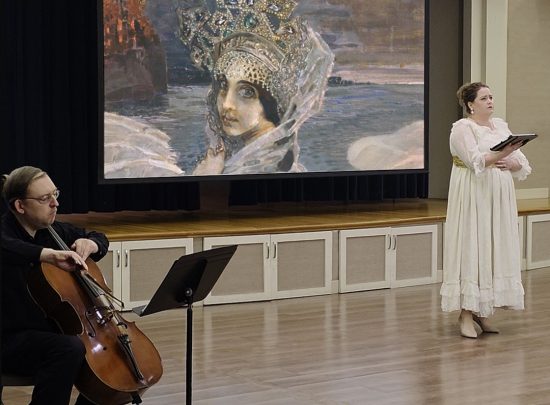
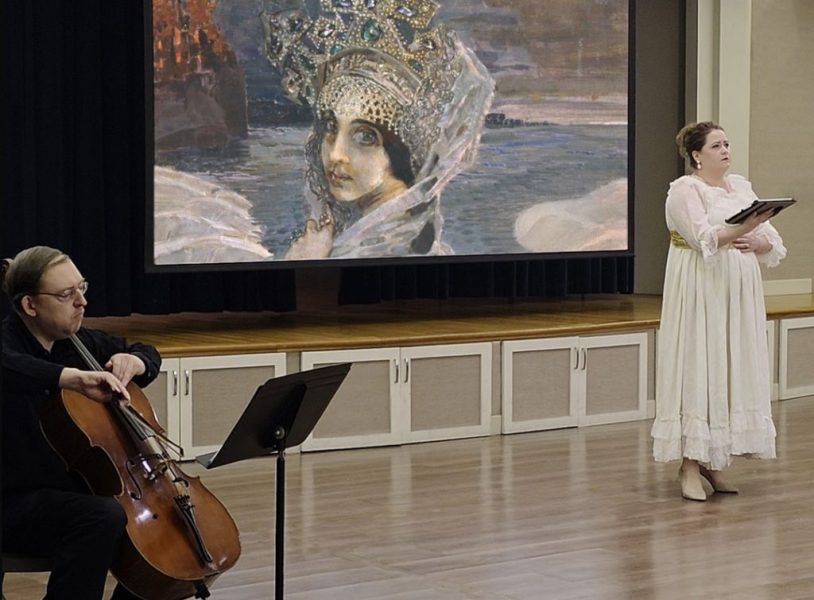
Soprano Esther Tonea singing an aria from Rubinstein’s “Demon” accompanied by cellist Igor Zubkovsky. Photo by Katerina Souvorova.
Bel Cantanti Opera’s current production of “Princes, Queens, and Demons” introduced Washington-area audiences to three Russian nineteenth-century operas— that is, excerpts from three thrilling operas which are very rarely performed in the USA, notes Artistic Director Katerina Souvorova. The pieces were provided in highly stylized form, from Tchaikovsky’s “Queen of Spades” (also known as “Pique Dame”), Borodin’s “Prince Igor,” and Rubinstein’s “Demon.”
…excerpts from three thrilling operas which are very rarely performed in the USA…
“The Queen of Spades” is based on the famous story by Alexander Pushkin, though Tchaikovsky and his brother, Modest, who wrote the libretto, have heavily accentuated the tale’s already romanticized elements with lush music and tragic plot elements. Set in the 19th century, the passions of gambling and love are rivals in the heart of the protagonist Herman as he tries to win the affections of both Lisa and win the winning secret of a card game involving the Queen of Spades (the “queen” in the title of “Princes, Queens, and Demons”). Mezzo-soprano Hannah Wardell sang lyrically of nature as Polina in the aria “Romance.” Baritone Andrew Payne sings passionately of his love Lisa: “I would gladly face all peril for your sake [as] I weep your tears.” Here, as in the other operatic selections of “Princes, Queens, and Demons,” the singers are wonderfully accompanied by Igor Zubkovsky on the cello and Tatiana Loisha on the piano, as well as the Four Seasons Dancers, choreographed superbly by the team’s artistic director, Elena Indrokova Jones.
Borodin’s “Prince Igor,” is based on Russia’s medieval epic “The Lay of Igor.” In a moving selection representing the “Prince” portion of “Princes, Queens, and Demons,” Mr. Payne returned to sing poignantly as Prince Igor, who has been captured. There is “no sleep, no rest for my tormented soul” while in captivity. He then sings in his aria heroically of attaining “victory over the enemy.” The dancers—wearing exotic costumes suggestive of the far-off lands in the Igor epic’s action—performed the opera’s famous “Polovetsian Dances.” This music was popularized in the Broadway musical, “Kismet,” notably the song, “Stranger in Paradise.” The eight beautifully appareled dancers of four seasons in variously colored costumes were especially effective in creating not only the locales of “Prince Igor,” but also the magic of “Kismet.”
The final opera, Rubenstein’s “Demon,” was by far the least known by American audiences. The story of a fallen angel who has been cast out of heaven because he has rebelled against God will remind English speakers of the biblically-based plot of Lucifer, the fallen angel from Milton’s “Paradise Lost.” “Late fallen himself from Heaven,” Milton informs us, this demon “is plotting now/ The fall of others…” In the case of Rubenstein’s opera, the person being tempted is Tamara, sung by soprano Esther Tonea. In her haunting aria, she wonders whether “to pray to the saints of the church,” but hears the fallen angel’s “sweet words” as he lures her to the fall from heavenly grave he has experienced. Pianist Loisha’s dramatic piano works adds highly effective tension to this scene.
There were also highly evocative visual images projected during the Russian opera gala performance. During the “Demon” perfromance, Mikhail Vrubel’s painting “The Swan Princess,” based on Rimsky-Korsakov’s opera, “The Tale of Tsar Saltan,” was shown in the background.
“‘Princes, Queens, and Demons: Russian Opera-Gala” ran February 28-March 1, 2026 presented by Bel Cantanti Opera at Bender JCC of Greater Washington, 6125 Montrose Road, Rockville, MD 20852. For more information about Bel Cantanti Opera, please go online.