
“Beyond doing less harm, an Office of Circularity could actively do good by recirculating usable items to New Yorkers in need, creating local green jobs and building community, all while offering a model the rest of the world could follow.”
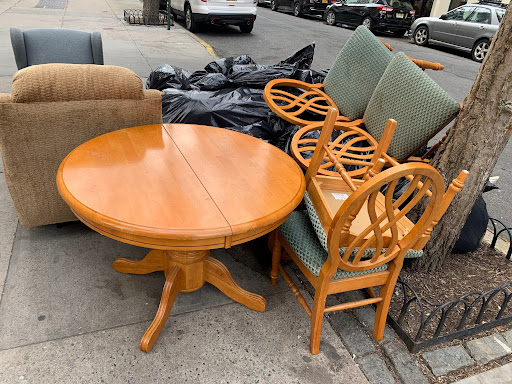
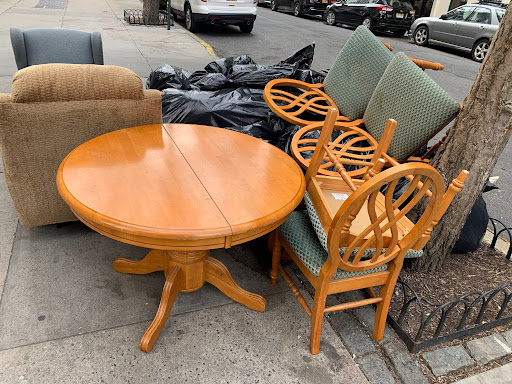 Items put out at the curb. (Photo courtesy Anna Sacks)

New York City’s Department of Sanitation collects 24 million pounds of waste every day, a figure that does not include the 20 million pounds of waste generated daily by businesses, or the estimated 33 million pounds from the construction and demolition industry.
Despite this dizzying scale, the city’s waste system remains largely linear: items are used briefly, then buried or burned at enormous financial, environmental, and human cost. New York City can take a substantial bite out of this problem by creating the world’s first municipal Office of Circularity, a centralized entity tasked with designing and implementing reuse, repair, and recirculation systems across residential, school, government, and commercial waste streams.
The absence of virtually any municipal circularity infrastructure carries real costs. New York City spends nearly $500 million annually in hidden costs burying or burning trash, poisoning our air, water, and soil, and sickening our neighbors who live near landfills and incinerators in Newark, New Jersey, and as far away as Lee County, South Carolina. Beyond doing less harm, an Office of Circularity could actively do good by recirculating usable items to New Yorkers in need, creating local green jobs, and building community, all while offering a model the rest of the world could follow.
Take New York City’s public school system, which serves over 900,000 students, a population greater than that of Indianapolis, San Francisco, or Seattle. During lunchtime, most students use a single-use disposable cup, fork, and plate, with some using multiple utensils and eating multiple meals throughout the day. As a result, the public school system likely discards three million single-use items every single day.
How do we transition approximately 1,600 public schools from linear, disposable dishware to circular, reusable systems, the way it used to be not so very long ago? I don’t know. But a dedicated Office of Circularity could figure it out, starting with a feasibility study (examining whether dishwashing could occur on-site, off-site, or through a hybrid model, and at what cost), followed by pilot programs, and then a three- to five-year implementation plan. This would create local green jobs (dishwashing is an unsung hero of circularity), save over half a billion items from being created and then disposed of each year, and teach students that it’s not normal to eat from a plate and then throw it “away” 15 minutes later.
There is also a massive opportunity to mine New York City’s residential trash for all the diamonds in the rough it contains. I have helped furnish my brother’s family home with many high-end items designated as trash, including a Jonathan Adler chandelier and a Ballard Designs desk that retailed for $2,000. There is currently no city-supported system to recirculate these perfectly usable and highly desirable items. Instead, recovery relies almost entirely on luck, being at the right place at the right time, under the right weather conditions, to spot and rescue items from the trash.
What if, instead, the Office of Circularity provided microgrants for community groups to host monthly swaps in each district? For larger items, what if it piloted a monthly furniture collection day, where residents could set out unwanted furniture, neighbors could take what they need, nonprofit partners with trucks could collect the rest, and the Department of Sanitation handled only what truly must be disposed of?
These neighborhood-scale interventions could then be anchored by permanent, citywide infrastructure. The Office of Circularity could establish material reuse centers in every borough, modeled on the brilliant work of the city-supported nonprofit Materials for the Arts in Queens. In 2023 alone, it gave away more than 4 million pounds of donated goods valued at over $27 million to its member organizations, including public school teachers, nonprofits, and city agencies, demonstrating once again that the city’s excess is a gold mine for our creative community. It also hosts repair events, community dye baths, swaps, and more for the general public. Public school teachers and nonprofits in Manhattan, Brooklyn, the Bronx, and Staten Island deserve the same convenient access to a free reuse center, and there is more than enough material currently being discarded by businesses and residents to keep these centers well stocked.
The possibilities of a dedicated Office of Circularity extend far beyond this. With city employees entirely focused on circularity, we could expand access to tap water and bottle refill stations in public spaces and large venues; support the transition to reusable dishware in restaurants, corporate cafeterias, and stadiums; promote deconstruction instead of demolition; help film and television productions re-home sets and props; strengthen existing circular climate programs like community composting, mattress recycling, cloth diapering, and the Billion Oyster Project; and support thrift stores struggling with donation overflow that often ends up in the trash.
As unemployment rises in our increasingly virtual world, circularity offers an antidote: local jobs rooted in our physical reality. A 2021 GAIA report found that landfilling or incinerating 10,000 tonnes of waste creates just two jobs, while repair—such as refurbishing electronics, refinishing a stained table, and then reselling these restored items—creates 404. These are skilled, long-term jobs that cannot be outsourced or replaced by AI, but do require government support to flourish.
Mayor Zohran Mamdani has the opportunity to create a landmark Office of Circularity, one that transforms circularity from a buzzword into a set of concrete, practical systems and offers a model other cities can replicate. In a city of more than 8 million people, the potential to divert waste, recirculate goods, help neighbors, build community, and create local green jobs is enormous. New Yorkers want to help one another; an Office of Circularity would provide the tools to do so.
Anna Sacks is a waste expert, founder of The Trash Walker, co-founder of the Save Our Compost coalition, and member of the Manhattan Solid Waste Advisory Board.