
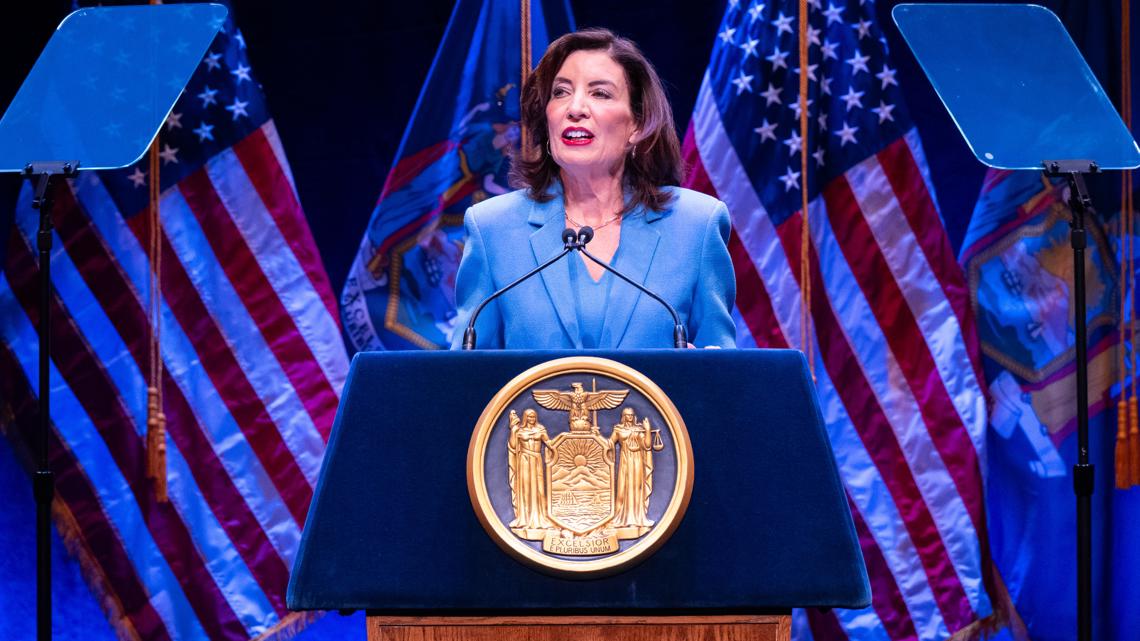
BUFFALO, N.Y. — NY Gov. Kathy Hochul appeared at the Amherst Chamber of Commerce on Monday to meet with local business owners about the impact of federal tariffs, while pitching for a refund to consumers of additional money they may have paid for goods produced overseas in the past seven months.
Hochul also took questions regarding a recent report that outlined the high costs to consumers of renewable forms of energy needed to meet the state’s climate goals.
Tariffs
Hochul held a roundtable with several invited business owners to gauge the effect of the Trump administration tariffs on imported goods.
The U.S. Supreme Court recently ruled the President could not use the International Emergency Economic Powers Act to levy the tariffs.
The ruling, however, still leaves the door open for the administration to levy tariffs through other means which still makes them a topic of relevance for businesses.
The consensus among business owners who spoke during the public portion of the meeting (reporters were asked to leave after a period of time) was that the uncertainty surrounding tariffs, the rates of which have fluctuated, are the biggest concern.
Jim Bittner, a Niagara County fruit farmer, remarked that it’s been tough to plan when you don’t know how much tariffs might add to the cost of fertilizer, equipment, or orchard stock produced in other countries.
“It just makes the decision process even more difficult. We just don’t know what to do,” said Bittner
An even larger industry locally is tourism.
“We are not effected directly by tariffs,” said John Percy, President and CEO of Destination Niagara USA, which leads the county’s tourism efforts.
However, Percy insists other policies enacted under the Trump administration have had a chilling effect on attracting visitors. Among then, a new $250 fee required for tourist visas.
“They already have to pay for a visa and we heard directly from our contact in India after that action was taken asking why. This has immediately put in a negative impact,” Percy said.
It should be noted, however, that the fee only went into effect in October so it’s impact may not be known until after the next tourist season and that in most cases the fee is actually reimbursable.
Give the money back
Following her closed door session with businesses Hochul spoke with reporters where she reiterated her call for the federal government to reimburse New Yorkers additional money they may have spent on goods, through President Trump’s sweeping tariffs on foreign made products.
While the Supreme Court made clear the President could not use the International Emergency Economic Powers Act to levy those tariffs, it left unclear whether hundreds of billions of dollars collected through the tariffs would have be paid back and to whom.
“I want the money back,” said Hochul, while standing next to a chart purporting to show that in just six months the tariffs cost consumers in New York an extra $13.5 billion.
According to a spokesperson, Hochul is relying on figures produced by the Yale University Budget Lab which also notes its numbers are implied through “well-respected economic and trade models”.
President Trump had also earlier suggested that the tariff money be returned to consumers but no concrete plan to do that ever materialized.
“I’m still waiting to see the federal government turn it back,” said Hochul. “If the federal government is gonna start releasing checks i don’t care whose name is on it. It could be Donald Trump. Just write the check for $1,750 17 to every New York family and we’ll call it even.”
Perhaps complicating such a plan though would be the assertions by several of the companies that sued the federal government over the tariffs that they did not pass on any additional costs onto consumers and absorbed them themselves.
High Costs of NYS climate goals
During what is an election year, Gov. Hochul has been talking a lot about reducing costs for New Yorkers, who reside a state with the highest combined taxes in the nation while paying some of the highest prices for consumer goods.
But, a recent memo from state energy officials suggests that if the state doesn’t scale down its climate agenda, then already higher utility costs could soar even further in New York.
The state’s climate action plan includes mandates for all electric buildings, electric cars, and heat pumps while relying on non-emission, renewable energy sources such as solar and wind power.
The New York State Energy Research and Development Authority predicts the existing climate goals could push gasoline costs to more than $2 a gallon above existing prices at time of enactment.
It also suggests all electric conversion of heating systems costs for households with natural gas or oil heat could face hit an additional $4,000.
The NYSERDA memo also says the marketplace cannot yet provide enough renewable energy, electric vehicles, or heat pumps or other technology to meet the stated goals in the 2019 law.
“Back in 2019 there were very ambitious goals,” said Hochul, regarding the plan pushed through by her predecessor Andrew Cuomo, while indicting her plans to speak with state legislative leaders on how to pursue the agenda without breaking people’s bank accounts.
Hochul, who has proposed that New York build its first new nuclear power plant in nearly 40 years to help meet its energy needs, claimed problems in meeting the state’s climate agenda can be traced to supply chain problems during the Covid 19 pandemic in 2020 and inflation which sored to record levels during the following four years,
“Wind and solar became too expensive so they were abandoned by people,” Hochul said.
But she was also quick to blame the Trump administration for pulling back on the taxpayer subsidies which have proved necessary to get such projects off the ground.
In making those moves, the Trump administration cited concerns over what it called the high costs and inefficiency of so called green energy projects as well as concern over negative impacts on the environment from them.
“We had off shore wind shut down by the Trump administration and solar projects the where the subsidies are gone,” said Hochul.
Hochul also predicted that Operation Epic Fury, the joint military mission in Iran by the United States and Israel, and which began over the weekend, will also result in increased energy costs.