
Sign up for Chalkbeat New York’s free daily newsletter to get essential news about NYC’s public schools delivered to your inbox.
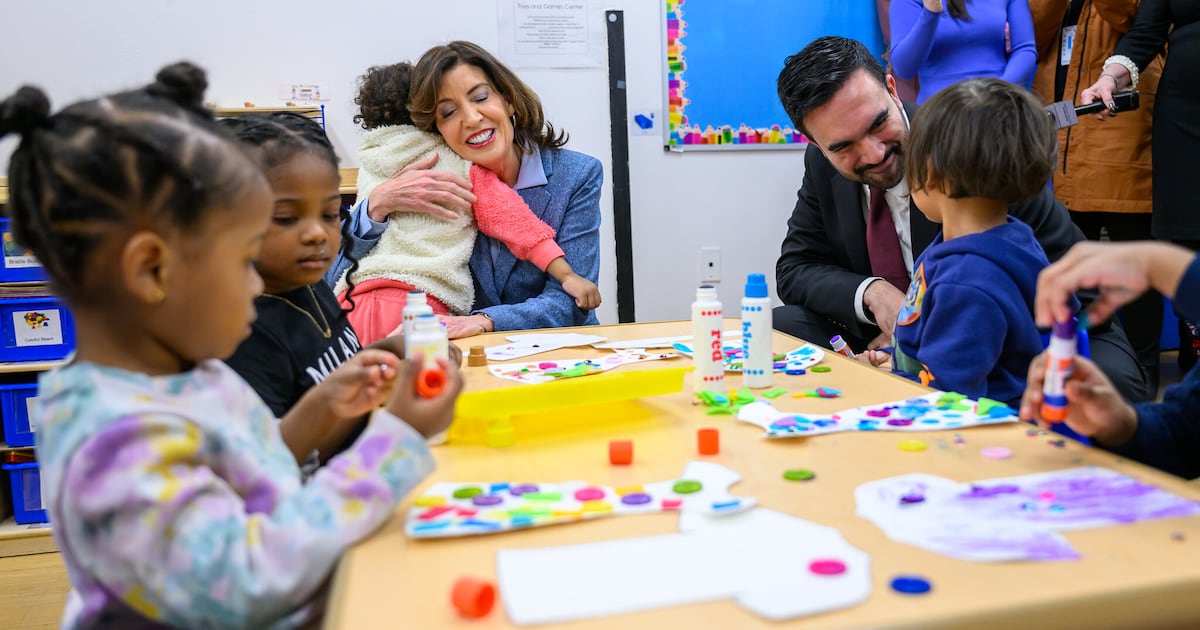
Neighborhoods in Manhattan, the Bronx, Brooklyn, and Queens will be the first to get free seats for 2-year-olds this fall, Mayor Zohran Mamdani and Gov. Kathy Hochul announced Tuesday.
Hochul committed $73 million to fund about 2,000 seats for the program’s first year. The following year, the state is planning to contribute $425 million to grow the program to 12,000 seats across all five boroughs by fall of 2027, officials said.
The program — which the city is calling 2-K — is eventually expected to provide free child care for 2-year-olds to any New York City family who needs it, regardless of ZIP code, income, or immigration status.
“Raising a child takes a village – and it takes a city government willing to step up and tackle the child care crisis head-on,” Mamdani said in a statement.
The initial round of programs aim to serve families in high-need neighborhoods, with an eye toward inclusive access for children with disabilities and families in temporary housing, officials said.
Here’s what you need to know about the program’s first year.
What communities are expected to get seats in September 2026?
• School District 6: Washington Heights, Hamilton Heights, and Inwood
• School District 10: Fordham, Belmont, Norwood, Morris Heights, Van Cortlandt Village, and Kingsbridge
• School Districts 18 and 23: Canarsie, Remsen Village, Brownsville, and Ocean Hill
• School District 27: Ozone Park, South Ozone Park, Richmond Hill, Howard Beach, Woodhaven, and Rockaways
City officials said they will release further information on the specific providers in the weeks ahead.
The city used a host of criteria to select these first four communities areas, officials said, including economic need, projected child care demand, existing access gaps, provider capacity, and readiness to scale up seats.
The programs will rely heavily on the existing child care infrastructure, particularly with home-based providers. The city has no plans at this time to open programs in schools, officials said during an unrelated City Council oversight hearing on Monday focused on a series of bills related to early childhood education.
“As we think about the spaces that are most developmentally appropriate, healthy, safe for our youngest children, we know that that is most often our child care centers and our family child care providers,” Emmy Liss, head of the Office of Child Care at the New York City Mayor’s Office, told council members.
Will all children who turn 2 in the calendar year be eligible?
Yes, but with a caveat, Liss explained.
Children may need to be 2-years-old at the time they start the program, depending on the setting, because of health codes. That means those children with fall birthdays may not be able to start right away.
Inspiration, advice, and best practices for the classroom — learn from teachers like you.
Across all of our bureaus, Chalkbeat reporters interview educators with interesting, effective approaches to teaching students and leading their schools. Get the best of How I Teach sent to your inbox for free every month.
So while seats will open in September 2026, the city expects to have rolling admissions throughout the fall to accommodate toddlers turning 2 from Sept. 10 (which is the anticipated first day of school) through Dec. 31. (The city’s preschool programs enroll children who turn 3 or 4 in a given calendar year.)
Will it be a “full day?”
It’s not yet clear whether all programs will offer a “full day” similar to public schools, which is 6 hours and 20 minutes. It may depend on feedback from providers and parents.
“We want to understand the capacity that our providers have. We also want to understand family interests, which we know varies by community, from community to community,” Liss said. “We do anticipate many providers and families will want a full day, but we have left open the option.”
What will the child/teacher ratio look like?
The answer isn’t straightforward, officials said.
Like the city’s programs for 3- and 4-year-olds, all programs will have at least two teachers in the room. But the number of children depends on the settings since some home-based providers serve mixed ages, from infants to older kids. For a group that’s exclusively for 2-year-olds, there would be two teachers for every 12 students. (For infants, the capacity is around eight. For 3-year-olds, there’s a maximum of 15 children, for 4-year-olds, it’s 18.)
What about children with disabilities or who might need extra support?
City officials pledged to take into account toddlers who might have particular needs, and said they plan to have coaches as well as “inclusion specialists” to help train staff.
The 2-K programs will also work closely with the Education Department’s Division of Inclusive and Accessible Learning as well as the bureau of early intervention at the Health Department to “further tailor their coaching for staff,” Simone Hawkins, deputy chancellor of the Division of Early Childhood Education, told council members on Monday.
How will the city address child care workers’ low salaries?
As New York City grapples with salary disparities between prekindergarten teachers at its city-run programs versus those that operate in community based organizations with city funding, the issue of salaries for child care workers in the 2-K program remains a big concern.
Kellan Calder, an organizer with New Yorkers United for Child Care, praised the city’s approach in focusing on high-need neighborhoods, but told council members, “we want to make sure it’s done right, and that starts with paying providers fairly.”
Liss said the city is aware of the issue, noting that workers across the sector earn a wide range of salaries, but doesn’t yet have the answer.
“Broadly, child care workers in the city earn less than 96% of other professions, and that’s something we need to address,” Liss said.
Amy Zimmer is the bureau chief for Chalkbeat New York. Contact Amy at azimmer@chalkbeat.org.