
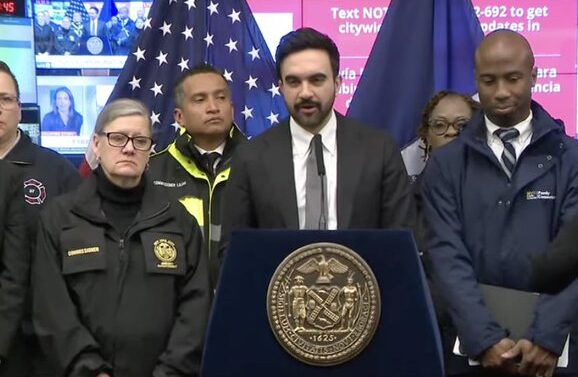
Christina Farrell didn’t ease into her first week as New York City’s Emergency Management commissioner. She spent part of it sleeping at agency headquarters in downtown Brooklyn as a historic blizzard swept through the city.
For Farrell, a 23-year veteran of NYC Emergency Management (NYCEM), it wasn’t unfamiliar territory. “I wouldn’t say we stay over often, but certainly in my tenure, there was Hurricane Sandy, there was the 2003 blackout,” she said in a recent interview with City & State New York, recalling past crises that required around-the-clock operations. The agency’s headquarters is equipped with cots, locker rooms and even a small gym to support staff during extended activations. As commissioner, she now has one added perk: a couch.
Farrell was appointed to the top job last week by Mayor Zohran Mamdani, succeeding Zach Iscol. She previously served as first deputy commissioner and has been part of the agency since 2003, when it was reorganized into a full-fledged department in the years following 9/11. Before that, she joined city government in 1994 in the Mayor’s Office of the Criminal Justice Coordinator.
Her path to leading the agency wasn’t mapped out from the beginning. “No, when I came into city government, I thought I was going to work for the city for two years and move to San Francisco,” she said. Instead, she stayed — now more than three decades into public service. What changed? “I just loved living in the city. I loved working for the city. Just the immediacy of it, the ability to help people and really see the impact of your work directly.”
Over two decades at NYCEM, Farrell helped build out key functions, including launching the agency’s external affairs arm. She also served as the agency’s first director of grants during a period of significant expansion in the emergency management and homeland security space.
The timing of her promotion was quickly tested. The recent blizzard followed another major January storm that brought extended frigid temperatures. Farrell said the agency had just completed a formal “hot wash” — a lessons-learned review with senior city officials and agency heads — days before the new storm hit.
“We were hoping that those lessons would then be applied next fall, next winter,” she said. “It turned out they were applied three or four days later.”
Among the adjustments: increasing the number of emergency shovelers and deploying them earlier, even during the height of the blizzard. “They went out in the middle of the blizzard, which is pretty incredible,” she noted. The Department of Sanitation also brought in equipment earlier than in previous storms.
Farrell emphasized that while headline-grabbing storms define the agency publicly, most of its work happens outside of crisis moments. Internally, staff refer to “blue sky days” and “gray sky days.” Gray sky days mean full activation. Blue sky days — the majority — are focused on preparedness, training and mitigation.
“Our mission is preparedness, education, response, mitigation and recovery,” Farrell said. That includes developing and updating emergency plans, training staff, and running exercises. The agency is already working on adding an extreme cold weather annex to its winter weather plan.
NYCEM also supports responses to large-scale fires and other daily emergencies, helping residents navigate temporary housing, pet accommodations and transportation logistics when schools or homes are disrupted. “There are emergencies in New York City every day, just not, you know, to the extent of this blizzard,” she said.
Looking ahead, the agency is preparing for the 2026 FIFA World Cup, which will bring an influx of international visitors to the city. Planning includes preparing for potential heat, flash flooding or power outages during June and July matches. Messaging will be a major focus, particularly for visitors unfamiliar with New York.
“There are going to be a lot of visitors in the city, potentially a lot of people who don’t speak English or aren’t familiar with New York the way residents or frequent visitors are,” Farrell said. NYCEM is coordinating with the FIFA host committee and expanding Notify NYC messaging in 14 languages, including American Sign Language.
Despite the high-stakes nature of her job, Farrell keeps one personal outlet. Asked about her favorite disaster movie, she pivoted to a television series: “I love Survivor,” she said, noting she and her husband watch each week. It’s a chance, she joked, to “troubleshoot everything and say what I would have done in that situation.”
For New York City, Farrell now moves from troubleshooting hypothetical scenarios to leading real-world responses — whether on blue sky days or gray ones.
(The Interviewer notes that parts of the conversation quoted above has been edited for length and clarity.)
(AI was used in part to facilitate this article.)