
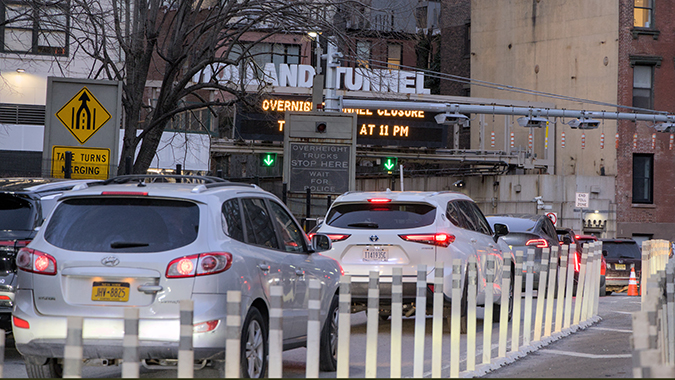
A federal judge in Manhattan ruled Tuesday that the Trump administration’s yearlong effort to kill New York City’s controversial congestion pricing toll program was unlawful.
The court decision by U.S. District Court Lewis Liman allows the tolls, which have been collected under approvals granted by the former Biden administration, to remain in place. However, separate lawsuits from other opponents, including the State of New Jersey, are still pending.
“The judge’s decision is clear: Donald Trump’s unlawful attempts to trample on the self-governance of his home state have failed spectacularly,” New York Gov. Kathy Hochul said in statement after the judge’s decision. “Congestion pricing is legal; it works, and it is here to stay. The cameras are staying on.”
The Metropolitan Transit Authority (MTA) launched the nation’s first of its kind tolling program aimed at reducing traffic congestion on Jan. 5, 2025. The Trump administration took office later that month and in February 2025 U.S. Transportation Secretary Sean Duffy ordered New York to stop the tolling program or risk the loss of federal funding.
Judge Liman had issued a temporary stay that allowed the traffic cameras to remain on and prevented the federal government from taking action against New York while the case was pending. His final decision is a victory for the MTA, which collected $518 million in congestion pricing tolls during the first 11 months of 2025 alone, and claims traffic has decreased by 11%.
Congestion pricing, which is designed to raise funds for mass transportation projects, charges most drivers $9 to enter Manhattan south of 60th Street during peak daytime traffic hours. Trucks pay a much higher rate of $21.60 every time they enter the zone, which adds up for a truck making multiple deliveries. Tolls are lower during non-peak evening hours.
New Jersey has opposed congestion pricing tolls because of the financial burden it places on Garden State commuters as well as businesses making deliveries to New York City. Former Gov. Phil Murphy also raised concerns about increased traffic and pollution in New Jersey communities located near New York City bridges and tunnels as drivers tried to avoid the tolls. New Jersey also argued that federal environmental reviews under the former Biden administration failed to adequately assess cross-border impacts on residents and businesses.
Although Judge Liman’s decision does not automatically end New Jersey’s legal case, it strengthens New York’s position and could make it more difficult for New Jersey to succeed.