
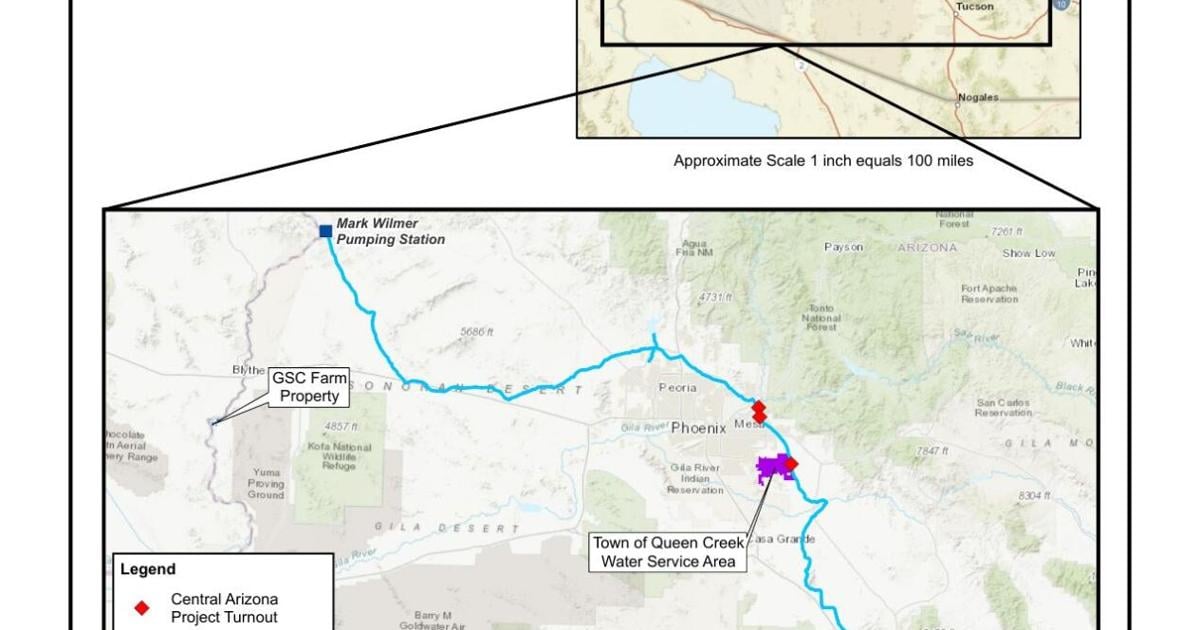
Queen Creek’s efforts to expand and diversify its 100-year water supply have been drawing a lot of attention.
The big-picture numbers are mind-boggling.
In less than a year, the town has made two purchases of water from the Harquahala Basin totaling 1.7 million acre-feet at an approximate cost of $285 million. (An acre-foot equals 325,851 gallons of water – enough to supply three homes for a year, according to the Arizona Department of Water Resources.)
Securing that water supply was one of the accomplishments featured in the Feb. 24 State of the Town presentation.
“The Harquahala purchase makes 90% of the town’s water supply insulated from water cuts and drought conditions,” Utilities Director Marc Skocypec said.
Out of the spotlight, town staffers are putting together pieces of the massive puzzle.
Here are two examples:
Infrastructure for Harquahala
At its Feb. 18 meeting, the Town Council quietly approved shifting $19.3 million from the fiscal ’25-’26 budget to purchase water resource infrastructure and consulting services in the first of three phases to develop the infrastructure needed to get water out of the water from the Harquahala Basin, which sits on 766 square miles in LaPaz and Maricopa counties in west central Arizona.
According to support material from that meeting’s agenda, the three phases will cost a projected $180 million on top of the $285 million Queen Creek paid for the water.
Ultimately, that $465 million will be paid with a water resource fee. Queen Creek residents will be paying $12.1 million to $14.8 million annually to service the debt.
That fee is planned to be started this coming January. Town officials have said that fee will likely be less than the Central Arizona Groundwater Replenishment District fees most Queen Creek water customers now pay.
However, the $19.3 million was not included in the approved fiscal year 2025-26 budget and will be funded by the elimination or delay of some road and water projects that were in that budget.
The phase 1 work will include beginning pumping from existing wells and treating water to make sure it meets the standards of the Central Arizona project canal, which will carry the water about 80 miles to Queen Creek. Water delivery is expected within two to three years.
According to the support material, the three phases will not be linear with some work from the phases running concurrently.
The $19.3 million budget adjustment was unanimously approved by the Town Council as part of the consent agenda.
A consent agenda includes several items, in this case seven, that are considered routine and are enacted with one vote. Council members can pull an item from the consent agenda for discussion.
Those infrastructure costs have not been covered in recent Harquahala water purchase presentations at Town Council meetings. The topic was discussed at a public hearing in November.
Town Manager Bruce Gardner said that now the State of the Town is over, Queen Creek officials plan to continuously communicate details of the $465 million, 100-year water plan to the town’s residents.
Recharging and recreation
Drivers on Meridian Road may have noticed the cleanup of mounds of dirt and construction materials about a mile north of the Olive Mill.
Those 54 acres on the west side of Meridian will be one of two recharging stations along the Queen Creek Wash. The other will be two miles east near Kenworthy Road.
Basically, the facilities will provide storage and distribution for non-groundwater sources.
“This is part of our overall water strategy,” Mark Skocypec said. “We need a place to recharge water we acquire.”
The facilities will be able to recharge about 8,500 acre-feet of water annually, with Meridian handling about 5,000 acre-feet and Kenworthy 2,500-3,500.
“That’s about one-third of our water supply now and it will be 15-20% at buildout, depending on the projections,” Skocypec said.
The recharging stations will allow water to enter the site, percolate back into the aquifer and then be pumped by recovery wells throughout the town. The geology of the soil along the wash is conducive to water storage, he said.
The process can handle a variety of water sources, such as surface water, treated effluent, water from the Harquahala Basin and water credits from area irrigation districts.
“In addition to seeing sources away from local groundwater that are less susceptible to drought, we are maximizing our treatment of effluent,” said Chris Connor, deputy utility director.
The Meridian facility will cover about two-thirds of the site with the western third being used as recreational area, Connor said. The Utility Department is working with Parks and Recreation in planning that space.
The Kenworthy site is about 50 acres and will not have space for recreation.
Since the project is still in the planning stages, no price tag has been set.
The Meridian recharging operation is planned to be online in about 24 months with Kenworthy, which is still going through permitting, about a year later, Skocypec said.
Those stations fit into Queen Creek’s strategy of securing water from a variety of sources.
“This is all part of the equation,” he said. “The more Queen Creek does on its own, the better we will be able to weather outside factors.”
Like the ongoing battle among seven western states, including Arizona, over allotments of Colorado River water.
“We will be more independent,” Skocypec said. “We can chart our future.”