
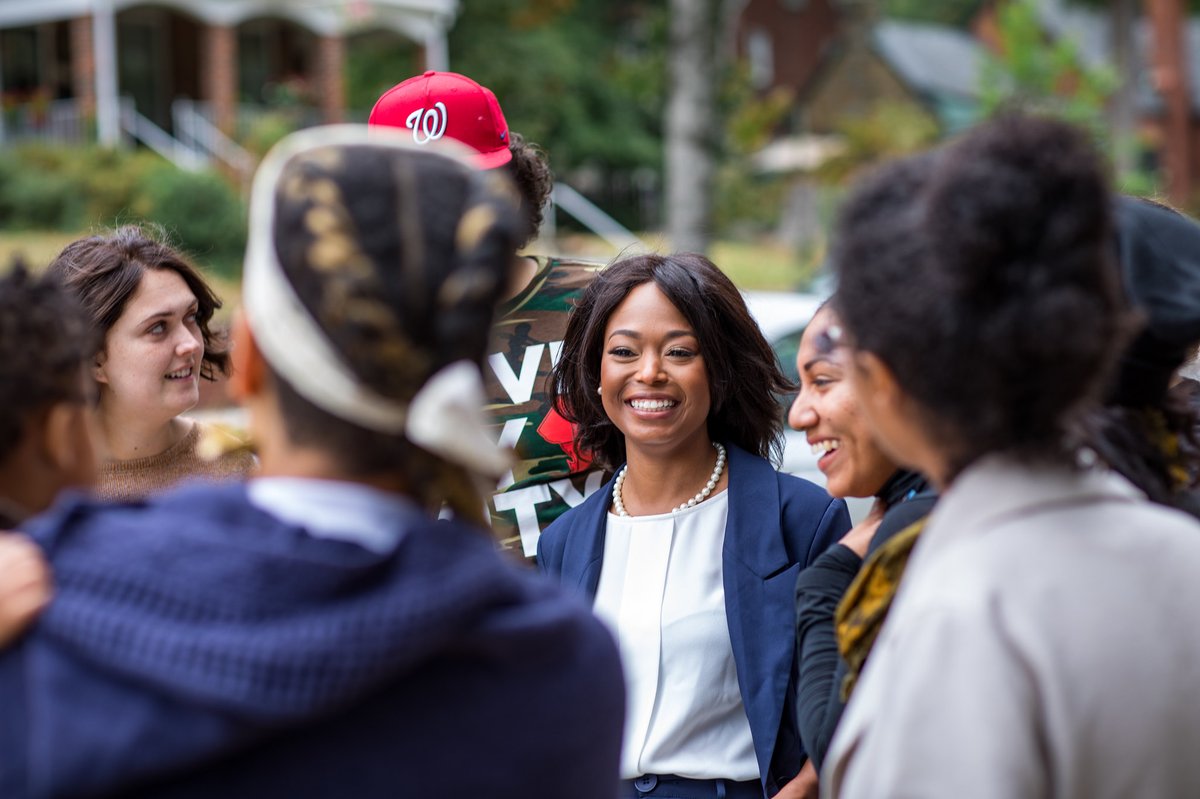
What do Washington, D.C.; New York City; and Seattle, Washington, all have in common? All three have football teams that have won the Super Bowl. All three cities are considered tech hubs. And, by the end of this year, Washington, D.C., may also join Seattle and New York City in electing a self-described democratic socialist mayor: current City Councilmember Janeese Lewis George.
D.C.’s current mayor, Mayor Muriel Bowser, announced in November that she would not seek re-election this year, opening up a competitive primary for the first time since 2006. Lewis George, who has represented Ward Four since 2021, is considered one of the frontrunners to be the city’s next mayor. Her main opponent, Kenyon McDuffie, is a centrist establishment Democrat who has been recognized by the D.C. Chamber of Commerce as one of the most “pro-business” council members. They cite McDuffie’s stands in favor of “pro-sports investments” and business-friendly development regulations.
The temptation to draw comparisons between the upcoming D.C. contest and last year’s race in New York City is almost irresistible. But the campaign George has built bears some subtle but important differences.
Like Mamdani, Lewis George has stressed the issue of affordability in her campaign. She kicked off her campaign on December 1 by highlighting proposals for universal childcare and social housing. The latter proposal would set up mixed-income public housing in neighborhoods where higher rents paid by more affluent tenants would subsidize the rents of lower-income tenants.
“D.C. has been hit really hard by the affordability crisis,” Marli Kasdan, a member of the political engagement committee of the Metro D.C. Democratic Socialists of America (DSA), tells The Progressive. “Nearly half of renters in the District are rent burdened, which means that they spend a third or more of their income on rental homes. The cost of child care is skyrocketing in D.C.—it is one of the most expensive cities in the nation for childcare.” On February 6, the Metro D.C. DSA formally endorsed Lewis George in the primary.
Kasdan says she sees a sharp contrast between the two frontrunners: Lewis George supports affordable childcare, tenants’ rights legislation, and social housing, while McDuffie has received donations from large corporations, developers, and wealthy individuals. Lewis George had a one-month head start in fundraising, but McDuffie quickly closed the gap following his announcement in January. The two are now roughly neck-and-neck in total campaign contributions.
While some have drawn a similarity between Lewis George’s race against McDuffie and Mamdani’s campaign against Andrew Cuomo in New York last year, Matthew Foster, a professional lecturer in the Department Government in the American University School of Public Affairs, considers the comparison an oversimplification.
“There’s not going to be a conservative, establishment lane, per se,” Foster states, “It’s going to be hard to envision that there is going to be super distance and daylight between their [Lewis George and McDuffie] policy positions.” He asserts that the ideological gap between Mamdani and Cuomo was much greater than the divide between Lewis George and McDuffie.
Indeed, in his formal campaign announcement, McDuffie stressed issues such as “economic growth with guard rails,” spreading economic prosperity across the city, as well as expanding affordable housing. McDuffie’s positions vis-a-vis Lewis George stand in sharp contrast to Cuomo’s attacks on Mamdani last year.
In last year’s New York mayoral contest, Cuomo lambasted Mamdani, claiming he supported “legalized prostitution,” was a Hamas sympathizer, and was in favor of defunding the police. Much like Mamdani, Lewis George’s campaign will benefit from a municipal election funds program that makes it more feasible for candidates without large corporate donor bases to mount campaigns. These programs operate in a similar way in both D.C. and New York City: New York City matches small donor contributions up to $250 with taxpayer funds at an eight-to-one ratio, while D.C.’s Fair Elections program matches contributions up to $200 at a five-to-one ratio.
“We do think the Fair Elections program is going to be a huge boost and already has been,” says Kasdan. “[Lewis George] will be seeking to max out the public matching program. This will be key to her running a competitive race. Here in D.C., there are powerful real estate, restaurant, and other big money groups and corporate interests backing her opponent.”
But Foster sees it differently. He tells The Progressive that Lewis George’s private fundraising efforts have been so successful in their own right—raising $40,000 in just four hours—that their sheer volume will diminish the role that matching public funds would play in this contest. Lewis George has received about $1,250,000 in public funds, giving her an edge of about $135,000 over McDuffie.
Still another parallel to Mamdani’s situation will be the constraints that Lewis George may immediately face if elected mayor. Since taking office, Mamdani has had to rely on a much more conservative Democrat, New York Governor Kathy Hochul, to fund many of his proposals. Lewis George will face a more unique predicament: As a federal district, every D.C. municipal budget and bill passed into law must be reviewed by the U.S. Congress, which has between thirty and sixty days to approve or reject the legislation before it’s finalized.
“The rub is the federal government and Donald Trump,” says Foster. “That’s the elephant in the room. Going forward, I think it’s going to frame the election, too. It is going beyond affordability. What makes the dynamics of this election so different is the reality of the influence of President Trump and his administration using D.C. as a guinea pig and lab for certain policies.” He adds that public pressure may force the next mayor, be it Lewis George or McDuffie, to take a harder line on Trump than Bowser has.
Bowser’s executive order stating that D.C. police would cooperate with federal law enforcement indefinitely after Trump sent the National Guard to patrol the streets in the capital, infuriated many in the Democratic Party’s base. Her decision to greenlight the destruction of Black Lives Matter Plaza near the White House also alienated some supporters.
Kasdan speculates that Congressional review of D.C. budgets and legislation “could definitely be a difficult hurdle to overcome.” Should Democrats retake the U.S. House of Representatives in the midterm elections in 2026, however, she says that Lewis George would face a significantly less uphill battle—although she believes the challenges posed by federal oversight on D.C.’s local government can only be permanently resolved through statehood.
Recently, Mamdani announced an executive order mandating that city agencies cannot share information collected for city purposes with federal immigration authorities, except when they are required to by law. The order also states that federal agents may not enter city property without a warrant.
“No New Yorker should be afraid to apply for city services like childcare because they are an immigrant,” Mamdani said. Lewis George has pledged, if elected, to sever any coordination between D.C. Metropolitan Police Department and federal immigration authorities.
“I definitely think that other cities could follow D.C.’s lead here. Other places turn to the nation’s capital when they are looking to enact policies in their own jurisdictions,” Kasdan says. “I think we are entering a critical moment when more and more cities are going to push back.”
New York City has now used ranked choice voting for its primary elections for a couple of voting cycles. D.C. passed ranked choice voting for both its citywide primaries and its general elections in 2024, and 2026 will be the first election cycle it goes into effect. In the 2025 New York City mayoral primary, because of the sheer number of candidates, no candidate reached 50 percent in the first round. Ranked choice voting came into play on the second round, when the votes of the losers were reallocated and Mamdani came out on top. But so far at least, in D.C., there are only two serious candidates.
While there are several candidates running in the D.C. mayoral primary, Lewis George and McDuffie are far ahead of the rest of the field, so the same dynamics may not be in play for the upcoming contest in June. A two-candidate race makes it far easier for one person to get more than 50 percent of the vote—bypassing the need to reallocate second choice votes under ranked choice.
“It’s basically a two-person race. Ranked choice voting probably won’t have a huge difference or impact right now,” says Kasdan. “But we do think ranked choice voting will have an impact in races with multiple competitive candidates like the at-large [city council] races and [especially the council seat in] ward one.”
Foster points out that context makes all the difference in assessing the impact of ranked choice voting. Since it consolidates votes behind the eventual winner, ranked choice voting does not necessarily favor more liberal candidates. He asserts that ranked choice voting will help moderate candidates in more moderate districts and progressive candidates in more progressive districts, since a winner is not declared until one candidate clears the 50 percent mark.
Just as in Mamdani’s campaign, Lewis George is relying on a massive grassroots outreach to voters.
“We’re planning to mobilize hundreds of volunteers to knock on thousands of doors to ensure [Lewis George] wins the primary in June,” says Kasdan. “We think that our ground game and ability to engage on a personal level with the average voter is going to go a long way to propel Janeese to victory.”
But Foster maintains that the energy behind the Lewis George campaign does not necessarily mean there will be an overall progressive wave this election year. He points out that some of the recent progressive victories in elections around the country have come in districts with split opposition—like in New Jersey’s 11th Congressional district—or with a toxic candidate, like Andrew Cuomo.
“I don’t think there is actually going to be a wave,” Foster adds, “but you definitely underestimate progressive candidates and the DSA at your own risk in some of these elections.”