
The “reform” offered us after the killing of Pretti was no one’s prosecution or resignation, but body cameras that all Homeland Security agents in Minneapolis are supposed to wear. This is a time-tested hoodwink. Install a facial recognition app on those suckers and the problem of surveillance only intensifies—the volley of images accelerates. While agents can work with impunity, all a body camera ensures is second unit coverage of the next snuff film.
No, as of this writing the bleakest image—no more upsetting than the footage of Alex Pretti and Renee Good, but more chilling in its implications—has surely been the AI-doctored photo of Nekima Levy Armstrong posted by the official White House X account. Armstrong and several others were arrested in January for interrupting a service the Sunday prior at a St. Paul church whose pastors include the local ICE field director. The “meme” of Levy Armstrong’s arrest—as some wet-mouthed Millenial comms director called it—replaced her stolid, dignified expression in the moment with a rictus of humiliation, fabricated by circuitry.
The future portended by state-propagated forgery like this picture is unsettling enough, but so too does it evoke an abysmal American past: Stalinist airbrushing would make a more apt point of reference if Levy Armstrong wasn’t a Black woman, and if the doctored image hadn’t also darkened her skin. This “meme” is in essence a quotation of white supremacist caricatures and cartoons of the nineteenth century—precisely the sort of representation that Douglass trusted photography to extirpate.
We may be used to feeling cynical about the idea that any photograph necessarily tells the truth (insert quotation marks, if you like), but the state’s open mockery of that association is especially tragic in light of Douglass’s hope that that capacity of photography was one and the same with its potential as an emancipatory resource. See, with your own eyes, the truth about Black people as they really are, and a truth is revealed about the equality of all humankind; so the camera becomes instrumental in solidifying a new democratic basis for society. This, at least, was the ambition Douglass and other early idealists placed in the so-called “democratic art.”
Instead, the terminally online sons of former slave owners dispatch a “meme” from Pennsylvania Avenue and smirk: “Thank you for your attention to this matter.”
A fitting epitaph.
*
Where stands the people’s photography?
The administration is obviously hostile to anyone who would challenge its furtive, empty assertions of a monopoly on image-making. Noem has called recording ICE agents “violence” and “illegal.” It’s not either of those things, of course, but in conflating documentation with outright interference, the state is more or less conceding that those acts have been de facto elided. (Both are grounds for summary execution, apparently.) To record the state is to indict it, morally if not legally; Noem seems aware of this.
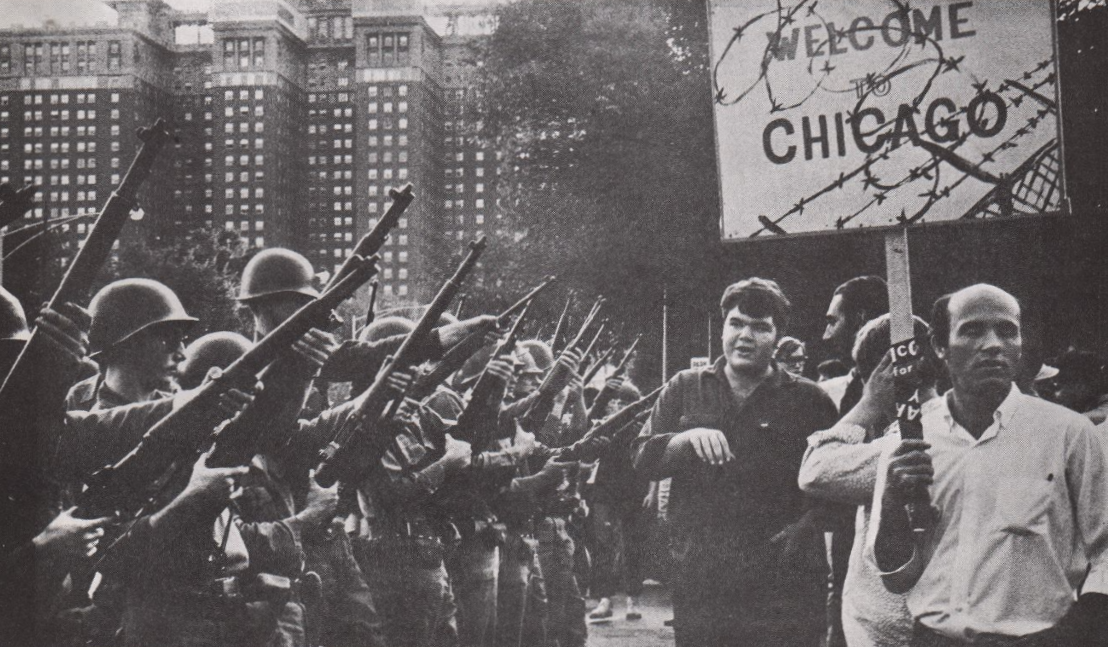
“Violent” and “illegal” to record, though? I don’t think you would have heard this kind of self-pity from a police spokesman in the sixties—and not because his fellow officers in Birmingham or Chicago were especially sensitive to the physical safety of photographers in their midst. Southern police routinely beat photographers and destroyed dozens, probably hundreds of cameras during the Civil Rights Movement. Outside the 1968 Democratic National Convention in Chicago, police clubbed photographers with abandon; the glint of a camera lens on Michigan Avenue was like red cloth in a bullring.
What makes Bovino and Noem so exasperating is that they will goad and taunt and kill and then cry bloody murder if a bystander so much as blows air on one of their boys’ cheeks. As an extension of the state’s prerogative to be as violent as it wishes, Bovino and Noem want the privilege to surveil without the liability of being watched themselves. Such an exemption from the stickiness of photography has always been elusive in this country, though. Certain qualities of photography—certain qualities of Americans, maybe—have kept it so.
Some have asked pointedly how much longer the noble if passive ethic of bystanderism will suffice in the face of the state’s escalating violence. It isn’t hard to imagine the avenues of legal redress decaying further and the situation becoming altogether more delicate. We should be realistic in granting that the political returns of documentation may be diminishing before our eyes.
Relatedly, inevitably, the subject of armed self-defense arises here, whether it pleases anyone for it to or not. It’s also appropriate, since the metaphor of the camera as a weapon is nearly as old as the affiliation of photography with democracy. One of the camera’s most consistent identities over the years is that of a proxy firearm.
In the middle of the sixties, Bob Dylan prophesied that you don’t need a weatherman to know which way the wind blows, and at the end of the sixties a militant tendency within Students for a Democratic Society agreed that this was so and prepared accordingly for a people’s war that the people ended up sitting out. In the days after Renee Good’s murder, it happened that a similar forecast came out of Philadelphia. The messengers, this time, were not the representatives of a resurgent white New Left, but another cohort conjured from the vapor of historical memory.